
On 19 December 2025, interstellar comet 3I/ATLAS will at long last make its closest approach to Earth.
This event, along with the days before and after, represents the final and best opportunity for ground-based observatories (and human comet-hunters) to capture and study the object as it makes its way back out of the Solar System. Once it is gone, it is gone for good.
At perigee – that's the closest point in its trajectory to Earth – 3I/ATLAS will be around 270 million kilometers (168 million miles) away. That's nearly twice Earth's 150 million-kilometer distance from the Sun, but still close enough for some really juicy observations.
Related: Don't Panic! 3I/ATLAS Isn't an Alien Death Probe, But It Is Wildly Unusual
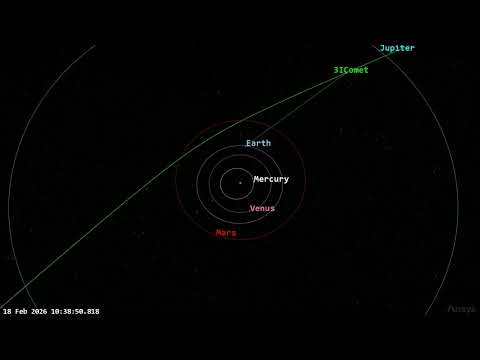
Since its discovery on 1 July 2025, 3I/ATLAS has proven to be one of the most peculiar comets humanity has ever seen. As it draws closer, first to the Sun and Mars, now to Earth, its strangeness only intensifies.
Measurements of its coma – the 'atmosphere' of gas and dust surrounding an active comet – revealed an unusually early outgassing producing large amounts of carbon dioxide. Continued observations also showed huge amounts of hydrogen cyanide (HCN) and methanol (CH3OH) appear in the coma as the growing warmth of the Sun caused the comet's ices to sublime.
In the first two months following its discovery, researchers also noted strangely high amounts of nickel and iron, noting a "potentially extreme composition" unlike any other comet.
In early October, 3I/ATLAS came within a cosmic whisker of Mars; the encounter was recorded by Martian and solar observatories. Observations of the comet became highly limited when its trajectory took it behind the Sun from Earth's point of view during a crucial part of its travels – perihelion, the closest approach to the Sun, which took place on October 29.
When the comet emerged from behind the Sun's glare, Earth observatories once again turned their gaze its way.
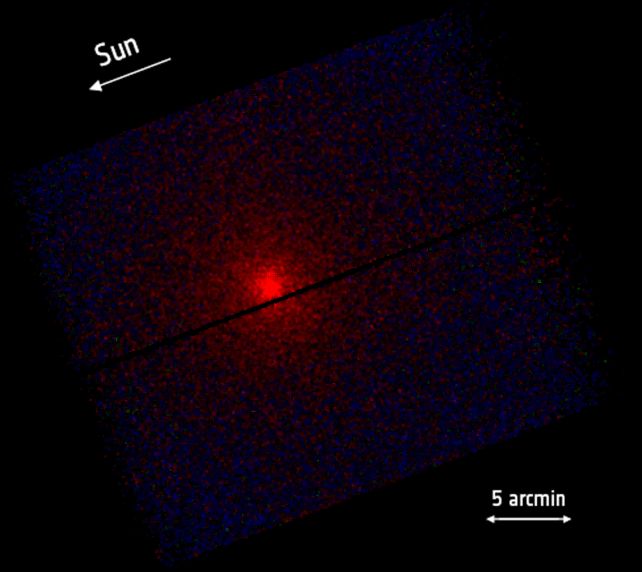
XMM-Newton, an ESA X-ray observatory in Earth orbit, spent 20 hours gazing at 3I/ATLAS, recording the glow of X-radiation as the charged solar wind slammed into the ballooning coma. XMM-Newton is sensitive to soft X-ray emission from ions like carbon, nitrogen, and oxygen produced when the solar wind collides with neutral gases in the coma.
In late November, NOIRLab's Gemini North telescope obtained observations of the comet that showed a hint of green. This is interesting because early images of 3I/ATLAS showed a more reddish tint, consistent with organic compounds called tholins dusting the comet's surface.
The greenish hue seen in many comets is generated by diatomic carbon (C2), which releases a green fluorescent glow when excited by solar radiation. However, pre-perihelion observations of 3I/ATLAS suggested that it was unusually low in C2.
C2 isn't usually part of the composition of cometary ice, but forms – and breaks apart – quickly therein from free-floating carbon atoms from other carbon-containing molecules that break apart under solar radiation.
The new images suggest that 3I/ATLAS only started forming C2 late in its journey through the Solar System – another of the comet's odd behaviors.

We don't know what all this means yet. Some scientists think that 3I/ATLAS could be an unusually metal-rich object bristling with cryovolcanoes that are sputtering its gases out into space. Another analysis suggests that the comet could be running out of ice, transitioning into life as a post-cometary asteroid.
In spite of all its oddities, everything it does points to it being a comet. The next critical flurry of observations will hopefully reveal more about the ways 3I/ATLAS differs from our home-grown Solar System comets. Ensuing analysis from scientists may then yield insights into the strange environment of interstellar space.
"This object is a comet," NASA associate administrator Amit Kshatriya said in November. "It looks and behaves like a comet, and all evidence points to it being a comet. But this one came from outside the Solar System, which makes it fascinating, exciting, and scientifically very important."
Header image credit: International Gemini Observatory/NOIRLab/NSF/AURA/B. Bolin
Image Processing: J. Miller & M. Rodriguez (International Gemini Observatory/NSF NOIRLab), T.A. Rector (University of Alaska Anchorage/NSF NOIRLab), M. Zamani (NSF NOIRLab)