
A 'shadow' cast on the faint, leftover glow of the Big Bang has revealed a giant object in the early Universe that defies our predictions of how the Universe should evolve.
It's a galaxy cluster named SPT2349-56. Spotted a mere 1.4 billion years after the Big Bang, the gas within it is far, far hotter than it should be. The gravitational heating of a galaxy cluster ought to be a slow process that takes billions of years to reach the temperature regime of SPT2349-56.
"We didn't expect to see such a hot cluster atmosphere so early in cosmic history," says astrophysics doctoral student Dazhi Zhou of the University of British Columbia in Canada.
"In fact, at first I was skeptical about the signal as it was too strong to be real. But after months of verification, we've confirmed this gas is at least five times hotter than predicted, and even hotter and more energetic than what we find in many present-day clusters."
Related: Black Holes So Massive They Shouldn't Exist Could Spawn From a Rare Triple Merger
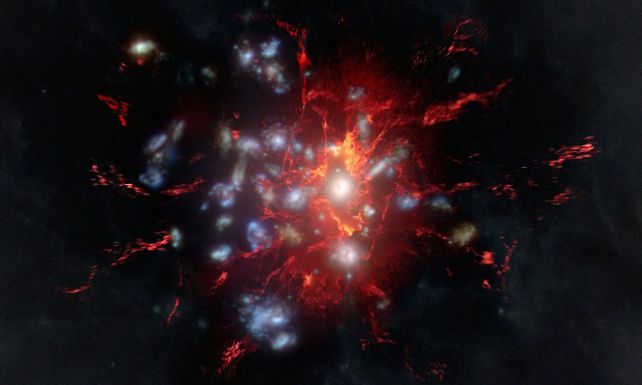
SPT2349-56 was first spotted in 2010 in observations from the South Pole Telescope in Antarctica, and early signs suggested it was unusual. Follow-up observations, published in 2018, confirmed that the object was a cluster of more than 30 galaxies, furiously forming stars at a rate 1,000 times faster than the Milky Way, and racing towards each other on a collision course.
Since this extreme drama was playing out in the early Universe, some 12.4 billion years ago, astronomers thought that it would likely yield some clues about galaxy evolution at a critical time in the Universe's history.
Led by Zhou, an international team used the ultra-sensitive Atacama Large Millimeter/submillimeter Array (ALMA) to probe the cosmic microwave background (CMB) – the faint, uniform glow that still permeates the Universe from when the cosmos cooled to a temperature that allowed light to stream freely.
What they wanted to find was a distortion known as a Sunyaev-Zeldovich signal, which is caused by electrons in hot gas between the galaxies in a cluster interacting with the CMB's photons. Because the CMB is so smooth, these 'shadows' create a contrast that can be detected and measured.

A galaxy cluster is a pocket of space where gravity intensifies as the galaxies pull each other closer together. This gravity acts on the gas inside the galaxy – the intracluster medium – squeezing and accelerating it, both of which increase its energy.
SPT2349-56 is an extreme example of a galaxy cluster in the early Universe, in both size and star formation, and previous measurements revealed a large amount of molecular gas between them. Zhou and his colleagues took a closer look at this gas to determine what it could tell us about the dynamics within the cluster.
"Understanding galaxy clusters is the key to understanding the biggest galaxies in the Universe," says astrophysicist Scott Chapman of Dalhousie University, formerly of the National Research Council of Canada.
"These massive galaxies mostly reside in clusters, and their evolution is heavily shaped by the very strong environment of the clusters as they form, including the intracluster medium."
The ALMA Sunyaev-Zeldovich signal wasn't just clear – it was powerful. Analysis revealed an unambiguous thermal signature from hot electrons, with temperatures exceeding 10 million Kelvin. While the researchers had hoped for early detection of a warm intracluster medium, this was far beyond expectations.

Based on existing models, there is no way gravity alone could generate this temperature. The researchers suspect that powerful jets from at least three supermassive black holes in SPT2349-56 may be injecting extra energy.
"This tells us that something in the early Universe, likely three recently discovered supermassive black holes in the cluster, were already pumping huge amounts of energy into the surroundings and shaping the young cluster, much earlier and more strongly than we thought," Chapman explains.
In turn, this suggests that our theoretical understanding of galaxy cluster evolution is far from complete – that the entire cluster ecosystem needs to be taken into account, even during the early Universe, when we may not expect certain dynamics to be at play.
"We want to figure out how the intense star formation, the active black holes and this overheated atmosphere interact, and what it tells us about how present galaxy clusters were built," Zhou says.
The research has been published in Nature.