
The vast cosmos seems like a cold and lonely place.
For all our scouring of the sky, we're yet to find concrete signs of alien life outside of Earth – never mind outside the Solar System.
And that's before we even get to technology – telltale signs that an intelligent civilization has developed ways to manipulate its environment that we might be able to detect across interstellar space.
That doesn't mean they're not out there. It may mean that we're just not looking hard enough.
And now, astronomers in China have used the world's biggest single-dish radio telescope to conduct a deep scan of 33 planetary systems that looked like promising places to search for technosignatures.
Most of them turned up precisely the result you might expect – no dice.
One was a little more interesting.
From the direction of K2-155, a red dwarf some 238 light-years away, came a narrowband radio signal that survived the researchers' initial attempts to weed out interference – that's a type of radio signal that can be difficult to produce without technology.
"Natural astrophysical processes rarely generate extremely narrow spectral features while engineered transmitters often do," writes a team of astronomers including first author Zi-Qi Li of Beijing Normal University in a paper published in The Astronomical Journal.


The question of whether we are alone in the Universe is not new – but the question of whether we may be able to find anyone else out there is rather less philosophical.
We have technology, and we know what technology looks like, more or less.
We also know what stars and other cosmic objects look like, and have a pretty good idea of the kinds of signals natural astrophysical processes can produce. They're pretty diverse, but the radio emissions from natural cosmic sources tend to be fairly spread across a swathe of frequencies.
Narrowband radio signals fall closer to the technology end of the spectrum – that is, a signal concentrated into a very narrow band. Radio signals from our own technology are often tightly constrained. So that offers one possible breadcrumb.
Another clue astronomers can look for is whether that signal moves around.
That's because a signal transmitted from the surface of a distant world wouldn't necessarily stay at exactly the same frequency.
The relative motion of a planet rotating on its axis and orbiting its host star can shift the frequency of a radio signal through the Doppler effect, producing a telltale drift over time.
So if astronomers were to see a radio signal that was both extremely narrow and drifting in frequency, it would warrant much closer scrutiny.
Unfortunately, we have a nasty habit of getting in our own way. Earth is positively awash with radio signals of our own making.
Satellites, aircraft, communications systems, navigation technology, and even microwave ovens can produce radio-frequency interference, or RFI, that contaminates astronomical observations.
And some of it can look tantalizingly – and frustratingly – like the very signals SETI researchers are trying to find.
This is the problem that the researchers wanted to tackle.
Using observations from China's Five-hundred-meter Aperture Spherical Radio Telescope (FAST), they developed a new way to sift through the vast cornucopia of radio data generated by the search for extraterrestrial intelligence (SETI), looking for narrowband, drifting signals while filtering out noise.
The observations themselves weren't new. FAST had observed the 33 target exoplanet systems in 2021 as part of previous SETI campaigns.
What Li and colleagues did was sift back through those data with a new search pipeline designed to tease out promising signals – and, super importantly, help eliminate the terrestrial impostors.
And FAST has a particularly cunning trick for this. Its L-band receiver observes the sky through 19 separate beams at once. That means the central beam can be trained on the target while the other 18 simultaneously monitor nearby patches of sky.
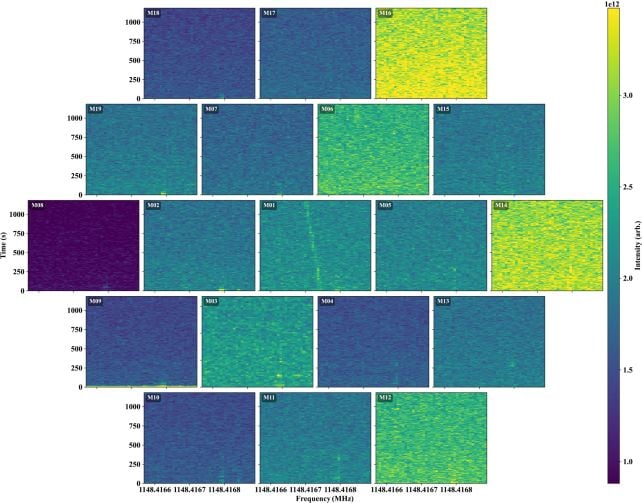
If a signal appears in multiple places in the sky – that is, multiple beams – it's probably terrestrial in origin. But if it only appears in the beam pointed at the target, it survives another round of scrutiny.
The researchers developed a machine-learning algorithm that uses a mathematical technique called wavelet analysis to tease faint signal patterns out of noisy radio data.
It was trained to recognize the characteristic tracks produced by narrowband signals drifting in frequency, before additional checks filtered out likely terrestrial interference.
The pipeline initially picked out 139,127 detections. Successive rounds of filtering and interference checks whittled that enormous haul down to just two signals the researchers considered particularly noteworthy.
One, detected in the direction of a star called Kepler-438, had already been identified in an earlier analysis and ultimately ruled out as Earth-based interference.
The other was new – and it came from a particularly juicy planetary system.
K2-155 is a red dwarf star with three known super-Earth exoplanets – and the outermost of those, a world 1.6 times the radius of Earth, is located close to the star's habitable zone, where liquid water may be able to survive on the surface without freezing into ice or evaporating into nothing.
Deep in the FAST data from K2-155 was a signal named NBS 260108.
At 1148.4167 megahertz, it was narrow. It was drifting. And it appeared only in the beam pointed at K2-155. It checked all three boxes and could graduate to "candidate technosignature."
But not a strong one, alas.
The signal appeared strongly in only one polarization channel, and similar signals at nearby frequencies appeared during observations of three other stars – clues pointing back toward terrestrial or instrumental interference.
But the researchers couldn't identify exactly what produced it.

At the moment, NBS 260108 remains unclassified, with an Earthly or instrumental origin considered more likely than an extraterrestrial one.
Even if it is just us again, though, scientists will have learned something from the experience – a refinement of the SETI processes that will make future searches more robust.
And hey, we've only been at this a short time. Humans have been cooking for around 300,000 years – but it's only been in the last century or so that we've been able to probe the skies for signs of alien tech.
If somewhere out there, E.T. is calling, surely eventually we'll find the right receiver to pick up.
The findings have been published in The Astronomical Journal.
This article was fact-checked by Rebecca Dyer and edited by Rebecca Dyer. While we pride ourselves on our process, we are only human. If you spot a mistake, please let us know.