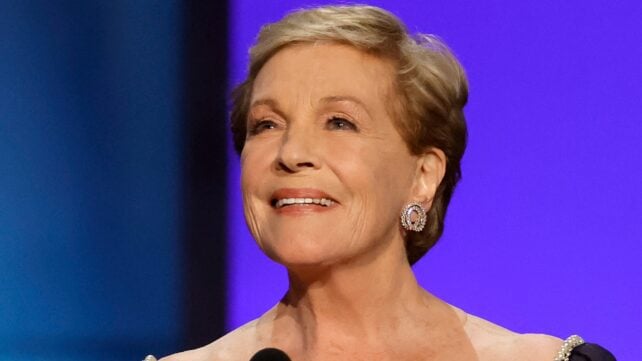
Julie Andrews is one of the most famous actresses in the world, and at age 91, she is still working creatively.
The long-celebrated star of Mary Poppins and The Sound of Music may no longer be in front of the screen, but she continues voice acting for Bridgerton, and she just published a new children's book with her daughter.
In a recent interview with InStyle, Andrews said she mostly keeps working and creating to keep her brain alive.
Emerging evidence suggests she's on to something.
In 2021, an international team of researchers examined the association between cognitively stimulating work and the subsequent risk of dementia.
They brought together data from more than 100,000 people in the United Kingdom, Europe, and the United States.
After adjusting for other risk factors, they found that those participants with cognitively stimulating jobs had an 18 percent lower risk of dementia.
The findings are supported by a string of other studies, which suggest that staying cognitively stimulated in later life may be important for the aging brain.
In 2023, for instance, scientists found that immediately after retirement, cognitive function declines at an accelerated rate.
That isn't to say that the decline is due to retirement; it's just an association. But the timing is suspicious.
It could be that people more cognitively capable are working into later age, or it may be that mentally stimulating work can help keep the brain fit and healthy.
Learning is, after all, known to support brain function in our younger years. Why not in our later years as well?
Rachel Wu is a psychologist at the University of California, Riverside, who is researching how learning can boost cognition even in older age.
In an interview with the American Psychological Association earlier this year, she said that "there seems to be a societal expectation that adults are not supposed to be learning as much as children are."
She wondered: "What if adulthood is one very long summer slide, similar to what students experience during summer break?"
She and her colleagues published a study in 2023 that had older adults learn at least three new skills, such as Spanish, drawing, or music composition, over the course of three months.
At the end of the trial, participants showed improved cognitive performances. In fact, their scores were on par with a separate cohort of much younger adults.
"Our multiskill intervention may provide broad cognitive gains, akin to the benefits experienced earlier in the life span," the study authors concluded.
The findings suggest that challenging yourself cognitively in older age, as Julie Andrews does, could help keep the brain young.
"I probably feel like in my 50s, honest to God," Andrews told Julia Louis-Dreyfus on her podcast Wiser Than Me at age 88.
"As long as the brain holds out, I'm doing okay."
During the podcast, Andrews explained that her father also was a lifelong learner. She got her love of books and writing from him.
He studied a whole new language at age 76.
Alexandra Touroutoglou is a neurologist at Harvard University who studies super-agers, or those who remain cognitively sprightly even into very old age.
"Anecdotally, talking with our participants, the super-agers say they really enjoy challenging themselves," she said in an interview with the Harvard Gazette earlier this year.
"They don't want to sit in the background; they want to learn new things."
Growing older is inevitable, but that isn't to say a person has no control.
The 2024 Lancet Commission estimates that around 45 percent of dementia cases worldwide can be prevented or delayed with changes to certain lifestyle habits, medical conditions, or environmental factors.
Working with language, like reading or writing books, seems to be particularly worthwhile for the aging brain.
A recent study, published in Neurology earlier this year, followed nearly 2,000 older individuals from Illinois in the United States who did not have dementia at baseline.
After nearly eight years, 551 had developed Alzheimer's disease.
Those who reported more frequent engagement in cognitive activities throughout their lifespan, like reading books, visiting libraries and museums, learning foreign languages, or using dictionaries, showed better cognitive outcomes in later life.
In fact, a higher lifetime score for cognitive enrichment was associated with a 38 percent lower risk of Alzheimer's, a 36 percent lower risk of mild cognitive impairment, and a delayed onset of cognitive decline by up to 7 years.
It also led to greater cognitive function later in life.
"Our findings are encouraging, suggesting that consistently engaging in a variety of mentally stimulating activities throughout life may make a difference in cognition," said co-author and neuropsychologist Andrea Zammit in February.
These findings support the idea of a 'cognitive reserve', which is sort of like a muscle reserve.
According to this concept, as a person ages, the more they have exercised their brain in the decades before, the more protected it is from decline.
In 2024, for instance, a study from Norway found that those with a history of cognitively stimulating occupations in their 30s, 40s, 50s, and 60s had a lower risk of mild cognitive impairment and dementia when they reached their 70s.
Julie Andrews has spent her whole life stimulating her brain and pushing herself creatively.
Even in her 90s, she chooses to keep learning to keep her brain fit and healthy.
In exploring her passion for writing, Julie Andrews swallows her medicine with a spoonful of sugar.
This article was fact-checked by Fiona MacDonald and edited by Fiona MacDonald. While we pride ourselves on our process, we are only human. If you spot a mistake, please let us know.