Dinosaurs get the most attention as monsters of a bygone world, but there are eons of overlooked extinct animals that are just as wild.
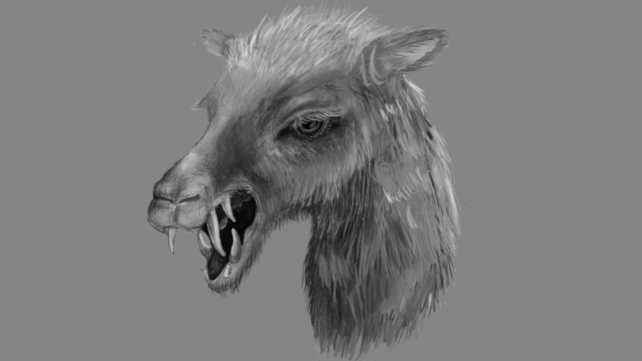
If you time traveled back 10 or 12 million years, for instance, on the Great Plains of North America you might run into a gigantic creature standing on four spindly legs, with a long, giraffe-like neck and a mouthful of pointed fangs.
You, my friend, have just met Vampyrocamelus welshi – the "vampire camel".
It may look pretty fearsome, but despite its name (and face), it was a vegetarian.
The new species (and new genus) has just been described in a monograph set to be published in the New Mexico Museum of Natural History and Science Bulletins.
Though the name and formal description are new, the fossils themselves have been gathering dust in museums for the better part of a century.
Childs Frick, a paleontologist at the American Museum of Natural History (AMNH), personally funded many fossil digs in the early 20th century, with a particular interest in camelids – the family that includes modern-day camels, llamas, and alpacas.
In the new monograph, paleontologists have reanalyzed tens of thousands of camelid specimens held in Frick's collection, reviewing and updating the camel family tree.
Vampyrocamelus is one of the intriguing new species to come out of that work. It lived roughly 10 to 13 million years ago, with its bones commonly found in Texas and Oklahoma, and occasionally in Nebraska.
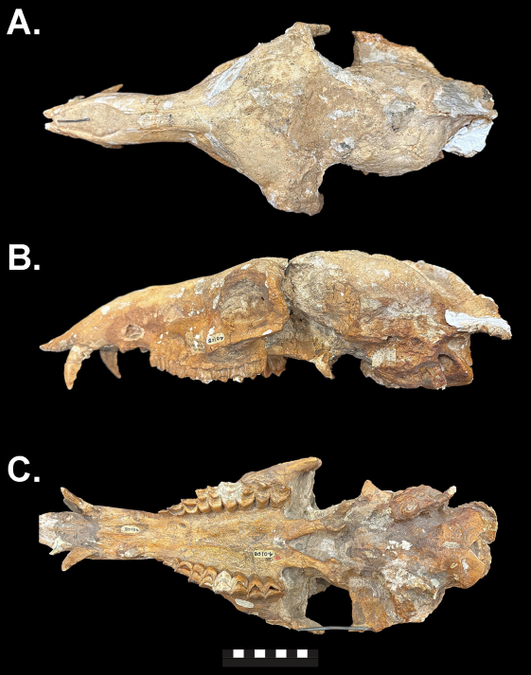
While its skull looks very similar to other known camelids, its defining feature is what gives it its name: fang-like canines that are roughly 40 millimeters (1.6 inches) long.
"The canines are enormous compared to any other known camelid, with a long recurved tip, coming to a sharp terminal point in most specimens," the researchers write.
"Where preserved, the first upper premolar is also large and recurved with a sharp point."
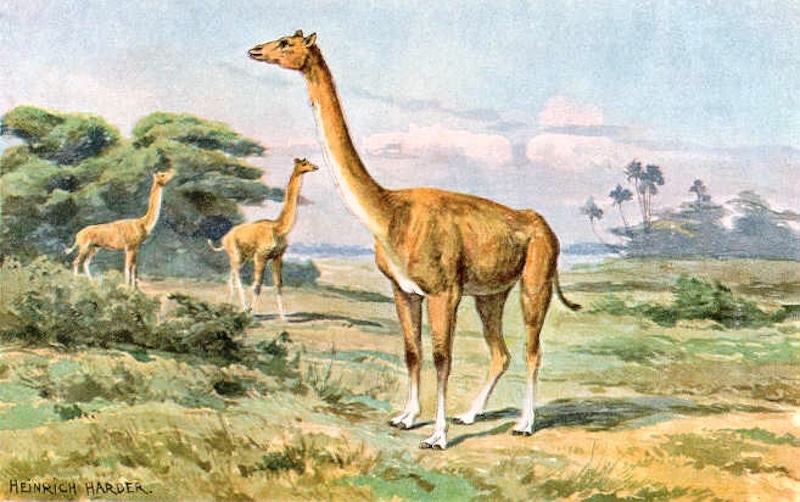
Little is known about the rest of the skeleton beyond the skull; there are a few broken limb and foot bones, but not a lot to go on. What has been found seems similar to a related genus known as Aepycamelus, which kind of looked like a giraffe.
Aepycamelus stood on stilt-like legs and might have grazed treetops with its long neck that reached up to 3 meters (10 feet) off the ground. Vampyrocamelus could have looked and lived in a similar way.

So if it wasn't hunting anything more vicious than leaves, what need did it have for the Dracula cosplay?
It's possible it used its sharp teeth to defend itself against predators – but according to the study's co-authors, they were more likely used by males competing for female attention.
"They may have been using [the fangs] to attract females, because the female animals did not have these," Katherine Marriott, paleontologist at AMNH, told Jake Buehler at Science.
Finding further specimens could help shed more light on what Vampyrocamelus actually looked like, and how it behaved.
But we may have more material than we realize: The team says that many of the bones attributed to Aepycamelus over the years could actually belong to Vampyrocamelus. The fangs are the main point of difference, which makes it hard to tell where a stray leg bone might have come from.
The rest of the monograph pieces together the history and evolution of camelids, but the real takeaway is just how much knowledge we might already have access to, if scientists are just given the time and resources to study existing collections.
After all, if a vampire camel can spring from a century-old jumble of random bones, who knows what other fascinating, forgotten creatures could be hiding in other overlooked fossil drawers in museums around the world.
The monograph is set to be published in the New Mexico Museum of Natural History and Science Bulletins.
This article was fact-checked by Rebecca Dyer and edited by Rebecca Dyer. While we pride ourselves on our process, we are only human. If you spot a mistake, please let us know.