
For the first time, astronomers have caught the moment when a supermassive black hole flare triggers a mighty wind blasting out into space at relativistic speeds.
The so-called ultrafast outflow, or UFO, was recorded reaching speeds 19 percent of the speed of light in a vacuum – about 57,000 kilometers (35,400 miles) per second. That's not the fastest such outflow ever recorded, but it is the first observation of the onset and evolution of the supermassive black hole flare and the UFO it unleashed.
"We've not watched a black hole create winds this speedily before," says astronomer Liyi Gu of the Space Research Organisation Netherlands (SRON). "For the first time, we've seen how a rapid burst of X-ray light from a black hole immediately triggers ultra-fast winds, with these winds forming in just a single day."
Related: Milky Way Supermassive Black Hole Caught Doing Something Never Seen Before
The galaxy NGC 3783 is a beautiful barred spiral galaxy located about 130 million light-years away, oriented with its broadside directly facing Earth – giving us a perfect view of the active supermassive black hole at its center.
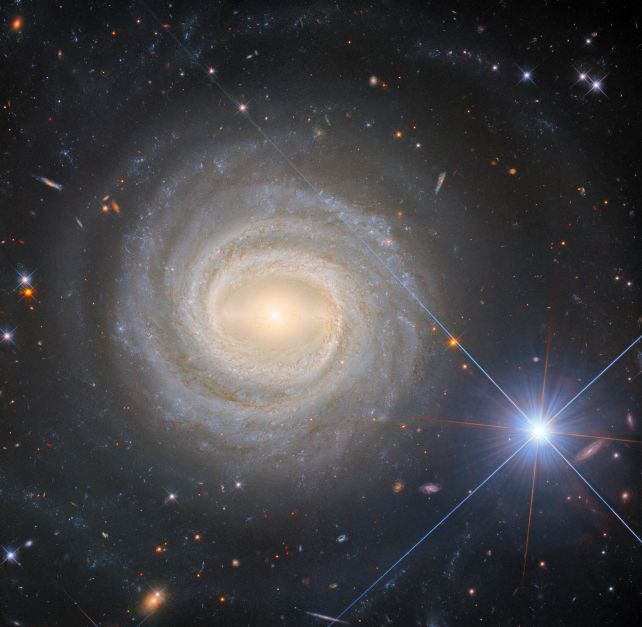
That black hole is a relatively modest one for the supermassive size range, clocking in at about 28 million times the mass of the Sun, but it's guzzling down material at a tremendous rate, causing the galactic center to blaze and flicker as dust and gas around the black hole interact in its powerful gravitational environment.
This specific flare, recorded in X-rays using ESA's XMM-Newton and the JAXA-led XRISM, was probably the result of a filament of magnetic field outside the black hole snapping and reconnecting – the same engine that unleashes powerful flares of energy on the Sun, but at a much larger scale.
The event, detected in July 2024, is therefore the supermassive black hole equivalent of a solar flare. The researchers recorded a giant rise in hard X-rays, followed by a peak in soft X-rays, consistent with a flare.

Then, within about 12 hours, they detected a signal consistent with an ultrafast outflow – analogous to a coronal mass ejection from the Sun, in which billions of tons of material entwined with ejected magnetic fields are blasted out into space like a sneeze.
It's a magnificent observation that, once again, reveals how similarly the Universe can behave across dramatically different scales.
"By zeroing in on an active supermassive black hole, the two telescopes have found something we've not seen before: rapid, ultra-fast, flare-triggered winds reminiscent of those that form at the Sun," says ESA astronomer Erik Kuulkers.
"Excitingly, this suggests that solar and high-energy physics may work in surprisingly familiar ways throughout the Universe."
The research has been published in Astronomy & Astrophysics.