When the brain's typical wiring patterns shift from the norm, it leads to psychotic disorders such as schizophrenia and bipolar disorder.
In a new study, researchers have identified 'brainquakes' that disrupt the brain's connectivity in people who live with these conditions and experience debilitating psychosis.
By mapping out the role these brainquakes play, the research team hopes to get a better understanding of common brain disorders and perhaps a step closer to treatment interventions that can help manage them.
Related: Scientists Pinpoint Where Extreme Moods of Bipolar Disorder Exist in Brain
Essentially, these brainquakes are an imbalance between the redundancy and synergy of brain networks, whereby brain cell circuits process either shared or complementary information, respectively. Redundancy makes the brain more robust, while synergy allows it to extract more information from related inputs.
The brains of the people with psychotic disorders were noticeably more unbalanced, the researchers found, showing more irregular and random connectivity.
"In this study, we provide converging evidence suggesting that the psychotic brain exhibits states of randomness across both spatial and temporal dimensions," Qiang Li, a computational neuroscientist at the TReNDS (Translational Research in Neuroimaging and Data Science) Center in Atlanta, and colleagues write in their published paper.
The researchers analyzed detailed brain scans of 1,111 participants, including 288 people with schizophrenia, 183 with bipolar disorder, and 640 healthy controls. Each scan lasted about five minutes, with the analysis tuned to find higher-order (more complex) interactions.
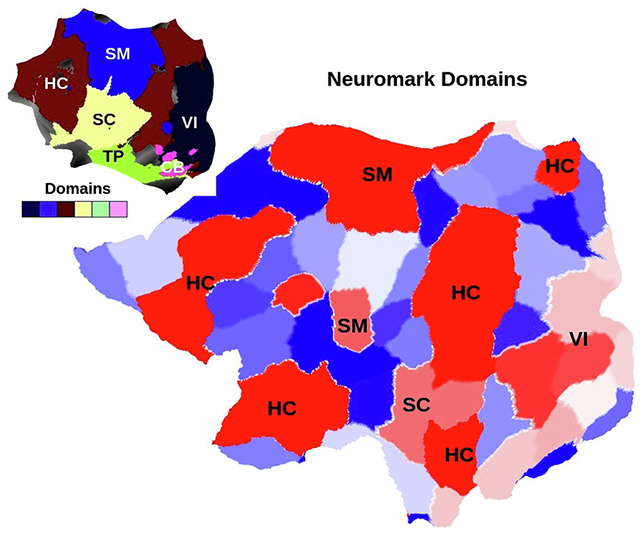
Brainquakes were detected 'rumbling' across the brains of people with schizophrenia and bipolar disorder far more than in the healthy controls, affecting brain regions linked to emotions, memory, and sensory information.
These brainquakes are like active volcanoes, the researchers say, with particular networks in the brains of people with psychotic disorders showing a tendency toward sudden and regular disruptions.
However, since the participants were all considered psychiatrically stable during the experiment, and the scans were taken during a resting state, the quakes aren't necessarily linked to psychotic episodes.
"These findings underscore the severe impact of psychotic states on multiscale critical brain networks, suggesting a profound alteration in the brain's complexity and organizational states," Li and colleagues write.
The research gives scientists a fascinating new look into the brains of people who live with psychotic disorders, though further studies will be required to track the pattern and the frequency of these brainquakes over periods longer than five minutes.
More work is needed to look at how brainquakes might affect cognitive function, the researchers say. At the moment, it's not clear if these disruptions are helping to drive psychotic disorders or are something that's a consequence of them.

The brain is such a sophisticated network system that it makes picking apart the causes of conditions like schizophrenia and bipolar disorder very challenging, though progress is being made. We're getting better at identifying people at a higher risk of these conditions, for example, through biomarkers in the body.
We also know about some of the triggers that can cause psychotic episodes, including high-potency cannabis use. Each of these discoveries tells us a bit more about what the brain is doing when it takes a few steps outside of reality.
As per the latest figures, as many as 3 in 100 people in the US will have a psychotic episode at some point in their lives – and while there are ways of managing these conditions, scientists continue to work on finding more effective treatments with fewer side effects.
"Psychotic disorders, such as schizophrenia and bipolar disorder, pose significant diagnostic challenges with major implications on mental health," write the researchers.
The research has been published in Molecular Psychiatry.