There's nobody who wants to hear some good news about coral reefs more than me. I celebrated my ninth birthday in Florida by snorkeling on an offshore reef with my grandma, and I never forgot the dazzling fish and vibrant corals.
Fifteen years later I returned, eager to share it with my partner, only to find a graveyard of dusty, dead coral. I sat on the beach and cried.
That one small reef in Florida is part of a planetary trend: As global waters warm, corals experience bleaching events, and many have died following that repeated stress.
So hearing the news that a coral reef off the coast of once believed dead was very much alive, put a huge grin on my face.
The newly documented coral community lies off the coast of Benin, a narrow West African nation on the Gulf of Guinea, sandwiched between Togo and Nigeria.
While Benin is perhaps best known for its rich cultural history as the birthplace of the Vodún (Voodoo) religion and home of the all-female Dahomey Amazon warriors, its offshore waters haven't been studied much.
Now, a new study in Frontiers in Marine Science suggests they may harbor one of the Gulf of Guinea's hidden marine treasures.
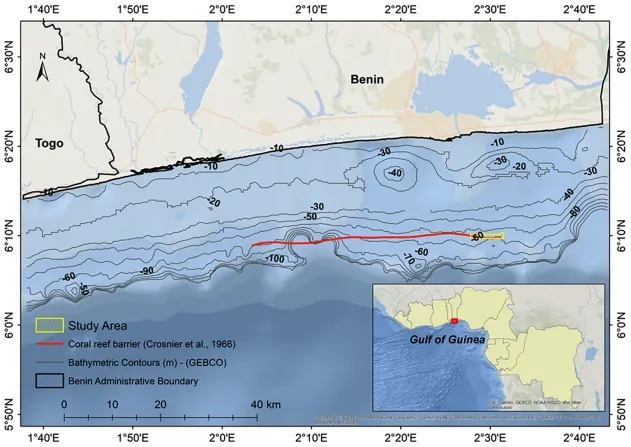
The researchers surveyed reefs around 54 meters (177 feet) below the surface – far deeper than most recreational scuba divers can safely reach.
These are known as mesophotic coral ecosystems, sometimes nicknamed the ocean's 'twilight reefs' because they exist in dimly lit waters where enough sunlight penetrates to support corals, but only just.
Mesophotic reefs have become increasingly interesting to marine scientists in recent years. They often host species different from those on shallow reefs, may serve as refuges from warming surface waters, and remain among the least explored ecosystems on Earth.
The Benin reefs have an intriguing history. During fishing surveys in the early 1960s, scientists detected what appeared to be coral formations at depths of 52 to 56 meters.
But because they relied on dredging and relatively primitive sonar rather than direct observation, they concluded the reefs were dead.
For six decades, no one returned to check.
This new expedition finally did.
"It was not an easy field campaign," said oceanographer Gérard Zinzindohoué of the Institut de Recherches Halieutiques et Océanologiques du Bénin, and lead author of the research.
"It was a mix of long days at sea, technical problems, and a lot of uncertainty. But then we saw structures on the sonar that looked like they could be reef signatures, which gave us hope that we were close."
Between April and December 2025, researchers used modern side-scan sonar to map the seafloor. They identified two patches of hard-bottom habitat stretching across roughly 7 kilometers (4.3 miles).
The real surprise came when they lowered underwater cameras and a remotely operated drone to inspect the sites.
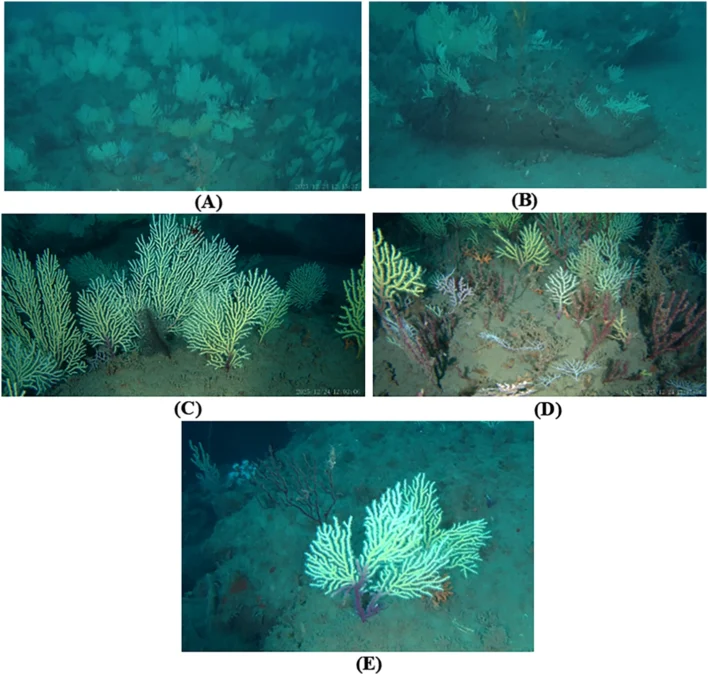
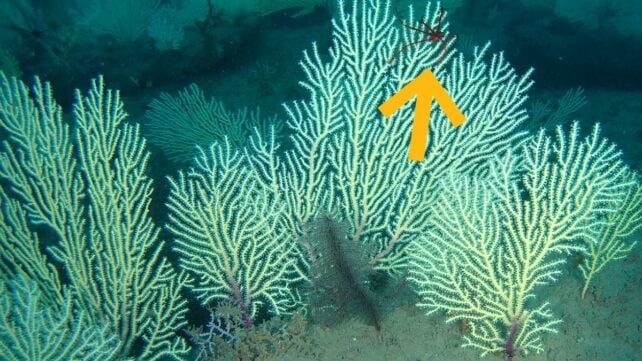
Excitingly, a lush, living coral garden was revealed.
"I still remember seeing those first images. It was a mix of excitement and disbelief, because after all this time thinking about this reef, suddenly there was something real in front of us," said Zinzindohoué.
Mesophotic coral gardens are different from those closer to the surface, and this one is made up primarily of soft, fern-like octocorals.
The researchers documented at least six different octocoral forms, along with two kinds of black coral – long-lived animals that can create complex underwater habitats.
Eight species of fish were recorded sheltering and feeding among the corals. Among them were golden African snappers (Lutjanus fulgens), blackbar soldierfish (Myripristis jacobus), and Guinean angelfish (Pseudupeneus prayensis), as well as three-banded butterflyfish (Chaetodon robustus) and two species of damselfish.
The study found isolated patches of rocky habitat supporting coral communities rather than one long continuous reef. That pattern actually resembles many other mesophotic ecosystems, where corals colonize scattered hard surfaces surrounded by sand.
Compared with regions like Australia, the Caribbean, or even Brazil, much of West Africa's underwater biodiversity remains poorly documented.
The findings raise an intriguing question: Are these reefs genuinely rare, or have scientists simply never looked closely enough?
"I think what we found is probably not an exception," said Zinzindohoué.
"It is more likely a reflection of how little we still know about coastal regions in West Africa and elsewhere. If we were able to find this reef again after 60 years, how many others are still undocumented or simply forgotten?"

As exciting as the discovery is, this study comes with important limitations.
The researchers only visually surveyed one of the two sonar-identified reef areas because of budget and logistical constraints. They did not collect coral samples, so many of the species identifications remain provisional, based solely on video footage.
Related: First-Ever Footage of Haunting Barreleye Fish Captured Deep Beneath The Atlantic
As the researchers write, this is a first glimpse rather than a complete inventory.
Even so, that glimpse may prove valuable. Continental shelf habitats face growing pressure from activities like bottom-trawling, while climate change continues to reshape marine ecosystems worldwide.
Knowing where these mesophotic coral gardens exist is the first step toward understanding – and potentially protecting – them.
The findings have been published in Frontiers in Marine Science.
This article was fact-checked and edited by Clare Watson. While we pride ourselves on our process, we are only human. If you spot a mistake, please let us know.