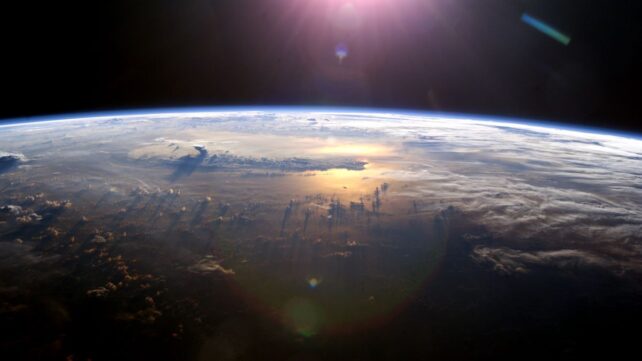
Our beautiful big round ball of a planet is not, in fact, a perfect sphere.
As it spins about on its axis, whirling around the Sun, rotation causes it to bulge at the equator and flatten at the poles.
This deformation is subtle – looking at a picture of Earth from space, it's not even remotely discernible to most eyes – but it is a known and normal result of rotational physics.
There's just one big problem. Earth is, apparently, changing shape – becoming, paradoxically, both more and less squished at the same time, depending on how you measure it.
According to a new study by geologist Christopher Kotsakis of the Aristotle University of Thessaloniki in Greece, that change is accelerating, with the rate at which the polar regions are rising roughly doubling in less than 20 years.
And at least one driver of that acceleration might be melting ice at Earth's coldest extremes.
"Our results indicate an acceleration of polar uplift accompanied by a comparably increasing rate of equatorial subsidence," Kotsakis writes in a paper published in the Journal of Geophysical Research: Solid Earth.
"This means that solid Earth's overall shape is becoming slightly less flattened."
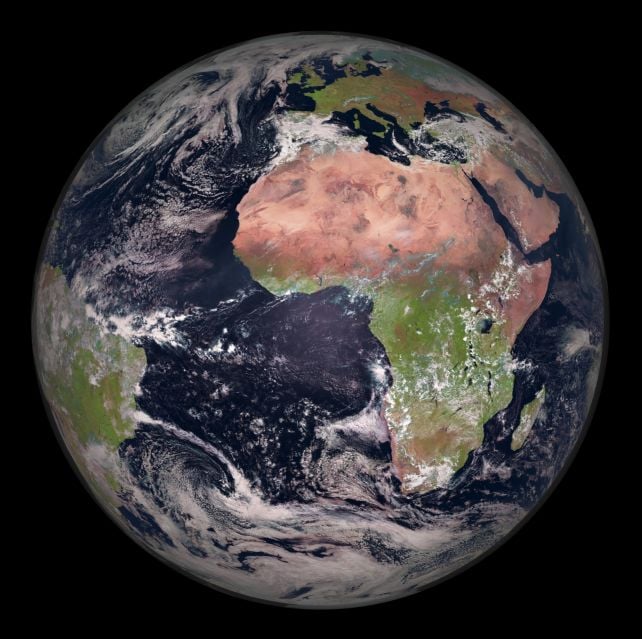
Earth feels extremely solid beneath our feet, but our world is a little more loosey-goosey than our day-to-day human lives might let on. Continents move. Tectonic plates collide. And, on geological timescales, the surface is surprisingly squishable.
If you accumulate mass in one area, the crust below will sink. Take that mass away, and the crust will gradually boing back up again.
We can see this happening today in parts of the world that were weighed down by ice during the last glacial period, which ended about 11,000 years ago. Even though the ice is long gone, the crust is still responding – a process scientists call glacial isostatic adjustment.
But not all the ongoing deformation has to do with changes long ago.
Greenland and Antarctica are rapidly losing ice, removing enormous loads from the crust beneath them and allowing the solid Earth to rise. Meanwhile, that meltwater is redistributed through the oceans, adding weight elsewhere and pushing the seafloor down.
Since the 1970s, scientists have been watching the changes wrought by this mass reshuffle in Earth's geoid – the lumpy, potato-like shape of the planet's gravitational field that tracks the distribution of mass.
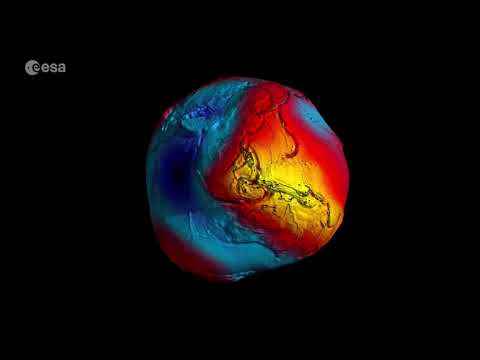
For the 1980s and much of the 1990s, those changes seemed to be consistent with what we might expect from glacial isostatic adjustment.
The overall shape of the geoid seemed to be growing rounder, with the equatorial bulge flattening as though the planet were becoming more gravitationally spherical.
Then, in the late 1990s, the trend reversed.
But the shape of the geoid does not necessarily reflect the shape of solid Earth. Kotsakis wanted to know whether the planet's rocky exoskeleton was changing in the same way as the geoid.
He turned to measurements from a global network of Global Navigation Satellite System (GNSS) stations, which can track tiny vertical movements of Earth's surface over time, pulling data from 1997 to 2015 to map how the solid Earth was rising and sinking around the globe.
This is where things get interesting.
Between 1997 and 2000, Earth's poles were rising at a rate of about 0.5 millimeters per year.
By 2015, the rate had risen to 1 millimeter per year.
Rocky Earth was unsquashing at the poles at an accelerating rate.
And the opposite squish was moving too.
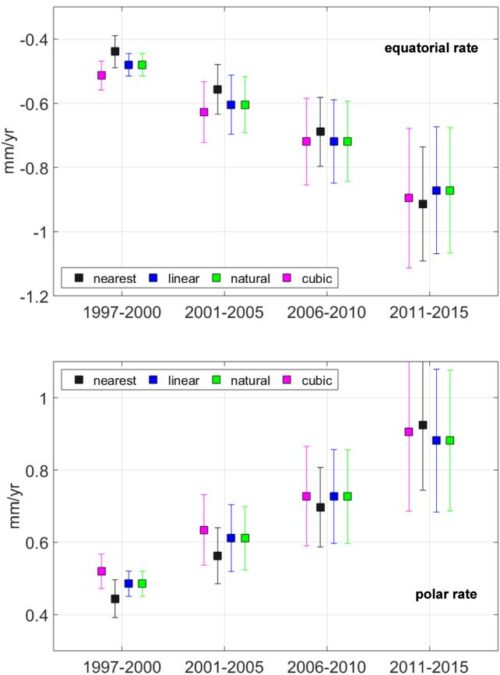
Around the equator, the solid Earth was sinking, at a rate that also increased over the study period. Put the two together – poles rising, equator sinking – and Earth's rocky exterior was becoming progressively less flattened.
But its gravitational shape was doing the opposite.
Kotsakis's calculations showed that the geoid was becoming increasingly flattened – exactly the trend scientists had observed since the turn of the century.
It sounds contradictory, but there's a surprisingly straightforward reason the two measurements can move in opposite directions.
As ice melts at the poles, the solid ground it weighed down starts to rebound.
But the mass of meltwater has to go somewhere – and some of it is redistributed towards lower latitudes, transferring the weight – and the squish – there.

Gravity, however, responds to the mass itself. Shifting mass away from the poles and toward lower latitudes makes Earth's gravitational shape flatter.
So the solid rocky part of Earth is becoming less squished, while the redistribution of water – and therefore mass – is making the geoid more squished.
Related: Giant Gravity Anomaly Under Antarctica Is Getting Stronger, Scientists Reveal
"While this behavior may appear counterintuitive when considered alongside the concurrent decrease in the solid Earth's flattening, the two effects are physically compatible," Kotsakis writes.
The findings highlight just how important it is to look at our planet from more than one angle. Neither its shifting mass nor its shifting surface tells the whole story on its own.
It's only by putting different kinds of measurements together that we can see the complex interplay of forces that shape our ever-changing world.
The findings have been published in the Journal of Geophysical Research: Solid Earth.
This article was fact-checked by Rachel Garner and edited by Fiona MacDonald. While we pride ourselves on our process, we are only human. If you spot a mistake, please let us know.