Pancreatic ductal adenocarcinoma, the most common form of pancreatic cancer, is particularly deadly and hard to treat.
Most tumors of this type are driven by one or more mutations in the KRAS gene, pushing rapid cell division that's difficult to stop.
They've long been considered so challenging to treat that KRAS has been labeled "undruggable" across decades of prior research.
Now, a new lab study points to a possible way around that problem.
A team from Florida A&M University College of Pharmacy and Pharmaceutical Sciences has been testing compounds called polyisoprenylated cysteinyl amide inhibitors (PCAIs) to try to outsmart KRAS malfunctions.
These PCAIs have been engineered to disrupt abnormal protein interactions associated with mutant KRAS signaling, rather than targeting a single KRAS mutation.
"The limited number of drugs to treat KRAS-driven cancers remains a significant healthcare problem, with the current drugs becoming ineffective due to intrinsic resistance," write the researchers in their new paper, published in the journal Oncotarget.
"In view of this, novel therapies are needed to combat the KRAS conundrum."
In tests on pancreatic cancer cells grown in the lab, the introduction of several PCIAs proved to be effective in disrupting the standard KRAS mutation game plan.
Of the compounds tested, the catchily named NSL-YHJ-2-27 led the way in terms of pancreatic cancer suppression, blocking more than 90 percent of cancer cell migration even at low concentrations.
A close analysis of the cells revealed the PCIAs were effective in several ways: They dialed up genes that suppress cancer, and turned down genes that help to spread it.
The compounds also reduced levels of proteins involved in cell movement. And they disrupted actin filaments, collapsing the internal scaffolding cells use to move around, maintain their shape, and invade surrounding tissue.
"These data obtained using pancreatic cancer cells with KRAS mutations suggest the ability of the PCAIs to prevent metastasis and tumor growth, strongly indicating their potential to serve as effective targeted therapies for treating cancer types driven by the multiple mutant forms of KRAS," write the researchers.
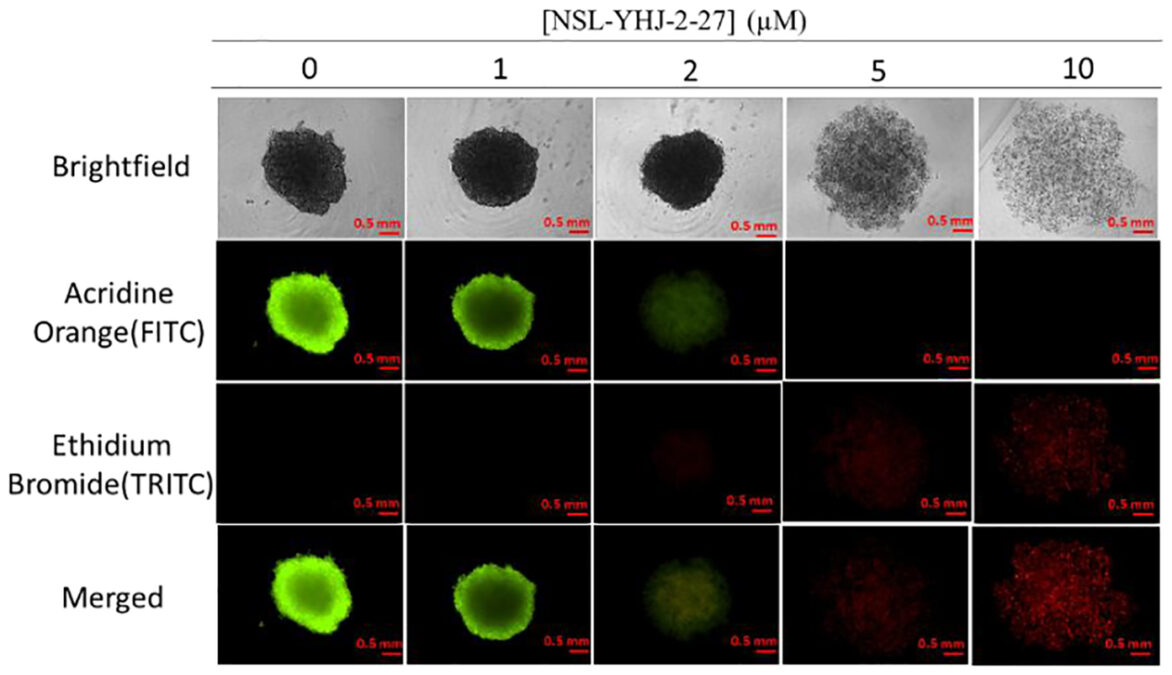
To give the compounds a further challenge, the team tested them on more complex 3D models of miniature tumors, and again the PCAIs proved adept at triggering cell destruction and breaking down the tumors.
However, the effect unfolded in a way the researchers did not expect.
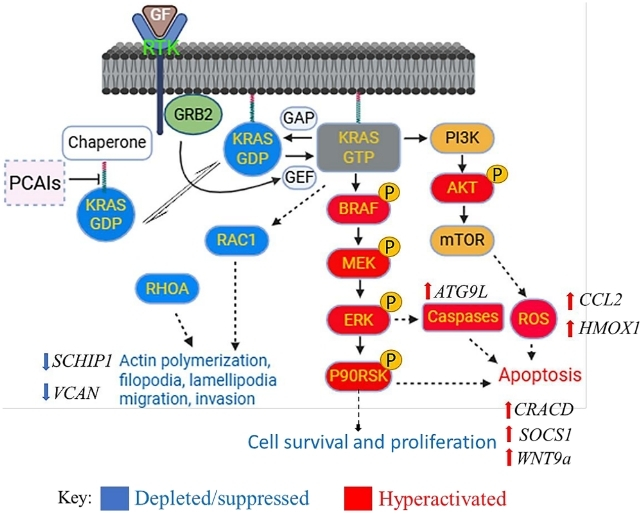
The key cancer growth signals in the cells were actually sent into overdrive rather than silenced, and this signal overload led to the promising results.
Further research will be needed to understand exactly what's happening here.
The results suggest the cells experience a surge in reactive oxygen species and essentially self-destruct – but whatever the mechanism is, it seems to stop cancer's growth and spread, at least in lab-grown cell models.

"Metastasis and invasion are major debilitating characteristics of tumor cells that cause high morbidity and mortality rates amongst cancer patients," write the researchers.
"Therefore, therapies that abrogate tumor cell motility have a strong potential to positively impact cancer management."
There are limitations to mention here – not least that this has only been tested on lab-grown pancreatic cancer cells so far.
More work is needed to figure out exactly how these PCAIs are working, whether they harm healthy tissue, and whether they remain effective and safe in animal models before any human trials could be considered.
Encouragingly though, the tested PCAIs appear to have what it takes to tackle KRAS mutations of several types. KRAS isn't just implicated in pancreatic cancer, and is linked to around 30 percent of all cancers with solid tumors, including colorectal and lung cancers.
Other research has already investigated some of the impacts these types of compounds might have more broadly.
The researchers are hopeful that the approach used here could lead to treatments for multiple KRAS-driven cancer types.
Related: Growing 'Cancer Crisis' Requires Millions More Healthcare Workers, Report Warns
"PCAIs are effective against a broader range of KRAS mutants, including KRAS-G12C, KRAS-G12D, and KRAS-G12V, thereby indicating potential pan-KRAS anti-cancer applicability," write the researchers.
"Indeed, our previous works revealed the effectiveness of the PCAIs against breast, lung, and prostate cancer cells driven by mutant KRAS proteins."
The research has been published in Oncotarget.
This article was fact-checked by Rachel Garner and edited by Rebecca Dyer. While we pride ourselves on our process, we are only human. If you spot a mistake, please let us know.