
The female brain undergoes profound changes to prepare for parenthood.
Yet even though the male brain never has to restructure itself for pregnancy, new evidence suggests this organ is still significantly altered by the birth of a baby.
In the weeks after a child is born, a rapid restructuring takes place in the paternal brain, based on a new study of brain scans involving 25 fathers.
The male brain seems to be pruning back certain pathways and rewiring others in preparation for fatherhood.
In the first 12 weeks postpartum, it appears that the male brain's gray matter gradually shrinks. Then, between 12 and 24 weeks, other parts swell in volume.
Researchers at RWTH Aachen University in Germany say this indicates a "dynamic pattern of change" to "help refine essential caregiving skills."
"Although further research is needed to substantiate this hypothesis, the observed temporal patterns support this assumption," the study authors conclude.
The most substantial rewiring of neural pathways seems to occur in the first six weeks postpartum.
During this time, scientists measured widespread reductions across multiple brain regions, including the parietal, temporal, frontal, and occipital lobes.
Twenty-four weeks after childbirth, these gray matter reductions had largely waned, although some parts of the cortex continued to shrink.
This apparent loss of gray matter volume is a broadly similar trend to what is seen in the female brain as pregnancy advances.
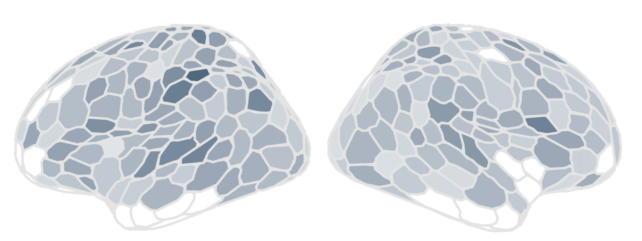
Losses to gray matter might sound detrimental, but they are actually a sign that the brain is restructuring its neural pathways to meet the demands of a new chapter in life.
For many decades, the human brain was thought to be hardwired and incapable of change.
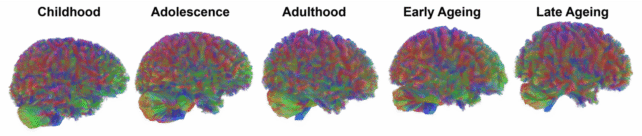
Today, we know it can restructure its finite tissue for key life stages, such as childhood, adolescence, or adulthood.
Parenthood is another transformative life stage, but neuroscience research on this period is still just beginning for both mothers and fathers.
The new study is one of the clearest investigations yet of what happens to a male brain during the first weeks of fatherhood.
"Although (soon-to-be) fathers do not undergo the immense endocrinological and physiological changes as mothers, they do have to adapt to meet the new demands of fatherhood," write researchers at Aachen University, led by psychiatrist Negin Daneshnia.
While some parts of the male brain appear to shrink with the birth of a child, other parts later swell in volume. This includes the left anterior cingulate cortex, which plays a key role in the anticipation of tasks and the dividing of attention.
This suggests the brain is reorganizing itself for the demands of a helpless baby.
Another part of the male brain that undergoes profound changes after childbirth is the substantia nigra. This region is critical for producing dopamine, the 'feel-good hormone' that underpins the brain's reward system.
What's more, the amygdala, which is involved in emotional processing, showed enhanced connectivity to other brain regions after childbirth. This brain region is closely tied to parental vigilance and attachment.
Taken together, all of these changes, explain Daneshnia and colleagues, are broadly consistent with the notion of the "parental brain network", a neural circuit that helps support human caregiving.
The trial is only small, but it aligns with a few other initial studies, which also show that first-time fathers undergo significant neurological changes, especially to their 'default mode network'.
This brain network is associated with parental acceptance and warmth.
The scans of male brains stopped at 24 weeks postpartum, so it is unclear how lasting these structural changes are. Some studies among mothers, for instance, have found that brain changes associated with parenthood can last many years after childbirth.
Fewer studies have been conducted among fathers.

Even though fathers do not experience a physical pregnancy, however, parenthood is still life-changing.
Studies suggest, for instance, that fathers can be just as impacted by postpartum depression as mothers.
Related: Having Kids Linked to Younger Looking Brains Later in Life, Study Finds
There are even signs that the brain changes differently depending on whether this is a parent's first or second child.
In the coming years, we are bound to learn much more about how the human brain has evolved to cope with parenthood.
Somehow, it's kept our species alive.
The study is published in Translational Psychiatry.