Metals everywhere need to be protected from corrosion, from beloved cars to iconic buildings, sculptures, and ships.
However, according to new research, there's a source of corrosion we didn't know about – and haven't been accounting for.
That source is electrically charged water. Water can get charged in many ways, from passing through a thundercloud to sliding across different surfaces.
Knowing that water can both become charged and corrode metal, researchers from the Max Planck Institute for Polymer Research in Germany wanted to see if there might be a connection.
The team's experiments showed that water carrying an electrical charge could create holes in a conventional protective coating on copper through an intense electrical process known as dielectric breakdown.
"We demonstrated that these charged drops can cause the coating to break down electrically and lead to corrosion of the metal," write the researchers in their published paper.
"As spontaneously charged water drops form naturally, this previously overlooked corrosion mechanism may contribute to the degradation of cultural heritage sites, buildings, ships, cars and other metal components."
The researchers ran a series of experiments using different materials and set-ups.
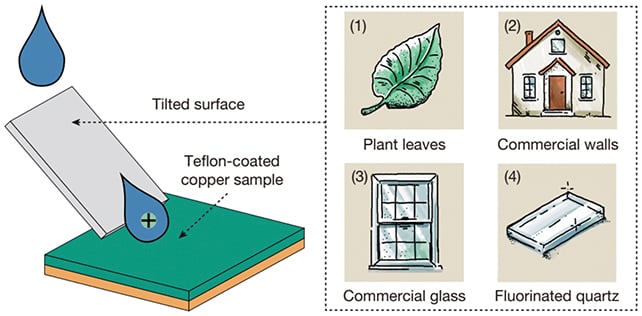
In the first, water droplets rolled across four common surfaces (a plant leaf, a thin PVC foam board, polystyrene, and quartz coated with a water repellent), then fell onto copper samples coated with either Teflon or polystyrene.
In another, the droplets slid across a continuous Teflon surface coating two adjacent materials.
The researchers measured the charge of the water drops as they slid and the corrosion patterns after thousands upon thousands of droplets had struck or slid over the coated metal surfaces.
Together, the experiments showed that water droplets caused damage to coated metals like copper and gold – not only from the impact of hitting them, but also by just moving across them.
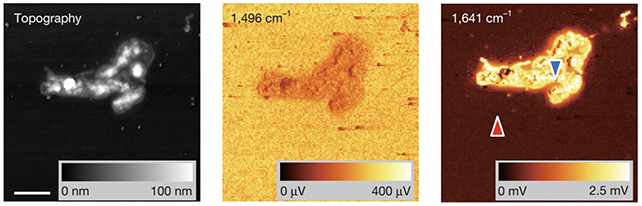
Using a powerful microscopy technique, the researchers could see the damage and characterize the products of the corrosive reactions that had occurred.
When electrically neutral water drops were added to the protected copper, no damage occurred.
Scientists only recently realized that sliding water droplets can become charged through an exchange of charges with the surface (similar to how static electricity works).
This new work furthers our understanding of the impact those charged droplets have on everyday materials.
Once the metal is exposed, it's vulnerable to corrosion. It's not that scientists haven't noticed rain and water breaking down metals before – it's a widely known issue – but we may have to rethink how we attribute this damage and protect against it.
"Conventional understanding attributes the coating failure induced by water drops mainly to two mechanisms: physical abrasion caused by moving drops, and chemical degradation from acidic substances and pollutants in the drop," write the researchers.
The results are telling, but the study was limited to lab experiments. For now it's not clear how much rainwater, for example, could be carrying an electrical charge that's significant enough to damage metal.
However, this is a distinct possibility. Future studies should be able to establish a clearer picture of just how much material degradation is due to these charged water drops.

"Charged drops can be generated naturally in clouds, thunderstorms, ocean waves, fountains, and waterfalls, or when sliding over hydrophobic materials before hitting the coated metal," write the researchers.
"They also occur in industrial processes such as electrostatic spraying, inkjet printing and reactions in chemical and pharmaceutical production. Consequently, this cause of corrosion may be relevant in many everyday or industrial processes."
If scientists can better quantify the threat of electrically charged water to protected metals, they could also develop improved coatings to guard against the dielectric breakdown observed here.
Now that they know what to look for, the study team believes similar corrosion could well be happening in other materials too, beyond those they tested.
Related: Most Materials Seem to Obey a 'Rule of Four' And Scientists Are Utterly Stumped
"Naturally charged drops can cause a coating to break down electrically, thereby initiating or exacerbating corrosion of the coated metals," write the researchers.
"Our findings can improve anti-corrosion strategies and emphasize the need for protective materials capable of resisting charge-induced damage from water drops."
The research has been published in Nature.
This article was fact-checked by Clare Watson and edited by Clare Watson. While we pride ourselves on our process, we are only human. If you spot a mistake, please let us know.