Our oceans are under constant threat.
In addition to plastic pollution, fentanyl-laden sewage, and skinny-dippers slathered in reef-harming sunscreen, oil spills are notorious marine devastators.
They also present a tough dilemma for frantic cleanup crews: allow the oil to disperse or set it ablaze?
In-situ burning may help slow the spread and clear the crude, but it also introduces drawbacks, generating dense black smoke, toxic soot, and a sickly sludge of unburned material.
To bypass these issues, scientists may have found a radical solution: giant fire tornadoes.
Unlike traditional oil-ignition techniques, the flames of these fire whirls spread upward rather than outward.
The resultant vortex acts as a natural supercharger, sucking in oxygen to fuel a hotter, more efficient blaze that can vaporize spills before they seep into sediments or engulf marine habitats.
"This is the first time anyone has conceived using fire whirls for oil spill remediation, and it's really just the beginning," explains Elaine Oran, an aerospace engineer at Texas A&M University and one of the study's co-authors.
"Our goal is to harness the chaotic nature of fire whirls as a powerful, precise restoration tool, to protect coastlines, marine ecosystems and the environment as a whole."
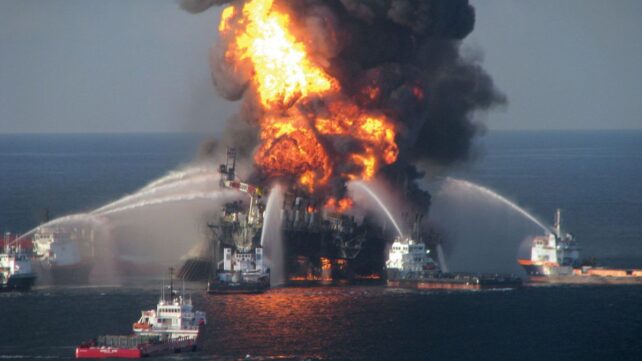
This technique may eventually help mitigate catastrophes like the 2010 Deepwater Horizon disaster, an oil rig explosion that resulted in the worst-ever offshore oil spill.
The event claimed the lives of 11 people, devastated untold millions of marine animals, and destroyed marine ecosystems, setting off a cascade of adverse effects felt more than a decade later.
Researchers have previously demonstrated the efficacy of fire whirls, but in smaller-scale lab settings. This study details a first-of-its-kind, large-scale assessment of scalability and effectiveness for oil-spill remediation applications.
The researchers, supported by the Bureau of Safety and Environmental Enforcement (BSEE) – established in 2011 in the wake of the Deepwater Horizon catastrophe – performed multiple field-scale tests using a 1.5-meter-wide (5-foot-wide) pool coated with crude oil and surrounded by three 5-meter-high (16-foot-high) walls.
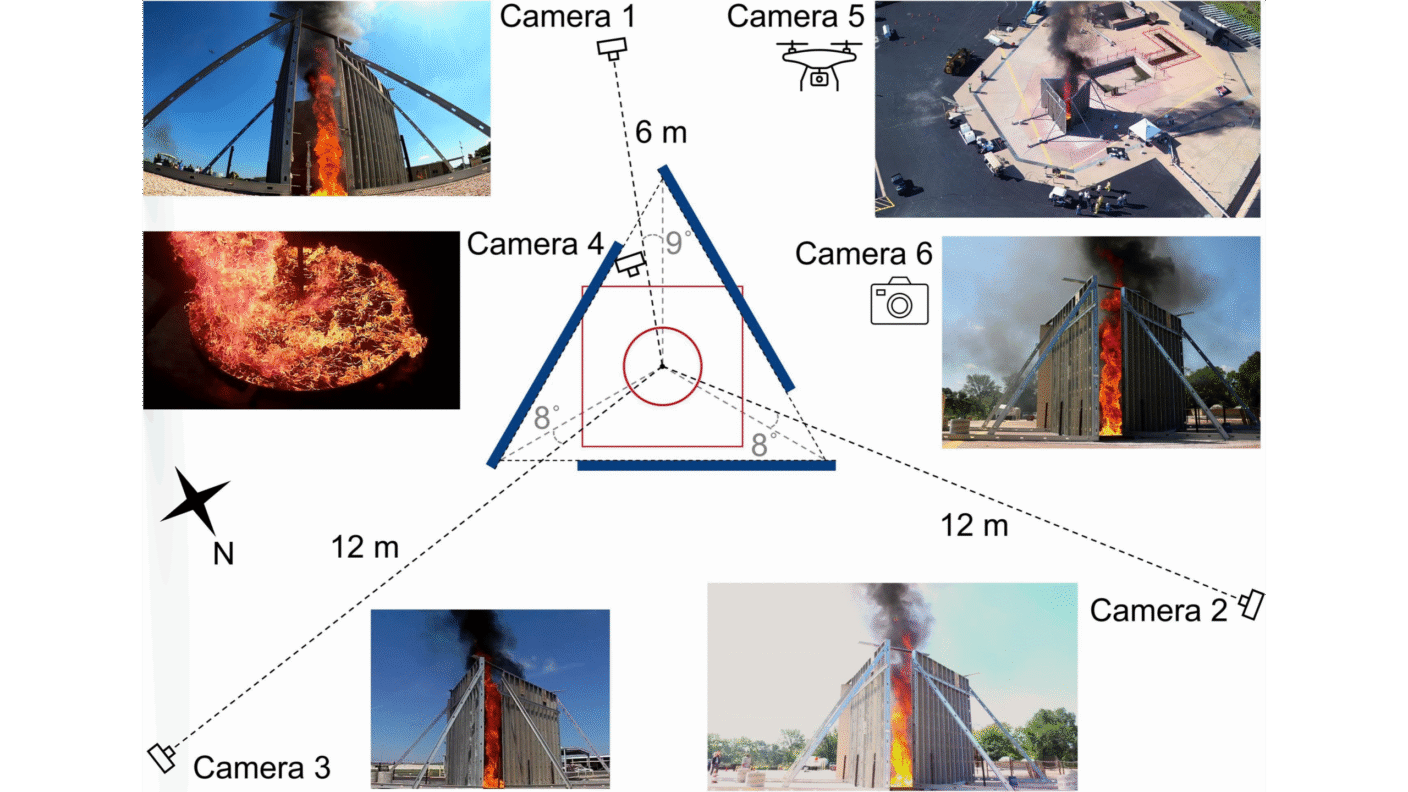
They compared the efficacy of vertically burning fire whirls against the conventional in-situ burning method – horizontally burning fire pools – under various wind conditions.
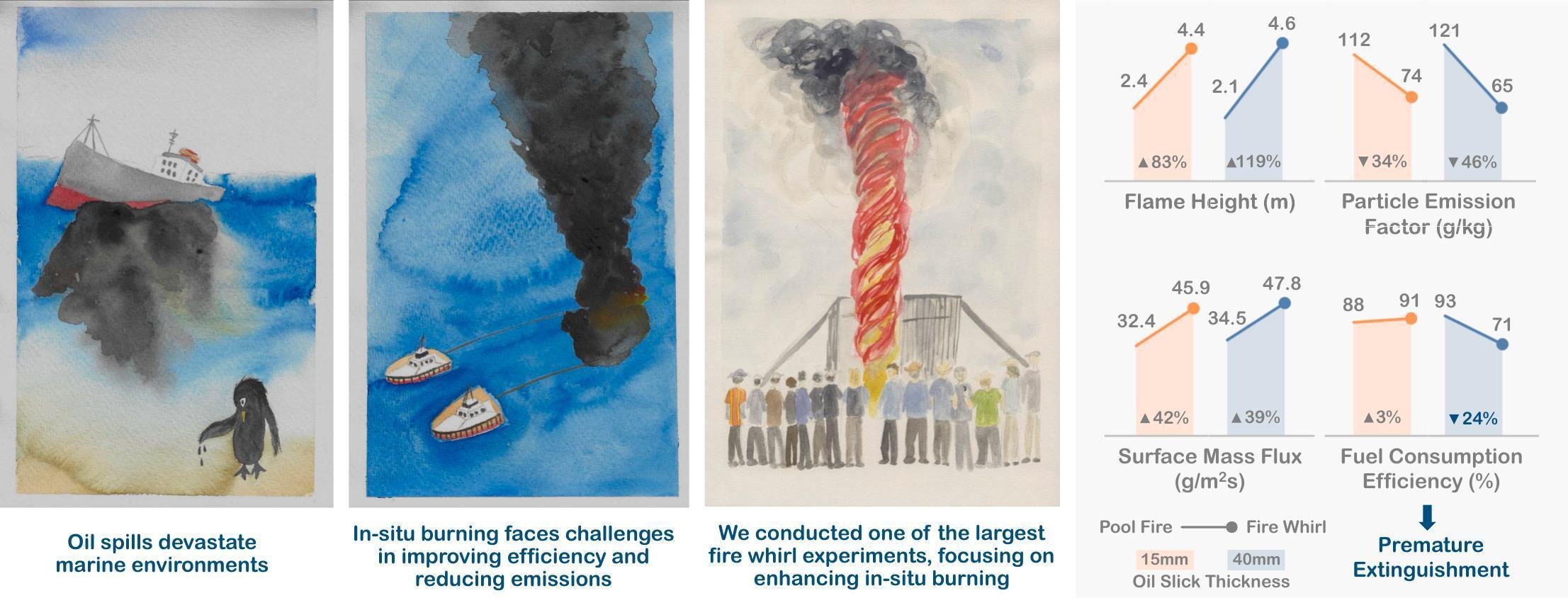
The researchers found that fire whirls sometimes burn cleaner and more completely, with almost twice the flame height and a better ability to transfer heat across the crude oil slicks.
Whirls can also burn hotter, reaching approximately 1,900 degrees Fahrenheit (1,000 degrees Celsius), compared to around 1,300 degrees Fahrenheit (700 degrees Celsius) for fire pools.
Overall, fire whirls show the potential to increase burning rates by up to 40 percent, decrease soot emissions by up to 40 percent, and achieve up to 95 percent fuel consumption.
However, these figures may be highly condition-dependent. A thicker oil spill or stronger winds may facilitate premature extinguishment, and the fire whirls' enhanced efficiency is currently only achieved under calm conditions.
"Fire whirls are incredibly powerful, and can be incredibly beneficial. But they're also sensitive and only reach high efficiency when the conditions are just right," Oran says.
As such, the scalability of fire whirls remains unclear and warrants further exploration.
For example, the walls enclosing the experiment were necessary to facilitate the fire whirl, but they may have confined it too closely, decreasing oxygen uptake, compounding the destabilizing effect of the wind, or physically stymying the flames.
Additionally, it may be impossible to replicate marine conditions in the lab or the field, given the immense size considerations and constantly fluctuating water turbulence.
Still, this research highlights an unconventional approach to cleaning our oceans and protecting marine life, including our unfortunately cocaine-addled sharks.
One day, mobile wall-like structures could be deployed around ignited oil spills, turning them into more efficient, cleaner-burning, and cooler-sounding fire tornadoes.
"This study is more than just an experiment, it's a glimpse into a future where fire isn't a force of destruction, but a tool to protect our oceans and planet," Oran says.
This research was published in Fuel.