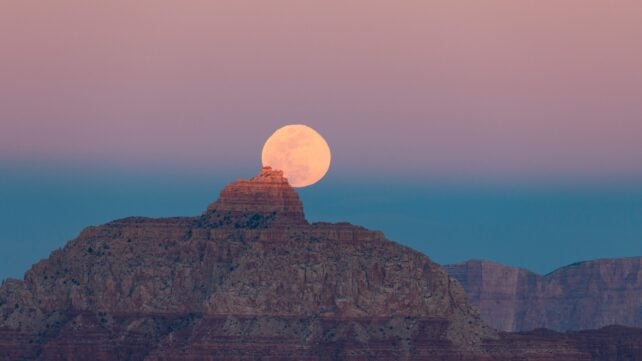
Roughly 1.25 billion years ago, the mudflats bordering an inland sea became the origins of the reddish-orange layers of the Hakatai shale.
This subtropical landscape on the ancient continent of Laurentia periodically became a landscape of evaporating moisture resembling a modern sabkha or playa.
As climate conditions changed, the sediments accumulated in rhythmic patterns.
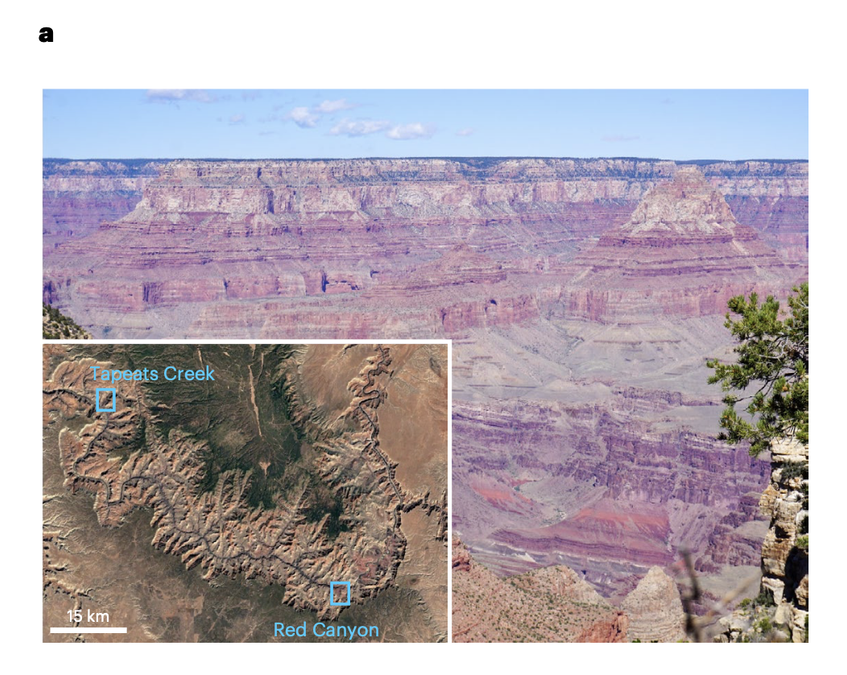
Today, the same patterns can be traced in outcrops 65 kilometers apart, and preserve a record of a time when an Earth day was radically shorter than the one we all live with.
Back then, a day only lasted about 19 hours.
In a new study, researchers figured this out by examining the colorful repeating patterns of the Hakatai shale that are today exposed in the central-eastern Grand Canyon, which reflect cycles in Earth's climate driven by its movements through space.
They appear to be geological fingerprints of changes in Earth's climate driven by subtle variations in its orbit and rotation known as Milanković cycles.
By studying those cycles, researchers have reconstructed aspects of the ancient Earth–Moon system. But it's not as simple as running today's astronomical models backward indefinitely.
Trying to reconstruct those cycles more than a billion years ago is a challenge. A lot of variables have to be accounted for, because Earth's orbit is chaotic over very long periods.
Over time, the shape of Earth's orbit changes, its rotational axis changes its tilt, and the orientation of that axis shifts – and the Moon's gradual movement away from Earth has changed the timing of some of these cycles.
All of these alter the amount and distribution of sunlight reaching the planet, affecting the type of shale that's laid down.
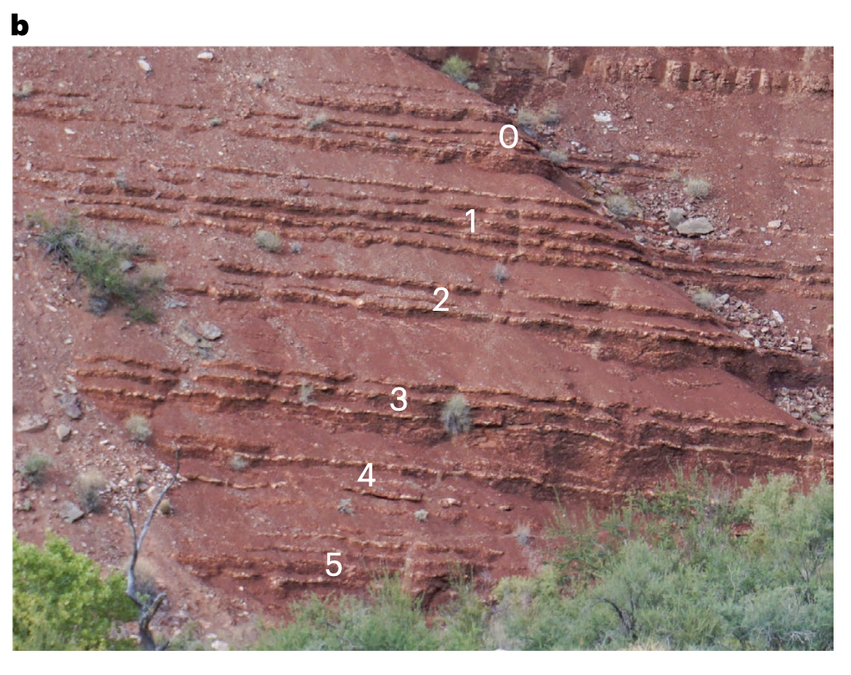
Examining the Hakatai Shale, the researchers found alternating layers of carbonate-rich and muddy rock that repeat at several scales.
These repeating patterns reflect different combinations of orbital circumstances involving Earth and the Moon. Once deciphered, the patterns can reveal aspects of the climate when the layers were laid down.
Similar layering patterns in the shale occur more than 60 kilometers apart, suggesting they reflect broad climate changes rather than local variations in sedimentation.
One of the signals expected from changes in Earth's axial tilt appeared to be split into two distinct parts. The researchers suggest this could reflect either changes in how the climate system responded to orbital forcing or changes in the solar system's orbital dynamics themselves.

After accounting for the unusual signal, they calculated a precession (a change in the orientation of the rotational axis of a rotating body) period of about 15,730 years. That then produced an estimate of 53.8 Earth radii for the Moon's distance, and the 19-hour day calculation followed from there.
This also matches up with existing models of how the Earth–Moon system evolved around 1.25 billion years ago.
The results also provide no evidence for a proposed period when Earth's day temporarily stalled at around 19.5 or 21 hours during the Mesoproterozoic.
This study shows how ancient sediments can preserve far more than a snapshot of the landscape where they formed (in this case, an inland sea).
The Hakatai Shale also records climate rhythms and the celestial mechanics that drove them from a vanished subtropical world with a much shorter day.
The research has been published in Nature Geoscience.
This article was fact-checked by Peter Dockrill and edited by Peter Dockrill. While we pride ourselves on our process, we are only human. If you spot a mistake, please let us know.