Our bodies age at different rates, sometimes closely correlated to the years we've spent alive, and sometimes less so. A new study links another factor to the speed at which our brains age: how much we help others.
Regularly volunteering can reduce the rate of cognitive aging by around 15–20 percent, according to research by a team from the University of Texas at Austin (UT Austin) and the University of Massachusetts Boston in the US.
The findings are based on approximately two decades of telephone survey data from 31,303 people aged over 50. Scores on cognitive brain tests were mapped against helping behavior – whether volunteering with an organization or simply giving friends, relatives, and neighbors a hand as needed.
Related: Experiment Reveals How Pressure to Tip Can Unexpectedly Backfire
"What stood out to me was that the cognitive benefits of helping others weren't just short-term boosts but cumulative over time with sustained engagement, and these benefits were evident for both formal volunteering and informal helping," says Sae Hwang Han, a social scientist at UT Austin.
"And in addition to that, moderate engagement of just two to four hours was consistently linked to robust benefits."
The observational nature of the study means that direct cause-and-effect isn't shown here.
Still, there does appear to be a substantial link – perhaps driven by the mental stimulation and social interaction that comes with giving support and assistance to others. Prior studies have shown that loneliness can be bad for our brains and that physical activity can keep the mind sharp.
Notably, the researchers examined both informal helping and structured volunteering, and they tracked changes over time. The slowing in cognitive decline appears cumulative; being a helpful person continues to pay off year after year.
"Informal helping is sometimes assumed to offer fewer health benefits due to its lack of social recognition," says Han.
"It was a pleasant surprise to find that it provides cognitive benefits comparable to formal volunteering."
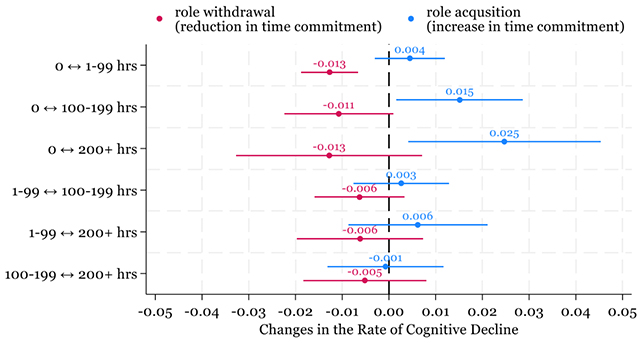
Around two to four hours per week spent helping others seems to be the sweet spot for optimizing its cognitive benefits. It's possible that beyond that point, the mental and physical efforts of being a helper start to take their toll.

With cases of dementia on the rise, scientists are on the lookout for modifiable risk factors – those that we can do something about, like changing our diet or exercise routine. Lending a hand to others could help maintain social connections in later life.
The researchers also found that when helping behaviors stopped, this was associated with lower cognitive scores and faster cognitive decline. There's a strong case here for ensuring that older adults have opportunities to give back to others and their community.
"Many older adults in suboptimal health often continue to make valuable contributions to those around them, and they also may be the ones to especially benefit from being provided with opportunities to help," says Han.
The research has been published in Social Science & Medicine.