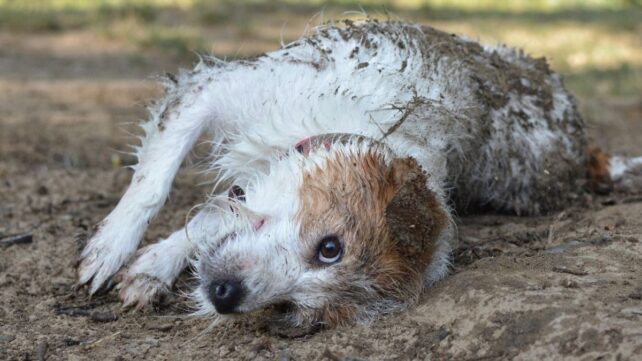
Dogs have been 'part of the family' for thousands of years, and we all know families share their microbes.
So how does this impact the health of the humans in your household?
A new study led by researchers at the Finnish Institute for Health and Welfare suggests that specific microbes in household dust, known to come from dogs, may even improve children's respiratory outcomes in their first year of life.
Parents of 368 newborn Finnish children tracked their babies' ear infections, fever, and antibiotic use, from the ninth postnatal week to one year of age. The families also reported whether they kept a pet dog.
When the child reached two months of age, the researchers collected dust from the living room floor of each family's home as a way of sampling the bacteria and fungi they were exposed to.
The results were published in Pediatric Allergy and Immunology.
"We show in this study that dog-associated bacterial and fungal genera or their combinations in house dust can explain up to one quarter of the associations between dog keeping and lower prevalence of respiratory infection during the first year of life," the authors report.
Given the nature of the research – recording data from an existing situation and using statistics to find patterns in the data – we still don't know that there's any causal effects going on here, but it's a promising lead for further research.
We know that we get beneficial microbes from human members of our family, and after sharing such a long history with dogs, it's definitely possible that we could have come to share some 'good bugs' with them, too.
"Respiratory tract infections in early childhood are a significant risk factor for asthma," says chief researcher Anne Karvonen.
"When some of children's respiratory tract infections can be prevented with dog-associated microbes, this may also reduce the child's risk of developing asthma later in life."
However, results from another observational study, published in the Journal of Allergy and Clinical Immunology: Global in May, suggest the picture is more complicated.
That research was based on data from 99,389 Swedish-born children diagnosed with asthma and airway allergies between the ages of three to 16 years. This was compared statistically with their dog ownership status across the years.
"In children with established asthma and allergy, continuous dog exposure does not seem to increase the risk of moderate-to-severe asthma, but it is associated with a modest increased risk of exacerbations," the authors of that study reported.

However, asthma outcomes didn't seem to change, at least at the population level, if the children's exposure to dogs ended.
The finding could mean that dogs aren't really the deciding factor when it comes to asthma, but again, further research would be needed to say for sure.
Another study, published in Brain, Behavior and Immunity in 2025, found that for people who live in urban environments, growing up with pets may protect against chronic low-grade inflammation.
This could be because it increases our exposure to what scientists call 'old friends' – the microbes that we humans have co-evolved with across the millennia.
Related: The Subtle Physical Clue That Could Indicate Your Dog Has Dementia
"Exposures to 'old friends,' which are thought to increase in homes with pets, interact with our immune system to produce more regulatory T cells," explained University of Colorado Boulder physiologist Christopher Lowry.
"Without sufficient exposure to 'old friends' we have reduced capacity to produce these regulatory T cells, which leads to inappropriate or unresolved inflammation."
Pediatrician Jenni Mäki, who was involved in the Finnish study, says the microbial environment during childhood plays an important role in immune system development, and dogs are a part of that.
"It has been suggested that in the future it may be possible to modify the home microbiota in ways that promote health," Mäki says.
"Our study shows that dog ownership already does this today."
This article was fact-checked by Rachel Garner and edited by Peter Dockrill. While we pride ourselves on our process, we are only human. If you spot a mistake, please let us know.