The world is now swimming in so many synthetic chemicals, some scientists think we have already breached our planet's safe limit.
Researchers are now warning that pesticides, pollutants, plastics, and forever chemicals may be contributing to a 'silent' fertility crisis.
In a new review, a team of toxicologists and biologists argues that "a diverse array of pollutants, combined with increasing pressure from worsening climate change" threatens fertility, biodiversity, and health on a global scale.
That goes for humans and numerous other animals, such as marine mammals, birds, fish, invertebrates, and reptiles.
In just half a century, Earth's wildlife populations have plummeted by more than two-thirds, and pollutants and climate change are thought to be significant causes of that decline.
At the same time, human infertility rates also seem to be on the rise in both males and females. While no one knows exactly why that is, some scientists have pointed the finger at the proliferation of hormone-disrupting chemicals in our lives.
Today, there are more than 1,000 synthetic chemicals on the market that can mimic or block natural hormones – and those are the just the ones we know about.
Only one percent of all synthetic chemicals have received sufficient safety evaluations, according to some estimates.
"Ecosystem and human health are deeply interconnected: warming temperatures, hypoxia, and chemical exposures interact to exacerbate reproductive stress," write the authors, led by ecotoxicologist Susanne Brander from the University of Oregon.
"Human fertility trends… parallel wildlife responses and highlight that all living organisms are involuntarily exposed to chemicals that have not been thoroughly vetted for safety."
As you can imagine, that sneaky possibility leaves the animal kingdom in a precarious position, especially when it is already teetering on the edge.
In the review, Brander and colleagues painstakingly compared how health and fertility outcomes in various animal groups were associated with climate change or synthetic chemicals.
A lot of the research is based on associations, which means it can only predict potential disasters; however, there are clear examples in the past where synthetic chemicals have severely impacted the health and fertility of other animals, and ourselves.
These are warnings.
Even if just a fraction of our pollutants are harmful, more than 140,000 synthetic chemicals exist, and clearly, just one toxic compound can cause disaster to several animals at once.
Insecticides, for instance, are chemicals designed to kill insects that harm human crops and health. They have been sprayed far and wide, and yet now, some of these compounds have been linked to lower sperm concentrations in humans around the world.
The infamous insecticide, DDT, is one of the few that we know for certain has negative health and reproductive effects in certain animals and at certain concentrations. It's the chemical featured in Rachel Carson's seminal book, Silent Spring, which causes birds' eggshells to thin, leading to substantial population declines.
There is also evidence that DDT lowered fertility rates among some marine mammals, and those rates have steadily rebounded since the chemical was banned internationally.
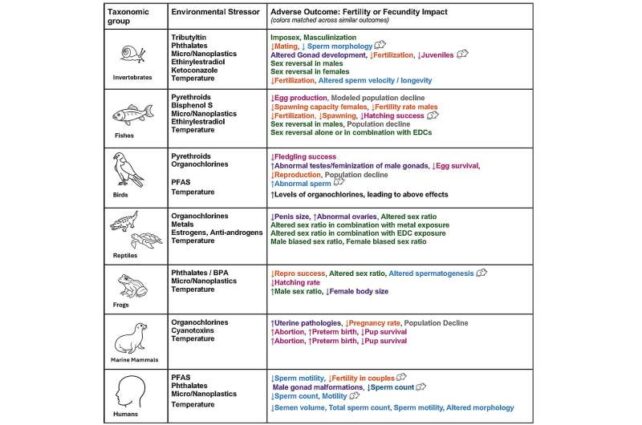
Meanwhile, forever chemicals, or PFAS (per- and poly-fluoroalkyl substances), have also been linked to lower human fertility rates, and some of these compounds are known disruptors of the endocrine system.
This system produces and distributes hormones – chemical messengers that help carry out crucial functions in the body, from growth and development to metabolism and reproduction.
As far back as the 1970s, companies knew that some PFAS compounds were toxic to humans, but they kept it quiet from the public. Some pregnant workers exposed to high concentrations of the compounds suffered miscarriages or gave birth to children with developmental defects. Several have now been banned.
While it is not clear how these adverse outcomes arose, disruption to reproductive hormones is a leading hypothesis.

Endocrine-disrupting chemicals (EDCs) can persist and build up in the environment for a very long time. Because they are so potent, it's possible that even at low exposure levels, they could have a significant impact on an animal's body.
Another potential disaster looms over the health impacts of microplastics, which may also disrupt the endocrine system. While some initial evidence has found microplastics and nanoplastics accumulating in reproductive gonads, at this point, we know shockingly little about the potential health or reproductive effects these pollutants may have on sperm, eggs, or a developing fetus.
Some scientists suspect the worst. If these pollutants prove harmful to human health, it will be very difficult to tackle the problem. Plastics are now found deep in the ocean and high up in the mountains. There is virtually no escape.
Besides, who's to say how these pollutants may interact with other synthetic chemicals once they are released from labs?
Related: 'Forever Chemicals' May Reduce Fertility in Women by Up to 40%, Study Finds
"The urgency of current negotiations toward a Global Plastics Treaty reflects recognition that plastic pollution – carrying thousands of potential EDCs and other stressors – represents not only an ecological but also a planetary health crisis," the review authors conclude.
The study is published in npj Emerging Contaminants.