Most of the mass in galaxies consists of stuff we cannot see.
According to current galaxy formation models, galaxies form inside massive blobs of dark matter that act as gravitational scaffolding, helping pull ordinary matter together.
Which makes a discovery about a galaxy 67 million light-years away both perplexing and tremendously exciting.
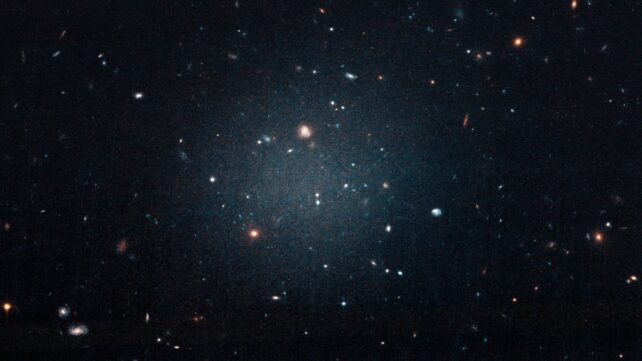
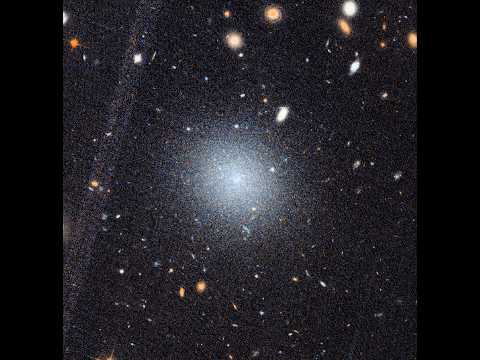
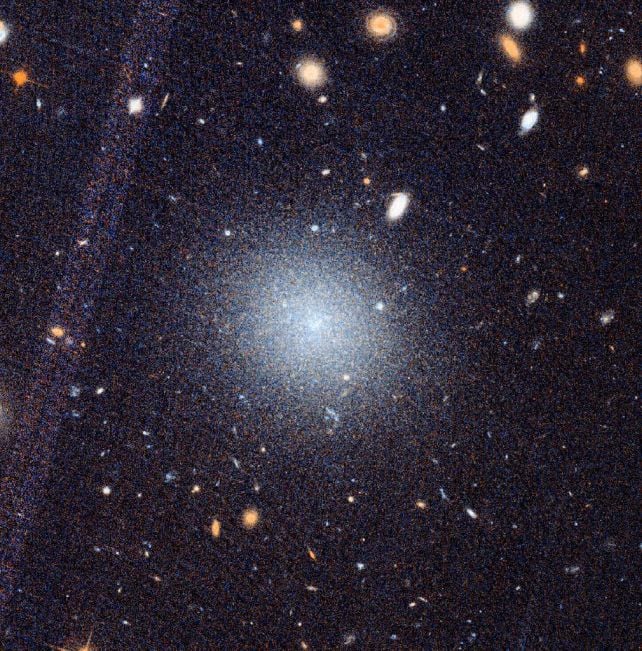
Its name is NGC 1052-DF9, and it's neither the first, nor the second, but the third galaxy yet whose motions can be explained without dark matter.
And the first two galaxies – known as DF2 and DF4 – belong to the same trail of galaxies wherein DF9 resides, lined up close together like diamonds on a chain.
Although we don't yet know how these galaxies ended up without dark matter, astronomers had previously predicted that if this trail had formed in an unusual way, other galaxies along it might also be missing dark matter.
DF9 appears to fit that prediction.
"Almost every galaxy in the universe is dominated by dark matter. But DF2, DF4, and now DF9 appear to be extraordinary exceptions," says astrophysicist Michael Keim of Yale University, who led the research.
"These findings provide some of the clearest evidence yet that these galaxies formed together in a violent event that separated ordinary matter from dark matter."
Dark matter is a mystery inextricably entangled with pretty much every corner of the cosmos.
We don't know what it is, but it seems to play a significant role in shaping the architecture of our Universe.
We know it exists because, once we've accounted for all the normal, or baryonic, matter in the Universe – including stars, planets, galaxies, black holes, dust, and gas – there still isn't enough visible mass to explain the gravity we observe.
Whatever is making that gravity is something we cannot see. The only way it interacts with the baryonic Universe that we can tell is gravitationally. We call this mystery stuff dark matter, and it's everywhere – it outweighs normal matter by about 5 to 1.
Because most galaxies are ensconced within giant concentrations of dark matter known as halos, including our own Milky Way, scientists believe that it plays an important role in galaxy formation.
So, when DF2 turned up in a 2018 paper led by astrophysicist Pieter van Dokkum of Yale University, looking like it had significantly less dark matter than expected, astronomers were stunned.
Then, in 2019, van Dokkum and his team published another surprise.
One galaxy could be an anomaly or a glitch. But there was DF4, sporting the same properties as DF2. And it was in the same little corner of space.
That could be a coincidence, but the surprises kept coming.
In 2022, van Dokkum and colleagues including Keim revealed that DF2 and DF4 were part of a chain of around a dozen galaxies in a tight linear formation.
And, in 2025, the next study led by Keim and van Dokkum revealed that the galaxies in this chain are all moving through space in the same way.
If these galaxies are related, the researchers reasoned, and if two of them behave like they have no dark matter, perhaps more of the objects in the formation would have the same properties.
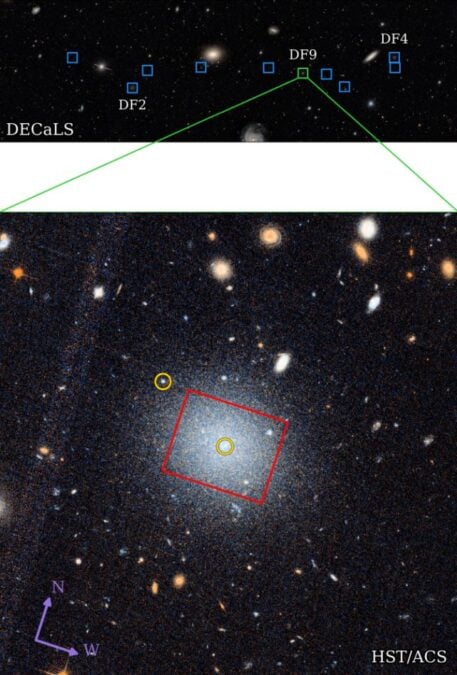
Of the galaxies in the trail, DF9 stood out as the closest match to DF2 and DF4, with a similar size, brightness, and population of star clusters. That made it the ideal target for testing whether other members of the trail might also lack dark matter.
So, they took a closer look – and this is where DF9 showed its hand.
"A line of galaxies lacking dark matter has never been seen before," Keim says.
"The discovery provides some of the strongest evidence yet that these galaxies formed through an extreme and previously unseen process and offers a rare new window into the nature of dark matter itself."
We don't know what that process was, but the researchers believe a type of event called a "bullet dwarf collision" may be the culprit.
Imagine two dwarf galaxies hurtling head-on towards each other in space. When they smack together, the stars mostly pass each other by through the empty spaces.
Dark matter is thought to behave similarly, so the two dark matter halos would also pass through each other.

The stars and dark matter would largely pass through the collision and continue on their way.
However, gas does not behave the same way. Clouds of this material inside each galaxy would smack into each other and come to a halt, getting left behind long after the galaxies are gone.
Related: Dark Matter May Have Finally Been Detected in Our Galaxy's Glow
Now you have a region rich in ordinary matter but relatively poor in dark matter – and, according to the team's simulations, this gas could clump together to form stars, which in turn may then assemble into tiny galaxies devoid of dark matter.
It's a really cool result, and one that may help scientists narrow down what dark matter might be. The researchers will continue studying this strange string of galaxies to look for further clues.
"The finding," van Dokkum says, "provides compelling evidence that dark matter behaves as a physical substance rather than the effect of an alternative theory of gravity, particularly at the dwarf-galaxy scale where those theories are most heavily debated."
The research has been published in The Astrophysical Journal.