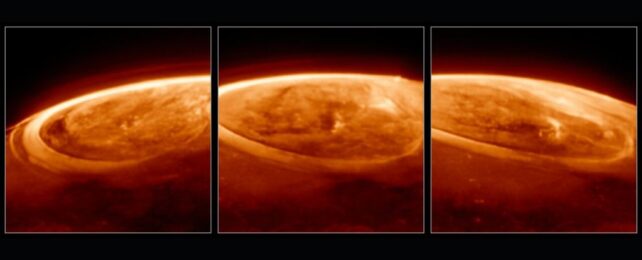
It's only fitting that Jupiter, nicknamed the king of the planets, wears a crown – and what a crown it is.
Although we can't see them with our naked eyes, the giant planet sports the most powerful auroras in the Solar System – permanent shimmering caps at its north and south poles, gleaming in non-visible wavelengths – ultraviolet, infrared, and occasional bursts of X-ray.
In recent years, observations with the most cutting-edge instruments have finally started to reveal the secrets of these giant, invisible auroras, but there's still a lot we have to learn. The world's most powerful space telescope has taken us a little bit further: new observations from JWST, obtained on 25 December 2023, reveal features astronomers have never seen before.
"What a Christmas present it was – it just blew me away!" says astronomer Jonathan Nichols of the University of Leicester in the UK.
"We wanted to see how quickly the auroras change, expecting it to fade in and out ponderously, perhaps over a quarter of an hour or so. Instead we observed the whole auroral region fizzing and popping with light, sometimes varying by the second."

The auroras on Jupiter are generated in a similar way to the auroras on Earth. Charged particles already circulating within the planetary magnetosphere are accelerated to tremendous speeds and whisked along magnetic field lines toward the poles. There, they plunge into the atmosphere, where their interactions with atmospheric particles generate a glow.
For Earth, that activity is predominantly driven by the Sun, which is why we see auroras when the Sun ejects particularly powerful outflows – such as coronal mass ejections or strong solar winds.
That happens on Jupiter, too, but the main source of the Jovian auroras is much closer to home: its volcanic moon Io, which is always spewing forth sulfur dioxide. This gas becomes ionized, forming a huge torus of plasma that constantly supplies charged particles to Jupiter's magnetosphere, where the planet's rapid rotation helps drive its spectacular auroras.
One of the molecules floating around in Jupiter's atmosphere that creates an infrared glow is the trihydrogen cation (H3+), a charged ion made up of three hydrogen atoms.
Trihydrogen ions can be used to study the energy budget of an aurora, so Nichols and his colleagues used the JWST observations to track the behavior of molecules in the Jovian aurora, using simultaneous ultraviolet Hubble observations to contextualize the emission.

"Bizarrely, the brightest light observed by Webb had no real counterpart in Hubble's pictures. This has left us scratching our heads," Nichols says.
"In order to cause the combination of brightness seen by both Webb and Hubble, we need to have an apparently impossible combination of high quantities of very low energy particles hitting the atmosphere – like a tempest of drizzle! We still don't understand how this happens."
It's pretty in keeping with Jupiter, which does a lot of very strange things that we don't understand very well. But with an ever-growing arsenal of powerful telescopes and probes, scientists are, little by little, finding the peculiar pieces of the Jovian puzzle.
This new information, while currently somewhat baffling, is just such a puzzle piece. How it fits into the bigger picture might just need a few more pieces. Future modeling work, for instance, could help explain features of the auroral emission that currently baffle scientists.
Meanwhile, the collection of more observations across a range of wavelengths is ongoing. The good thing is that, since the auroras are always there, there's no waiting for just the right moment. Any observation of Jupiter in the right light is going to capture something of the magnificent radiation thereon.
The findings have been published in Nature Communications.