If we could hear the cosmos, our lives might be filled with endless unease.
We can't, of course. Sound can only propagate through a medium with particles close enough to jostle one another.
But when space observation data is translated into sound, we're given a small taste of a very different, very eerie Universe.
From the deep booming of black holes to the disconcerting twang or whistling chorus of Earth's magnetic field, space could easily be a cacophony of the creeps.
Saturn is among the worst offenders. With its giant system of rings and moons and its extremely orderly magnetic field, the space around Saturn generates activity that squeals and screams in ways that are difficult to forget.
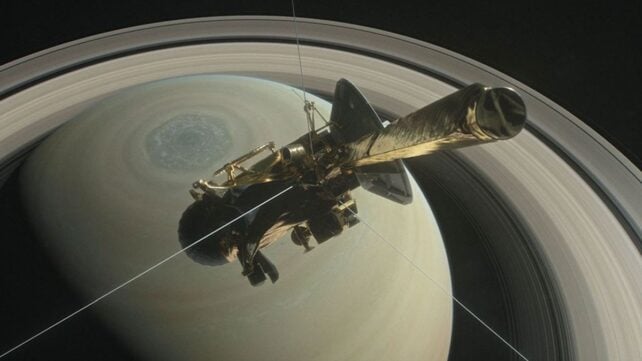
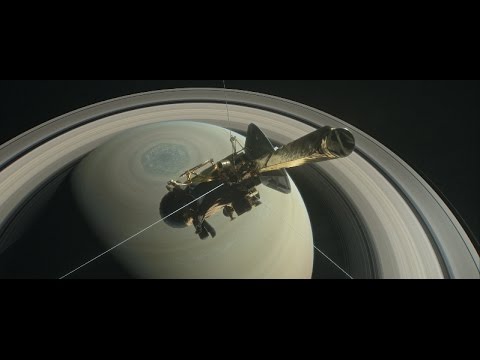
And, just before it plunged to its death in 2017, the Cassini probe orbiting Saturn recorded some truly unnerving behavior.

What you're hearing in the above video is not sound propagating through a medium but plasma waves rippling through the space around Saturn, two weeks before Cassini made its final dive into the planet's wild storms.
It's not just a fun video, either. Two papers published in 2018 in Geophysical Research Letters revealed previously unknown interactions involving Saturn, its rings, and its moon Enceladus.
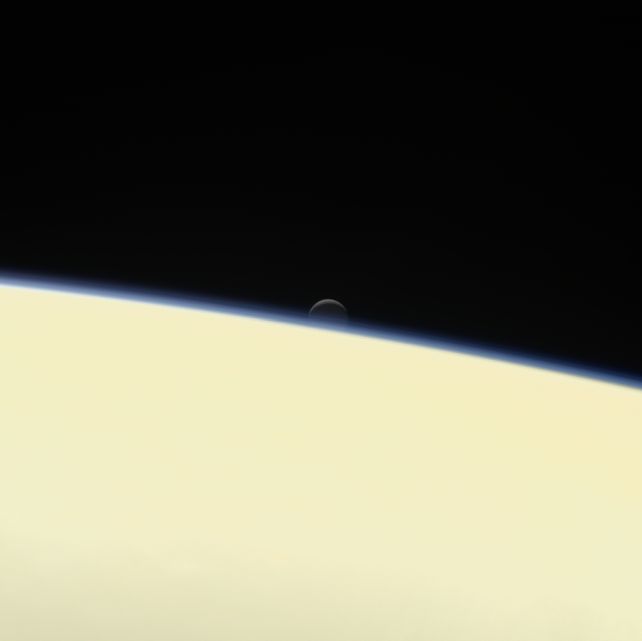
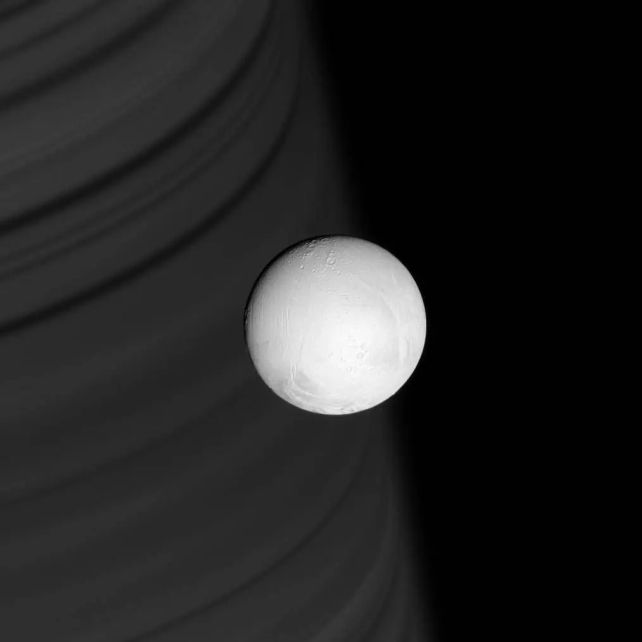
One of the studies showed for the first time that plasma waves travel between Saturn and Enceladus along magnetic field lines connecting the two bodies.
When Cassini drew ever closer to Saturn during the final stages of its Grand Finale mission, it took advantage of its unique proximity to take readings that would not have been possible from a greater distance.
And, on one of its closest dives, two weeks before the final plummet, it used its Radio and Plasma Wave Science (RPWS) instrument to detect plasma waves traveling between Saturn and Enceladus.
"Enceladus is this little generator going around Saturn, and we know it is a continuous source of energy," said planetary scientist Ali Sulaiman of the University of Iowa, and a member of the RPWS team.
"Now we find that Saturn responds by launching signals in the form of plasma waves, through the circuit of magnetic field lines connecting it to Enceladus hundreds of thousands of miles away."
There is no actual sound in space. Sound is a vibration in a medium such as air that, when it reaches and vibrates the eardrum, is perceived as sound. With no air in space, such vibrations can't propagate.
But the signals Cassini detected weren't sound. They were electrostatic plasma waves, which can travel through the vacuum of space.
Because those waves occur in the audio frequency range, scientists were able to convert them into sound for us to hear.
Scientists converted those signals into audio that humans can hear, and sped the recording up from 16 minutes to 28.5 seconds.
The result is, quite literally, unearthly.
A strange, clicking, whistling howl that falls and then rises, a signature more commonly (although not always) associated with auroras, and thus called an auroral hiss.
Previous auroral hiss observations were made during close flybys of Enceladus; however, this is the first observation of this signature close to the planet, rather than its moon.

We already know that the relationship between Saturn and Enceladus is very different from the relationship between Earth and the Moon. We know that geysers on Enceladus shooting water particles into space feed one of the planet's rings.
Related: Listen to The Eerie 'Sounds' From A Black Hole, Captured by NASA
We also know that Saturn's magnetic field encompasses the geologically active Enceladus, but Earth's Moon orbits well outside Earth's magnetosphere for much of each month.
The analysis of the Cassini data shed new light on this close relationship between planet and satellite, while underscoring Saturn's amazing idiosyncrasies – and giving us an excellent new recording to add to our collection of eerie howls from space.
Meanwhile, nearly 10 years after its mission ended, scientists are still finding fresh discoveries in the data obtained by Cassini – eldritch wails and all.
The research was published in Geophysical Research Letters here and here.
This article was fact-checked by Rebecca Dyer and edited by Peter Dockrill. While we pride ourselves on our process, we are only human. If you spot a mistake, please let us know.