
Tsunamis are not exclusive to the ocean: with the right conditions, they can happen in lakes, too.
At Lake Iseo in northern Italy, medieval humans set the scene for two such catastrophic wave events, and researchers are warning that it could easily happen again.
In a paper published in Nature Communications, an international team has brought together data from sediment cores, seismic profiles, a medieval manuscript, archaeological records, and the modern-day lake itself.
This range of sources helped them recreate the unusual medieval disasters via computer models.
Lake Iseo is downstream of the Italian Alps, from which it receives a regular supply of water via snowmelt. The same tectonic activity that helped to form the Alps also brings the occasional earthquake to the region.
Two thousand years of intensifying land use changed the way sediment settled in the delta, making its sides steeper.
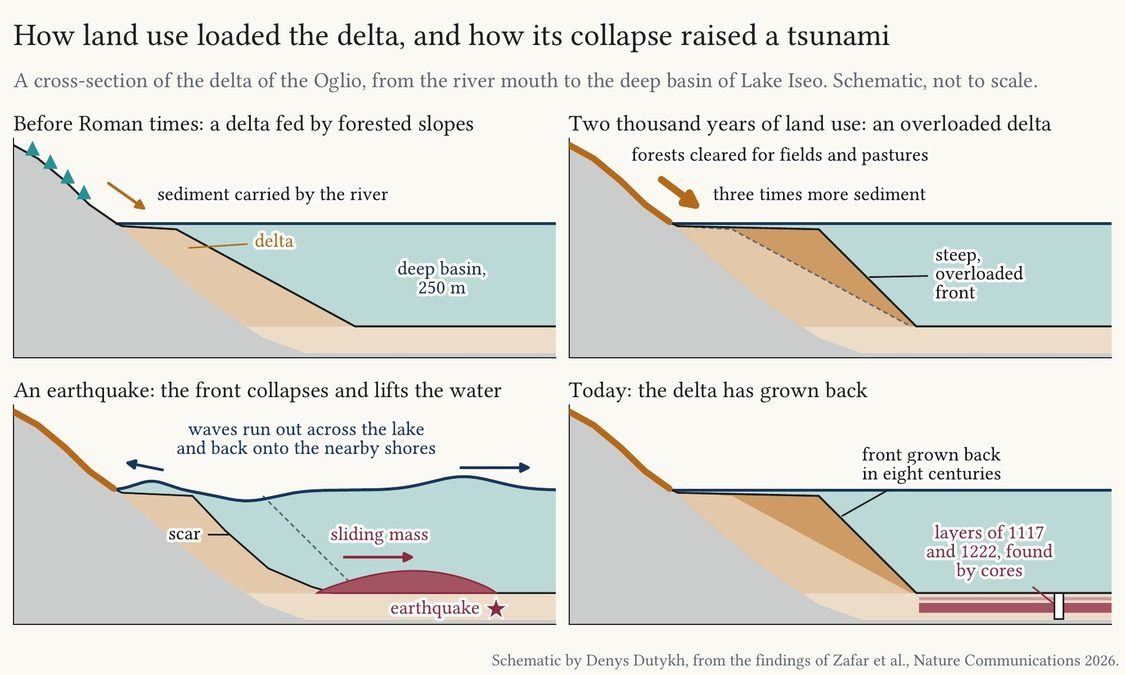
Before the Middle Ages, the Oglio River delta was surrounded by forest. When it rained, loose sediment would flow downhill, but its passage was slowed by the dense networks of tree roots and fungi that held the soil together.
Underwater, the delta's slopes were gentle, gradually tilting towards the lake's deepest point, which is around 250 meters.
But things rapidly changed around the fall of the Roman Empire.
In the centuries that followed, more and more forests that once surrounded the delta were removed for pasture and mining; the human population grew; and three times more sediment was flushed into the lake each year on average.
More and more sediment accumulated at the lake's northern end, creating precariously steep underwater banks just waiting to crash.
And that's exactly what happened, twice.
The natural shape of the delta could handle some seismic activity from time to time without necessarily flooding the surrounding towns.
But when the violent 1117 CE Verona Earthquake shook the lake's steepened banks, they collapsed in an underwater landslide, displacing a massive amount of water that, according to the researchers' modeling, would have flooded large sections of the shores of Lake Iseo without a minute's warning.
"Our simulations reveal that the medieval delta collapses in Lake Iseo generated some of the largest subaquatic landslide-induced tsunamis ever inferred in a lacustrine setting," the study's authors write.
By their calculations, waves in the northern part of the lake would have exceeded 50 meters, inundating nearby shores in less than a minute, with water reaching up to 2.7 kilometers inland.
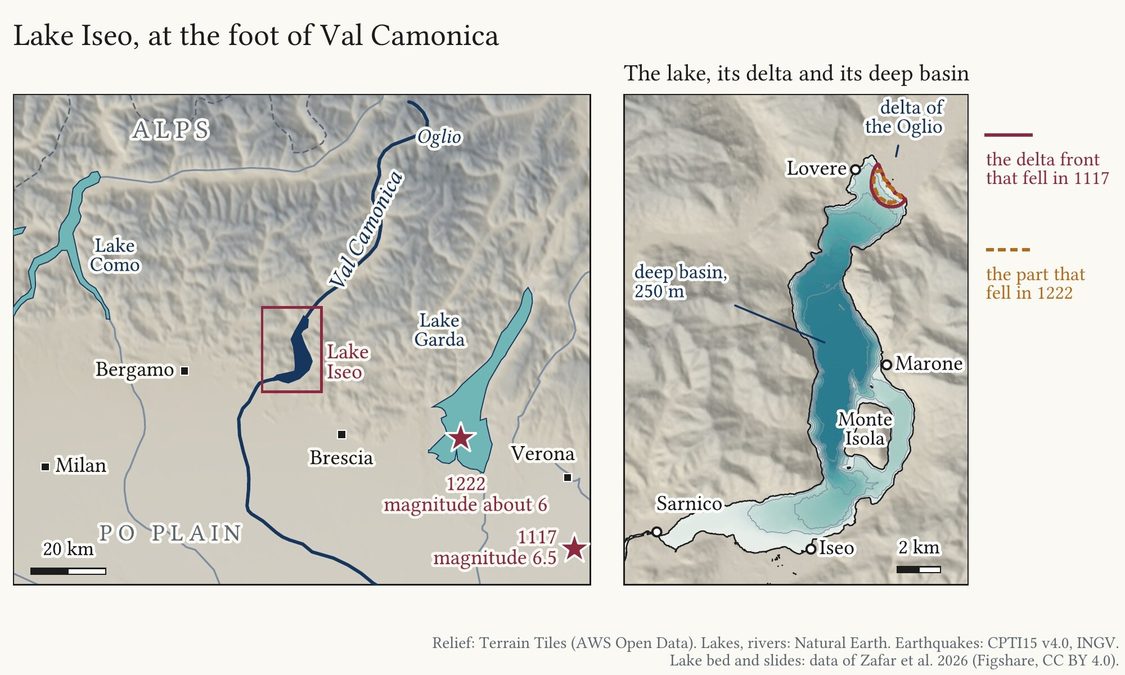
A 12th-century manuscript now held at the Vatican Library describes the catastrophic event in vivid detail that matches the modeling well. The passage is translated to English as follows:
"The lake overflowed so much that very few of the inhabitants of the nearby villages escaped this danger. Many castles and fortresses also collapsed miserably, with the destruction of their inhabitants."
But alas, medieval folks are not especially known for their scientific inquiry – disasters like this were more likely seen as a message from God. They rebuilt, and resumed the practices that had led to the first fatal tsunami.
Just over a century later, a second earthquake hit: the 1222 CE Brescia earthquake.
Another large tsunami ensued in Lake Iseo, with waves peaking at around 13 meters, and water rushing up to 1 kilometer inland.
"Both tsunamis propagated rapidly across Lake Iseo and were strongly influenced by Monte Isola, the central island, which acts as a natural barrier, splitting the waves and partially shielding the cities behind it," the authors explain.
"Despite this protection, areas such as [the town of] Iseo still experienced significant impacts, with maximum wave heights of ~5.5 meters (1117 CE) and ~2 meters (1222 CE), arriving ~7 minutes after the landslides."
Lake Iseo now has the most densely built shores of any lake in the Italian Alps. Meanwhile, more than eight centuries' worth of sediment has built up since the 1222 CE collapse.
"A tsunami comparable in magnitude to the catastrophic events that struck Lake Iseo during the medieval period would cause severe devastation today, given the region's dense population and shoreline development," the authors write.
"A global lake synthesis showed that human-driven erosion has reached its highest levels since the Industrial Era, progressively overloading deltas worldwide; thus, similar catastrophic failures may become more likely in the future."
The research has been published in Nature Communications.
This article was fact-checked by Fiona MacDonald and edited by Fiona MacDonald. While we pride ourselves on our process, we are only human. If you spot a mistake, please let us know.