Cases of myopia, or short-sightedness, are increasing rapidly around the world, and a new study suggests that our modern tendency to spend more time indoors could be a key driving factor.
While we still don't know exactly what is behind the rise in myopia, the work by researchers from the State University of New York (SUNY) College of Optometry suggests that it's not just about screen time.
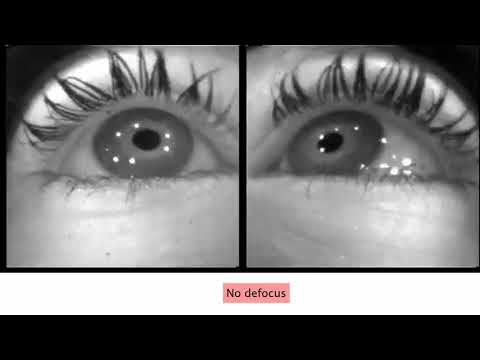
The SUNY team ran lab tests on 34 volunteers, 21 with myopia (myopes) and 13 with normal vision (emmetropes). The participants were given square targets that varied in brightness and contrast, to repeatedly focus on, one eye at a time.
Eye behavior recorded in myopes suggests that activities and tasks that require close-up viewing – so-called near work – could be contributing to short-sightedness, because of the way the pupil constricts to limit how much light enters the eye.
"Myopia has reached near-epidemic levels worldwide, yet we still don't fully understand why," says visual neuroscientist Jose-Manuel Alonso.
"Our findings suggest that a common underlying factor may be how much light reaches the retina during sustained near work – particularly indoors."
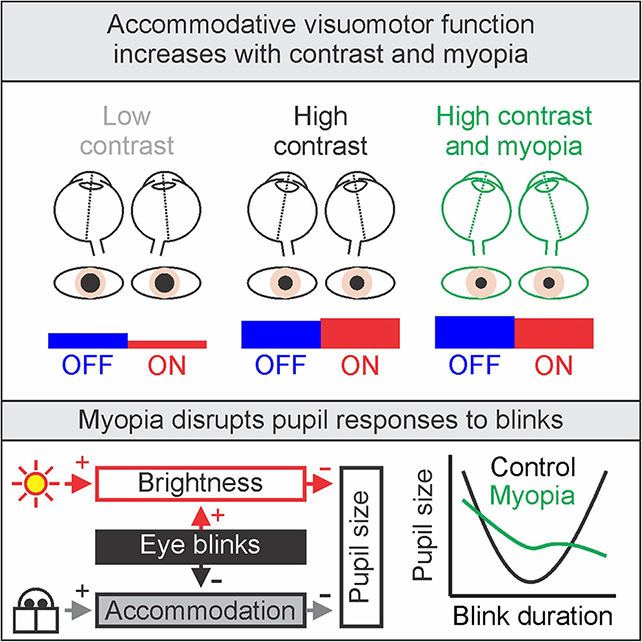
The researchers wanted to look at three behaviours associated with looking at nearby objects: how the eyes focus (accommodation), how they turn inward, and how the pupils constrict. They made adjustments to account for the activation of the ON and OFF pathways in the retina, responsible for processing light and darkness, respectively.
A weaker ON pathway has previously been linked to myopia, but the underlying mechanism hasn't been clear. One of the key findings here was that contrast mattered more than brightness when it came to the eyes turning inwards and the pupils shrinking.
The team also observed that in myopes, the eyes tend to already be turned inwards to a greater degree even before focusing, and that their pupils shrink more than those with normal vision. That combination is likely to then weaken the ON pathway.
These observations were enough to inform a new hypothesis: that in myopia, focus is prioritized over brightness, creating a kind of feedback loop that overcompensates and then worsens the condition.
And indoors, where there's much less light, it's a bigger problem.

"In bright outdoor light, the pupil constricts to protect the eye while still allowing ample light to reach the retina," says optometry doctoral student Urusha Maharjan.
"When people focus on close objects indoors, such as phones, tablets, or books, the pupil can also constrict, not because of brightness, but to sharpen the image. In dim lighting, this combination may significantly reduce retinal illumination."
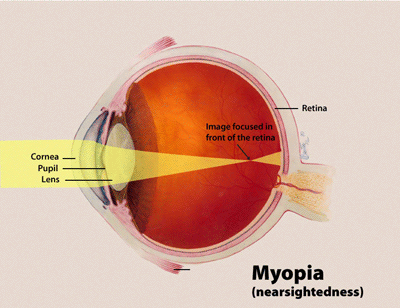
Myopia is challenging to study because it involves numerous factors, including a strong genetic component. It's caused by the eyeball being longer than normal, which means incoming visuals are not focused properly on the retina – the light-sensing tissue that lines the back of the eye.
The argument here is that it's not just blurry vision that triggers or worsens myopia, but also light loss.
That might help explain why corrective lenses that are too strong can be problematic: The SUNY team suggests they reduce light as well as affect focus.
"Our results support the hypothesis that myopia develops in children with poor retinal stimulation," the researchers report.
It's important to note the limitations of this study. It was carried out with a small sample of people, whose eyesight wasn't measured over time, nor was it compared in outdoor versus indoor conditions. The researchers are making some educated guesses based on their findings and on previous research.
However, these educated guesses can now be analyzed in more detail, and could give us much-needed insight into why myopia affects so many of us. Nearly 40 percent of young people are expected to have the condition by 2050.
Related: First-of-Its-Kind Treatment Boosts Vision in Human Trial, Scientists Report
While that worrying rise has often been attributed to children spending more time in front of screens, there might be something else at play: an increasing inclination to stay inside and focus on nearby objects, including phones and laptops.
"This is not a final answer," says Alonso. "It's a hypothesis grounded in measurable physiology that brings together many pieces of existing evidence."
"More research is needed, but it gives us a new way to think about prevention and treatment."
The research has been published in Cell Reports.