
In 2023, in water so deep that sunlight never reaches it, scientists operating a remote vehicle found a mystery at the bottom of the ocean.
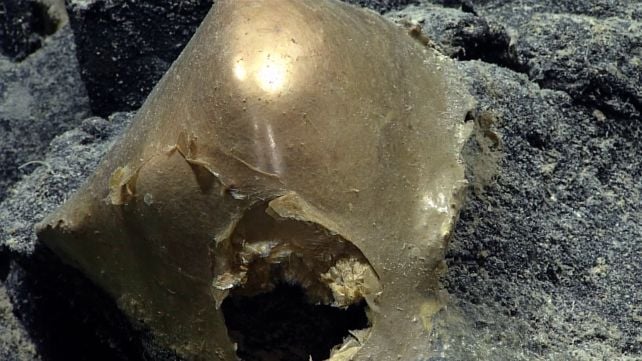
Tightly adhered to a rock was an orb-shaped mass of golden material that shimmered in the bright lights of the ROV Deep Discoverer, appearing to be something no one had ever seen before.
Initial speculation seemed to favor that the mystery object was the abandoned egg case of some deep-dwelling creature. Now, after three years, we finally have answers – and it's not what scientists initially suspected.
But it's still deeply weird: The shining blob of tissue was a chunk of 'skin' left by a glorious sea anemone, possibly discarded when the animal either picked up and moved or tried to reproduce.
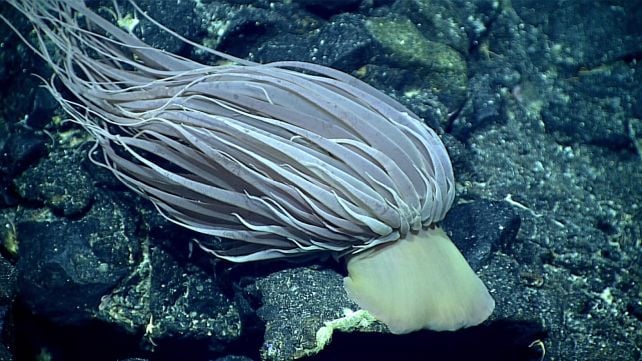
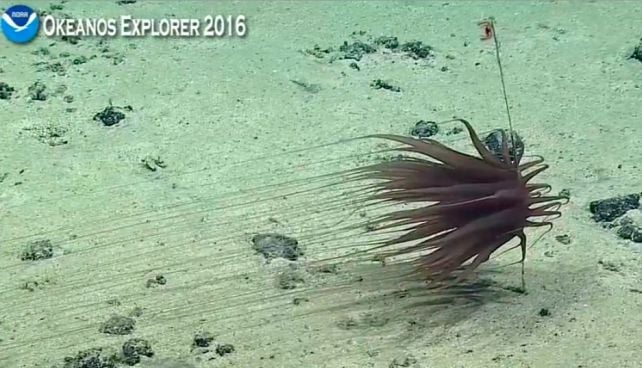
Painstaking work even revealed the species: Relicanthus daphneae, a deep-sea cnidarian with tentacles that can grow more than 2 meters (6.6 feet) long.
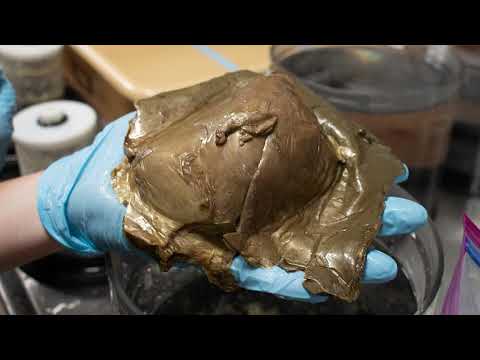
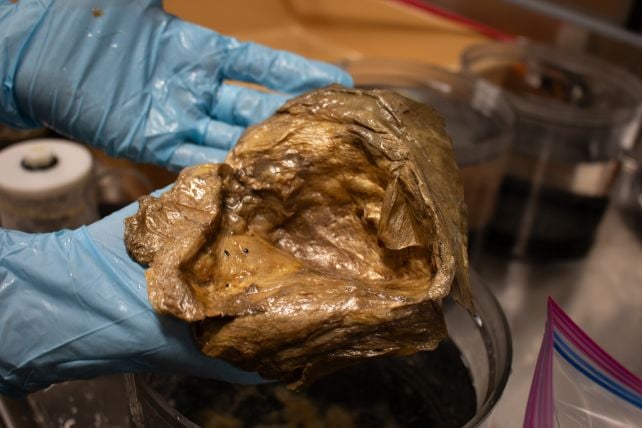
The initial discovery of the blob, measuring around 10 centimeters (4 inches) across with a hole in one side, had scientists simultaneously baffled and delighted. It was found stuck to a rock at the bottom of the Gulf of Alaska, around 3,250 meters (about 2 miles) below the ocean's surface.
At those depths, the ocean is very cold, very dark, and the ambient pressure is crushing – significant barriers to human exploration.
Scientists aboard the NOAA ship Okeanos Explorer came across the mass while observing a live feed as they controlled the remotely operated vehicle Deep Discoverer.
"I don't know what to make of that," said one of the researchers on a livestream of the expedition back in 2023.
"It's definitely got a big old hole in it, so something either tried to get in or tried to get out," another speculated.
"I just hope when we poke it, something doesn't decide to come out," one researcher said. "It's like the beginning of a horror movie."
They carefully collected the specimen using the ROV's robotic arm and took it to a laboratory for testing, expecting it would either turn out to be an egg case or a dead sponge or coral. Here, the mystery deepened.
"We work on hundreds of different samples and I suspected that our routine processes would clarify the mystery," explains zoologist Allen Collins of NOAA Fisheries' National Systematics Laboratory.
"But this turned into a special case that required focused efforts and expertise of several different individuals. This was a complex mystery that required morphological, genetic, deep-sea, and bioinformatics expertise to solve."
The researchers found that the specimen did not have the typical anatomy expected in an animal.
Instead, it was fibrous and packed with stinging cells called cnidocytes that are typically seen in corals and anemones. The specific cnidocytes found in the blob were spirocysts, which are found only in the Hexacorallia class of cnidarians.
However, at this point, the investigation ran into a snag.
Superficial DNA testing was inconclusive because the blob was riddled with other microscopic organisms. It was only by sequencing the whole, deep genome that the researchers landed on a close match – R. daphneae, first described in 2006.

The blob, the researchers explained, is a cuticle left behind by one of these anemones. The cuticle is a thin, multilayered coating secreted by the outer tissues of some anemones, forming flexible, sheet-like structures that can detach and remain on the seafloor.
Its main ingredient appears to be chitin, the tough, fibrous material that makes up hard parts of other organisms, such as beetle cases and fungal cell walls.
"Observations of animals in situ suggest that cuticle is left behind as the animal moves, suggesting that the animal can detach from it," the researchers write.
Collected specimens of R. daphneae rarely have a cuticle; this ability to move on and leave it behind might explain why. The abandoned cuticle might also be a clue to how the animal reproduces – a process that is difficult to understand in creatures living in such an inaccessible habitat.

"Although genetic and morphological data confirm the identification of the taxon in question, explanation of the golden orb morphology remains a vexing issue," the researchers write.
"One possible interpretation is that the orb is a remnant of incomplete asexual reproduction. Some sea anemones are capable of pedal laceration, whereby the base of the polyp is abandoned, and the upper portion of the animal moves away, leaving a stump of the body that then regrows a new polyp."
Whether this is the case for R. daphneae is still unknown, but even if it is an incomplete reproduction, it's still conducive to life in the inhospitable depths.
The sheer volume of microorganisms found on the cuticle suggests it may act as a microscale hotspot of microbial activity, where microbes feed on and break down the decaying tissue, one key part of the nitrogen cycle.
Related: Ancient Blueprint For Human Bodies Discovered in Sea Anemones
So there you have it. An anemone shucked its 'skin', giving a free lunch to the microbes.
"This is why we keep exploring – to unlock the secrets of the deep and better understand how the ocean and its resources can drive economic growth, strengthen our national security, and sustain our planet," acting director of NOAA Ocean Exploration Captain William Mowitt says.
You can read a preprint of the team's findings on bioRxiv.