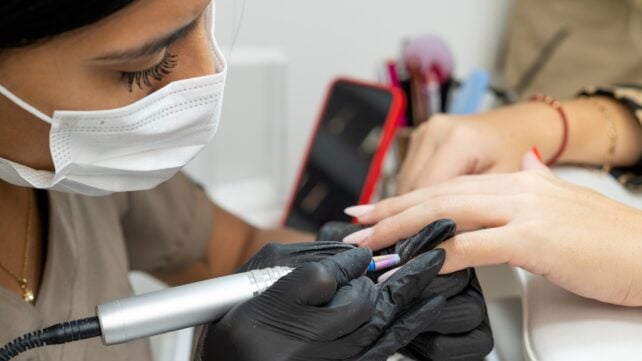
Nail salons aren't exactly known for their mountain-fresh air.
In pursuit of the perfect manicure, people in the United States spend more than $8 billion each year at nail salons.
Nails are filed, polish pared back with acetone, and acrylic dust piled atop glued-on plastic tips, bound with a liquid monomer and fixed with UV.
And that's all before the final coat of color.
When you're getting your nails done, you're only breathing in the fumes from the various chemicals involved for the length of your appointment. But for nail technicians, that exposure is day-in, day-out, for hours on end.
A new study published in the journal Risk Analysis reveals that concentrations of chemicals associated with cancer and other health risks can vary widely throughout the workday at five different New York City nail salons, sometimes reaching levels the lead researcher says are on par with industrial chemical manufacturing facilities.
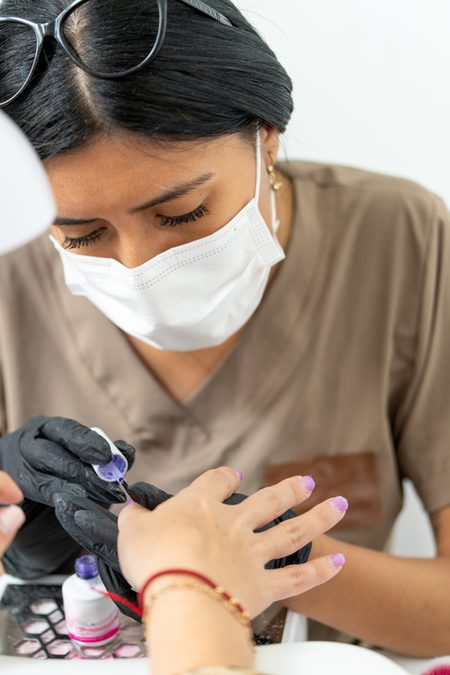
"This research shows that traditional air sampling and risk assessment methods don't tell the whole story for nail salons," says Anthony Ierardi, an occupational and environmental health and safety researcher at CUNY School of Public Health.
"Nail technicians and other salon employees may be exposed to high, intermittent peaks of airborne chemicals throughout the workday, yet the health impacts of those exposures have been underestimated."
That's largely because exposure risks have typically been measured as an average across the whole day. But many of the salons reached peak exposure levels well above the median, which means salon workers may be intermittently exposed to chemicals far beyond the levels that daily averages suggest.
Ierardi and team measured total volatile organic compound concentrations in the five NYC salons between April 2023 and March 2024.
A data-logging photoionization detector recorded measurements every minute during working hours for about a week at each salon.
This granular approach gives a clearer picture of the troughs and spikes in airborne chemicals that salon workers are exposed to.
"What surprised me most was the sheer magnitude of some of the short-term peaks in chemical concentrations," Ierardi told ScienceAlert.
He says the concentrations are comparable to levels that you might see in industrial settings, where chemicals are manufactured or used in large quantities.
"The important difference is that these industrial workplaces are generally subject to more extensive occupational health and safety oversight and are more likely to have access to qualified professionals who routinely monitor chemical exposures and implement protective measures, such as ventilation systems and appropriate personal protective equipment (PPE)," he said.
"Nail salon workers, on the other hand, often lack access to these same resources and protections, despite potentially experiencing similarly high exposures to airborne chemicals."
Typically, there were 15.1 parts per million of total volatile organic compounds in the salon air. But peak exposures, measured in averages across 15-minute periods, were much higher. The median peak was 31.4 parts per million; one salon reached 113 parts per million.
The dominant chemicals detected in the air were ethyl acetate, acetone, n-butyl acetate, and methyl acetate, along with some traces of benzene.
"Although benzene was present at relatively low concentrations compared to other chemicals in the salons we visited, our risk assessment suggested that long-term exposure could pose an elevated cancer risk under certain conditions," Ierardi told ScienceAlert.
"Importantly, however, we calculated estimates of potential risk, which is not evidence that workers are actually developing cancer as a result of these exposures. Future research must examine actual health outcomes among nail salon workers, particularly cancer, to better understand the long-term consequences of these occupational exposures."
Unfortunately, the surgical or cloth masks that many salon workers opt for are ineffective against the chemical fumes.
Evidence shows ventilation is an essential strategy for mitigating the risks to salon workers, but costs, noise, and space can make it difficult for salons to install and operate these systems.
Opening doors and windows, where possible, is another option, along with keeping product containers closed as much as possible, and keeping chemical-soaked materials contained in covered bins after use.
Ierardi says a separate analysis would need to be conducted to understand what exposures and associated risks customers may experience from their more limited time spent in salons.
"However, customers have an important role to play in advocating for nail salon workers' health and safety," he added.
"Some prior research has suggested that nail salon workers may face pressure from customers to avoid wearing certain PPE or may otherwise experience negative reactions when taking steps to protect themselves.
"As customers, we should support workers who use PPE, encourage safer workplace practices, and recognize that protecting worker health should never come at the expense of customer satisfaction."
The research has been published in Risk Analysis.
This article was fact-checked by Fiona MacDonald and edited by Fiona MacDonald. While we pride ourselves on our process, we are only human. If you spot a mistake, please let us know.