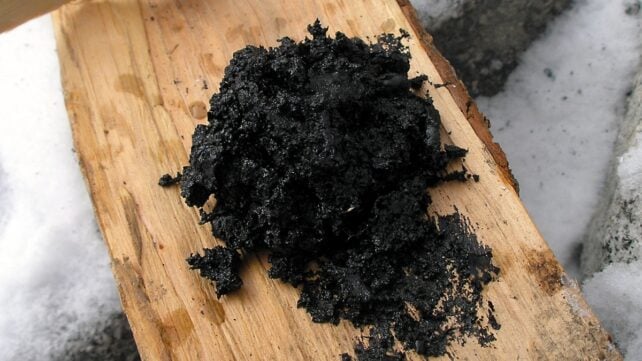
Relatives of modern humans may have created and used a sticky substance both as a glue and to treat their wounds, preempting modern medicine by as much as 200,000 years, a new study suggests.
Researchers have known that Neanderthals used birch tar, a viscous substance derived from birch bark, to glue spear points onto handles in a process known as hafting.
This substance has been found across Europe, and it served multiple purposes, including as some of history's oldest water sealant and Hubba Bubba.
"Alongside these findings, there is also growing evidence of medicinal practices and the use of plants among Neanderthals, which is why we were interested in the use of birch tar in this context," explains Tjaark Siemssen, an archaeologist at the University of Cologne and Oxford University and the study's lead author.
So in the recent study, researchers at the University of Cologne, the University of Oxford, and the University of Liège recreated this birch tar using the ingredients and processes that were possibly utilized by Neanderthals.
Then, researchers at Cape Breton University in Nova Scotia, Canada, performed biological tests to confirm the tar's medicinal properties.
"That is exactly what we proved. The substance Neanderthals made 200,000 years ago, we now know, also possesses antibacterial properties," says Matthias Bierenstiel, a professor of chemistry at Cape Breton University and study co-author.
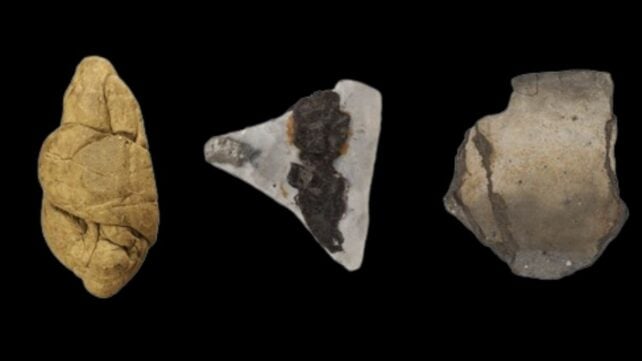
To recreate this deeply historical glue-medicine, the researchers collected bark from two types of (dead) birch trees widely documented during the Late Pleistocene, circa 129,000 to 11,700 years ago.
They then used three tar extraction methods to turn the bark into a gooey, spreadable compound.
The first method involves heating birch bark in a tin. This technique is inspired by the Mi'kmaq nation, the Indigenous people of Nova Scotia, who for generations have used birch tar as a cornerstone of their traditional pharmacy.
The other two techniques recreated what Neanderthals may have done. In one method, the researchers burned birch bark in a sealed underground pit, achieving a dry distillation that occurs in the absence of oxygen.
In the second period-specific method, the researchers burned birch bark next to a hard surface, a stone, and then scraped off the tar that condensed on the stone's surface.

The tar samples obtained through these different methods showed varying but positive antibacterial activity against Staphylococcus aureus, a bacterium associated with wound infections.
Yet perhaps unsurprisingly, the tar was not as effective as the common antibiotic Gentamicin. Additionally, the tar had no effect against the infamous Escherichia coli bacterium, which is commonly found in the lower intestine.
The findings suggest that ancient populations used birch tar to specifically treat wounds or skin conditions at risk of infection.
So how did our ancient relatives discover these secrets? Easily, since scientists say birch tar gets everywhere whenever anyone is trying to do anything with it. Plus, a little tar goes a long way: just 0.2 g can cover 100 cm2 of skin.
Importantly, this ancient knowledge may help fight antibiotic-resistant and hospital-acquired infections, as it's effective against S. aureus. Alarmingly, this pathogen is capable of becoming resistant to every class of currently used antibiotic and causes around 500,000 hospitalizations in the United States every year.
Related: 6,000-Year-Old Chewing Gum Reveals Clues on Neolithic Gender Roles
"Our findings show that it might be worthwhile to examine targeted antibiotics from ethnographic contexts – or, as in this case, from prehistoric contexts – in greater depth," concludes Siemssen.
Like other aspects of history, healthcare may be cyclical, so when new interventions become ineffective, it can be worthwhile to draw inspiration from (incredibly) older options.
This research was published in PLOS One.