The human brain, like the brains of most vertebrates, has a lot of crossed wiring in it.
The left part of our brains controls the right part of our bodies (and vice versa), while sensory inputs from our right side are processed in the left side of the brain (and vice versa).
Many different hypotheses have been put forward as to why this is the case, but the biological and evolutionary reasoning hasn't been satisfactorily settled yet.
Now neuroscientists Martin Wessendorf and Daniel Wang, from the University of Minnesota, have published a study in Frontiers in Neuroanatomy in which they suggest a new explanation for this crossed (or contralateral) wiring.
Wessendorf and Wang take an evolutionary perspective, looking back through hundreds of millions of years for the first evidence of contralateral organization in animals.
"Many studies of lateralization have been published over the past 50 years," write the researchers in their published paper.
"To date, though, there appears to have been no attempt to synthesize these studies into an evolutionary history of contralaterally organized brain circuits."

The researchers didn't carry out any new experiments or uncover any new fossils. Instead, they looked at existing studies on all the major vertebrate groups, from amphibians to mammals, to analyze how crossed pathways overlapped between species.
According to the researchers, the first wire crossing most likely happened in vision, and specifically in jawless fish over 500 million years ago.
The eyes of these fish naturally flipped incoming light, and the signals from each eye crossed over to the opposite side of a part of the brain called the optic tectum (or the superior colliculus in mammals).
Then, as sensory inputs for touch, vibration, and pain began to develop, they essentially followed the lead set by the optic tectum.
By the time mammals came along with their more advanced cerebral cortex, the researchers argue, it made the most sense in terms of evolutionary efficiency to build on top of the existing contralateral arrangement rather than start again and switch all the wiring back again.
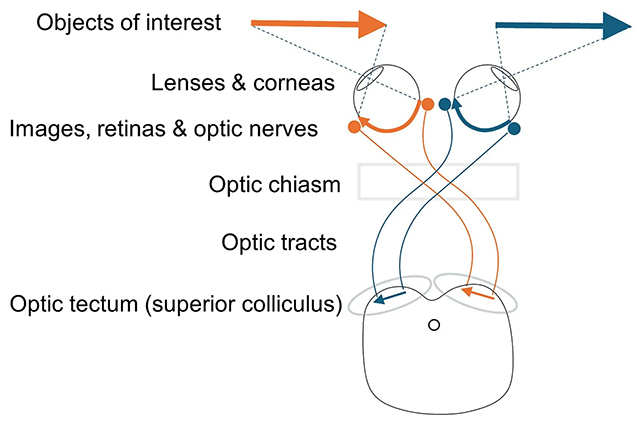
"We propose that the contralateral organization of the optic tectum biased the subsequent evolution of sensory and motor systems toward contralateral organization," write the researchers.
"By the time true mammals appeared about 165 million years ago, their contralaterally organized somatosensory, rubrospinal, and tectospinal systems had already existed for almost 200 million years."
This is usually the path that evolution follows, for expediency – adapting what's already in place rather than inventing something completely new.
Previous explanations have argued that the crossed wiring in our brains came about because it's somehow more efficient, or because the body of an ancient ancestor of all vertebrates got twisted. However, these explanations don't take into account the full evolutionary picture, suggest Wessendorf and Wang.
That's not to say the matter is now settled. Future studies of ancient fossils, looking for further evidence of the theory, should tell us more about its credibility, in particular fossils of those 500-million-year-old fish.
In addition, the theory could be put to the test by analyzing the neural wiring of animals that haven't been fully mapped yet, including crocodiles and birds. The differences and similarities found there would offer more clues about where contralateral organization appeared in evolutionary history.
Now the theory has been documented though – and traced back through millions of years – it can be prodded and probed, and the researchers behind it believe it'll hold up.
"As the neocortex evolved, the most economical way for it to integrate with those pathways was by being contralaterally organized, with the right side of the brain responsible for the left side of the body," write the researchers.
"We predict that in most or all vertebrate brains, the existing contralaterally organized 'wiring design' will be found to be more efficient than any plausible ipsilaterally organized alternatives."
The research has been published in Frontiers in Neuroanatomy.
This article was fact-checked by Peter Dockrill and edited by Peter Dockrill. While we pride ourselves on our process, we are only human. If you spot a mistake, please let us know.