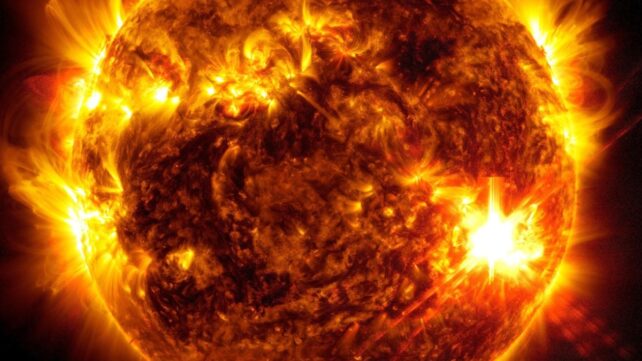
Scientists have just realized that surface measurements of the Sun's radiant activity haven't captured its full story.
Probing deeper than before, astronomers have 'listened' to our closest star's internal rumblings and found sizeable shifts over the past 40 years.
They say their findings suggest the Sun may be entering a "different mode of behavior".
"We have uncovered evidence of systematic changes in the solar activity cycle," explains University of Birmingham astrophysicist Bill Chaplin, the new study's lead author.
"Crucially, magnetic activity is becoming more tightly confined near the surface with each cycle."
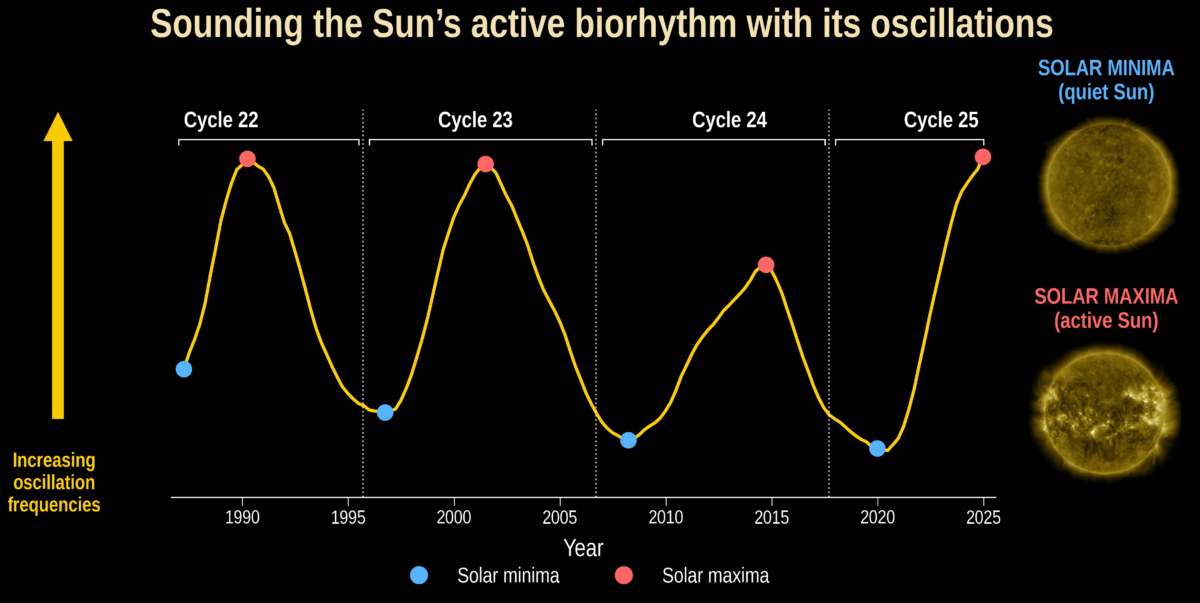
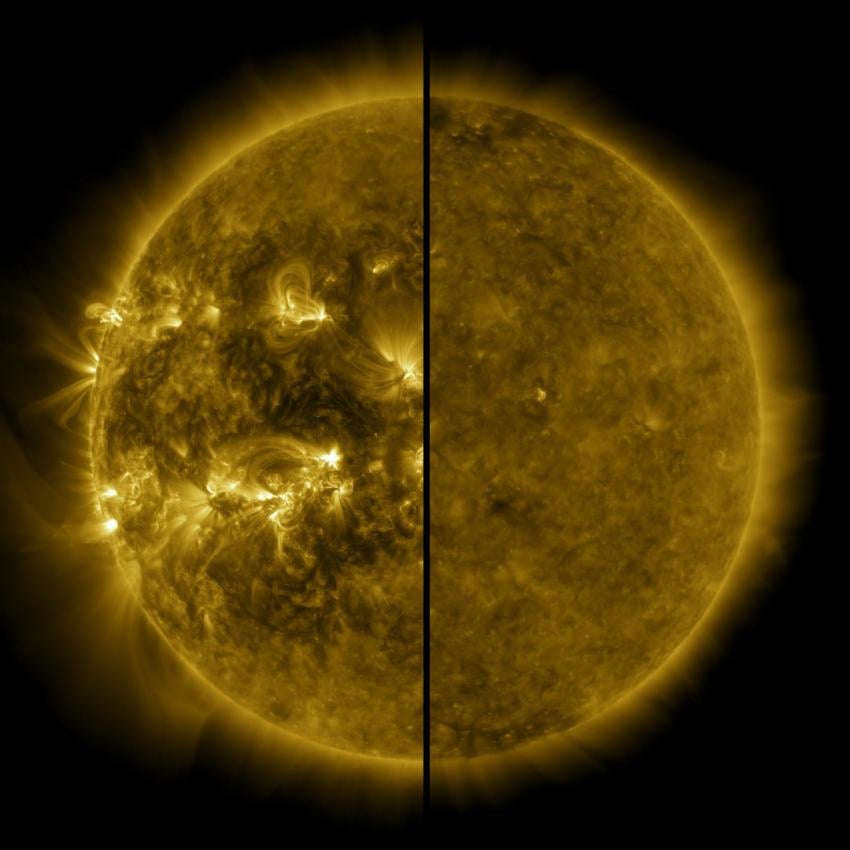
The Sun's activity increases and decreases throughout an 11-year solar cycle. During the solar minimum, our star is relatively quiescent and Earth-friendly.
But during the solar maximum, it's especially tempestuous, and liable to launch violently energetic flares and coronal mass ejections. These outbursts can disrupt satellites, GPS, communications, and power grids.
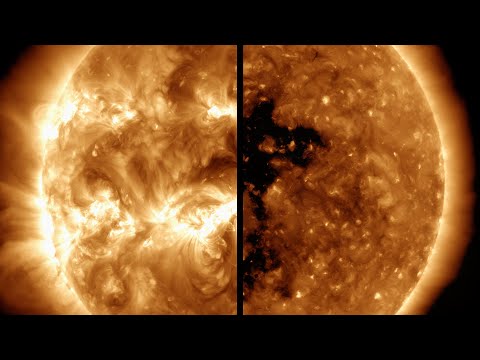
Like a basic bar magnet, the Sun has a magnetic field with two poles, generated by the constant churning of hot, electrically charged plasma that, well, makes up the Sun.
The turbulent stellar interior and the Sun's uneven rotation (it rotates faster at its equator) twist and drag this field in a messy magnetic dance.
Eventually, it causes the north and south magnetic poles to flip, which occurs approximately every 11 years, constituting one solar cycle.
The past few cycles have displayed significant changes in overall activity and the evolution of magnetic fields across the Sun.
The preceding Cycle 24, for example, was significantly weaker in solar activities, including sunspots and radiation emissions at various wavelengths.
The current Cycle 25 was expected to continue this overall trend, but it seems to exhibit some intriguing changes occurring below the solar surface.
To probe our star's interior activity, Chaplin and colleagues assessed nearly four decades' worth of Doppler velocity data from the Birmingham Solar Oscillations Network (BiSON). Going back to 1987, the data captured Cycles 22 through 25.
The BiSON observatory is a network of six spectrometers located around the world to keep a constant watch on the Sun.
It has been operating since 1976, tracking solar activity through a technique called helioseismology, which detects the tiny changes in the Sun's light caused by vibrations within its interior.
The researchers analyzed such vibrations, called "p-mode oscillations," formed as sound waves ripple throughout the Sun, causing it to 'ring' like a massive thermonuclear bell.
To gauge activity at different depths through the Sun's interior, the team analyzed three oscillation frequency ranges: low, mid, and high.
They then compared these data with a couple of commonly used "global activity proxies", which measure activity across the Sun's surface.
These proxies include the number and size of sunspots as well as a measure of the Sun's radio emissions, to compare inner activities with what's happening in the outer atmosphere, including the oft-confusing corona.
A remarkable pattern emerged: The Sun's outer activity appears weaker, as recently expected, but its inner high-frequency oscillations appear stronger, more in line with older Cycles.
As a result, the researchers say that solar-cycle-driven magnetic activity and structural changes in the Sun are becoming more confined to shallow regions, around 1,000 kilometers (621 miles) below the surface.
"This is the first such discovery and would have been impossible without the long BiSON observations," Chaplin adds.
Long-term tracking is essential for teasing out trends and changes in the Sun's activity.

Understanding how magnetic fields affect outbursts, and vice versa, will improve space weather forecasts, helping us better predict the onslaught of charged particles and geomagnetic storms that impact Earth's electrical infrastructure.
This research also draws out associations between the Sun's interior and exterior forces.
"We discovered that the relationship between internal solar oscillations and surface activity has evolved over the past few cycles," says astronomer Sarbani Basu of Yale University.
Related: A Hidden Shift Inside The Sun Could Help Explain Weak Solar Cycles
Further BiSON observations will show this relationship plays out as Cycle 25 ends and Cycle 26 officially begins, around 2030.
Will it prove a sustained trend, or will it change again unexpectedly?
Either way, it portends a significant shift in the Sun's interior:
"This trend cannot be explained simply by weaker magnetic fields. Instead, it indicates a structural reorganization of how the Sun's magnetic activity is stored beneath the surface," Basu concludes.
This research was published in the Monthly Notices of the Royal Astronomical Society.