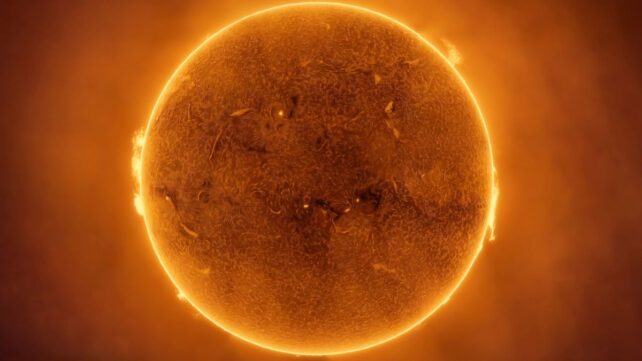
The Sun's periods of rowdy activity may get all the glory, but even in its quieter times, our home star can subtly reshape its interior.
According to a new analysis of decades' worth of data, the lulls in the Sun's 11-year activity cycle aren't identical – and measurable shifts in its internal vibrations occurred during the deepest solar minimum in recent history.
"For the first time, we've been able to clearly quantify how the Sun's internal structure shifts from one cycle minimum to the next," says astronomer Bill Chaplin of the University of Birmingham in the UK.
"The Sun's outer layers subtly change across activity cycles, and we found that deep quiet minima can leave a measurable internal fingerprint."
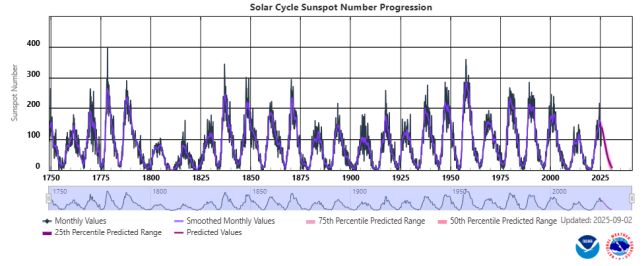
Our Sun isn't a static, unchanging nuclear furnace in the sky. One of the clearest manifestations of its dynamic nature is the solar cycle, which is linked to a reversal of its magnetic poles. Every 11 years or so, the Sun surges to an activity peak called a solar maximum before subsiding back to a solar minimum.

Activity ramps up toward solar maximum, bringing more sunspots, flares, and coronal mass ejections. Around this time, the Sun's magnetic poles reverse. No two solar cycles are exactly alike, with some maxima stronger than others. Minima, however, all seem pretty similar to each other, at least on the surface.
But what about beneath the surface?
Using the Birmingham Solar-Oscillations Network (BiSON) – a network of six telescopes around the world – a team led by astrophysicist Sarbani Basu of Yale University took a closer look at four successive solar minima, spanning the transitions between cycles 21 and 25 (we're currently in solar cycle 25).
The team examined acoustic oscillations inside the Sun – trapped sound waves that bounce through the solar plasma, making the Sun's surface light flicker ever so slightly.
Just as seismic waves traveling through Earth reveal details about its interior, sound waves inside the Sun can expose what's happening beneath its surface. This analysis technique is known as helioseismology.

The researchers were looking at two main signals. The first is known as the helium glitch. There's a layer just below the visible surface of the Sun where helium becomes ionized through the loss of electrons, a change in its energy state that leaves a distinctive "fingerprint" in the oscillation data.
The second is the speed of sound inside the Sun. Sound travels at different speeds through a medium depending on its properties, such as temperature and pressure. If the Sun's interior structure changes even slightly, the speed of sound changes, and that shifts the vibration frequencies.
The team also compared these measurements against models of solar behavior based on slightly different internal conditions.
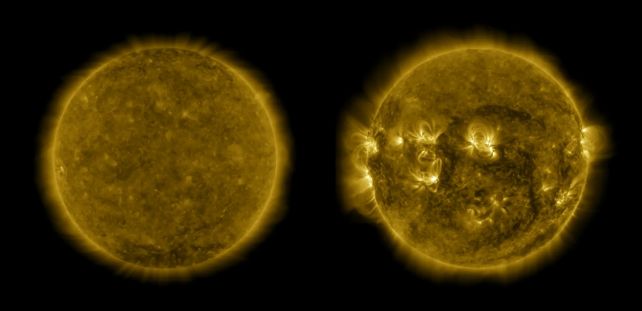
The four minima took place in 1985, between cycles 21 and 22; in 1996, between cycles 22 and 23; in 2008 to 2009, between cycles 23 and 24; and in 2018 to 2019, between cycles 24 and 25.
Importantly, the 2008 to 2009 minimum was one of the longest and quietest since record-keeping began – and it showed the clearest internal shifts of the four. The helium glitch signal was stronger than the other three minima, and the speed of sound was faster in the Sun's outer layers.
This suggests that gas pressure was higher, temperatures were slightly hotter, and magnetic fields were weaker in certain regions of the Sun during this minimum.
"Revealing how the Sun behaves beneath its surface during these quiet periods is significant because this behavior has a strong bearing on how the activity levels build up in the cycles that follow," Basu notes – and, indeed, solar cycle 24 was unusually quiet, with one of the weakest maxima ever recorded.
Forecasting solar behavior is notoriously difficult, in part because the engine that drives it lies hidden beneath the surface. It's a roiling, rotating, magnetized ball of plasma, where even tiny internal shifts can ripple outward into large differences in activity.
Related: The Sun's Activity Can Trigger Earthquakes, And Now We Know How
This new paper shows that even solar activity that looks similar on the surface can arise from subtly different internal conditions. That suggests a layer of variability that solar models may need to account for more carefully.
"Our work demonstrates the power of long-term stellar seismic observations," Chaplin says.
"With upcoming missions such as the European Space Agency's PLATO, the techniques used in this study could be applied to other Sun-like stars, helping us to better understand how their activity changes and how they influence their local environments, including any planets they may host."
The research has been published in the Monthly Notices of the Royal Astronomical Society.