
A new study gives us an idea of how much extra working time you may expect to squeeze into each day if your mental capabilities are firing on all cylinders – and it's more than you might think.
The team behind the study, from the University of Toronto Scarborough in Canada, says that top-tier mental acuity can help you complete the equivalent of 40 extra minutes of work within a regular day.
It helps to explain why some days we're crushing our to do lists, and other days… not so much.
To reach their conclusions, the researchers tracked 184 students over the course of 12 weeks, using cognitive tasks to measure their mental sharpness each day. Participants later reported whether or not they achieved the goals they'd set for that day.
Importantly, these participants weren't compared against each other. Instead, the variations in task completion were analyzed for each individual across the study period, showing that these fluctuations in mental sharpness affect most of us, irrespective of personality type or schedule.
"Some days everything just clicks, and on other days it feels like you're pushing through fog," says University of Toronto Scarborough psychologist Cendri Hutcherson. "What we wanted to understand was why that happens, and how much those mental ups and downs actually matter."
That 40-minute boost applied across all tasks, whether it was filing an essay or cooking dinner – this wasn't a study purely about academic tasks.
A 'bad' day could reduce participants' productivity by the same amount, meaning there could be up to 80 minutes' difference between your best and worst days of work.
What's more, there were several additional findings from the data worth digging into.
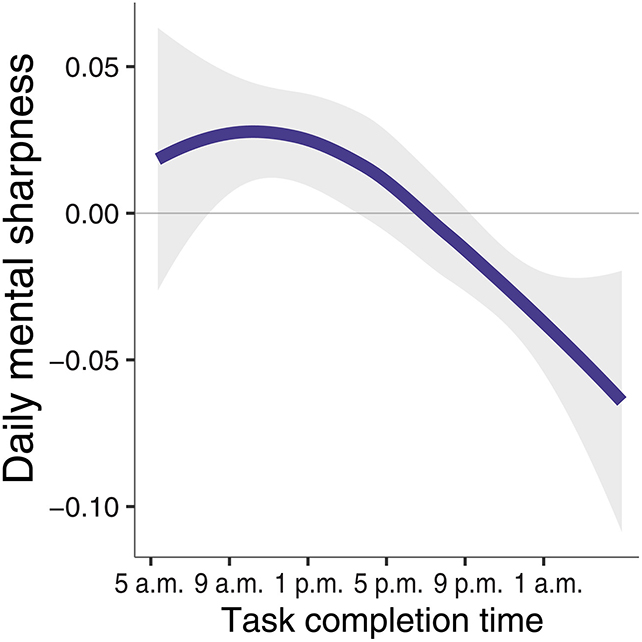
Increased mental sharpness meant goals were more likely to be achieved, as you might expect, and also led to people setting more challenging goals for themselves. On days of mental sluggishness, even routine jobs could prove difficult.
While personality traits such as self-control and conscientiousness still had an effect on how people performed tasks on average, these characteristics didn't protect against variations in mental sharpness from day to day.
"Everybody has good days and bad days," says Hutcherson. "What we're capturing is what separates those good days from the bad ones."
Technically speaking, what the researchers were studying here was the intention-behavior gap, the space that can exist between what we want to get done and what we actually get done – a gap which can clearly widen or shrink depending on multiple factors.

This study shows that mental sharpness is one of those factors, although the researchers stop short of claiming direct cause and effect. There may well be other mediators at play here, including health conditions and stress.
It all adds some scientific background to that feeling that's going to be familiar to most of us: having some days where we're absolutely on top of everything we need to get done, and having others where we can't make much headway at all.
Future studies along similar lines could look at a broader demographic, as well as monitoring more precisely mental performance and task completion. Studies that take a more experimental approach could examine whether methods to boost cognitive performance actually make a difference to how much work gets done, for example.
The researchers also looked at the different ways that mental sharpness could be influenced. They included sleep quality the night before, for example, plus levels of distraction and feelings of motivation, which could fluctuate between days. To some extent, we can control how 'switched on' we are each day.
Related: 5 Easy Tips to Have a Great Day at Work, From a Workplace Psychologist
"From our data, there are three things you could do to try to maximize mental sharpness: getting enough sleep, avoiding burnout over long periods of time, and finding ways to reduce depressive traps," says Hutcherson.
"Sometimes it's just not your day, and that's okay. Maybe that's the day where you give yourself a little slack."
The research has been published in Science Advances.