Many childhood experiences affect us long into adult life, and that has a significant effect on health – it's estimated that more than half of us have some kind of adverse event happen to us as kids, that then leads to mental or physical problems later on.
But while we know this happens, and the scale of the problem, in order to do something about it we need a better understanding of the biological mechanisms involved.
In a new study published in Neuron, researchers from across the US took a closer look at the Ventral Tegmental Area, or VTA, in mice, a brain region that manages the chemical dopamine – and, through that, our reactions to reward, motivation, and stress.
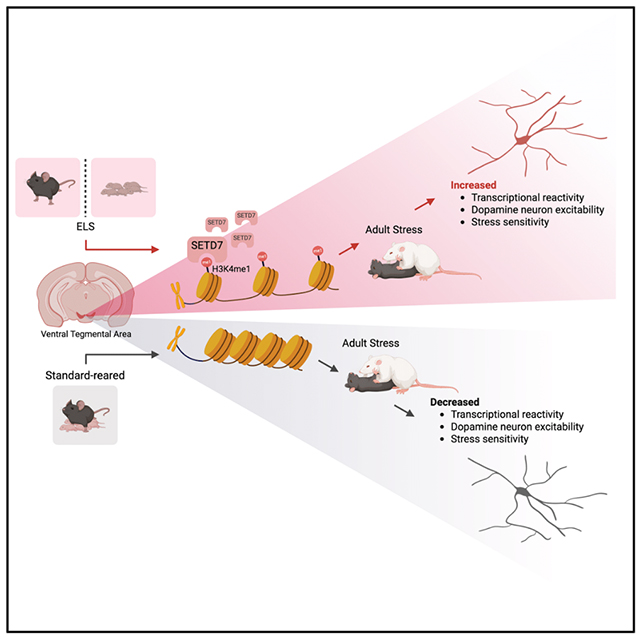
The team found that when stresses hit the mice at a young age, the coiled DNA inside VTA neurons is marked to loosen slightly, making its gene dials more accessible.
The researchers compare the DNA to a childhood slinky toy.
When further stressful experiences arrive later in life, VTA neurons and their genes – in this more uncoiled state – are then primed to react in a stronger way to these experiences, leading to a dopamine imbalance and problems such as anxiety.
"We have uncovered a new biological process linking experience of early-life adversity to this long-term vulnerability to mental illness," says anesthesiologist Meaghan Creed, from WashU Medicine in St. Louis.

"This finding reveals a physical scar left by trauma experienced during development inside brain cells, providing scientists with a concrete biological target to develop new treatments and interventions."
The researchers found that stress on the mice increased the abundance of an enzyme called SETD7.
More SETD7 led to more chemical tags designated as H3K4me1 – chemical tags that label DNA as ready for uncoiling inside the VTA neurons.
What that essentially does is make it easier for genes in these dopamine-producing cells to be turned on in the future.
To further test the idea, the researchers artificially boosted SETD7 in stress-free mice, and blocked it in others put through stressful experiences.
As expected, more SETD7 meant a lower tolerance of stress as adult animals, and more anxious behavior, while less SETD7 caused stressed mice to be more resilient than the control group.
"There are currently no treatments for what early-life stress does to the brain, partially because we have not had a clear picture of what molecular mechanisms to target," says neuroscientist Catherine Jensen Peña, from the Princeton Neuroscience Institute.
"This work is exciting because it reveals a clear mechanism, and also helps explain why the impact of stress is both latent and broad."

These findings still need to be confirmed in people, but given what we know about the biological similarities between mice and humans, and the existing evidence around childhood adversity, it's likely that something similar is going on.
Now we know about these stress-related chemical bookmarks that get left behind in VTA brain cells, work can get started on looking at ways to try and target them and protect against these vulnerabilities – though it's going to take a while to develop treatments.
Related: Stressed? Your Body Thinks You're Fighting Lions Every Day, Say Anthropologists
Something else the researchers want to explore going forward is whether positive experiences such as early access to socialization and nutrition can have beneficial effects on the same group of neurons.
That's another area that animal studies have already looked into, and could help inform ways of helping build protection against stress through entire lifetimes.
"If we can step in with supportive care, therapy or social resources to buffer children during those sensitive windows of development, we may be able to protect the epigenome – preventing the genetic slinky from locking into an open position and perhaps giving the developing brain a chance to build natural resilience," says Peña.
The research has been published in Neuron.
This article was fact-checked by Fiona MacDonald and edited by Fiona MacDonald. While we pride ourselves on our process, we are only human. If you spot a mistake, please let us know.