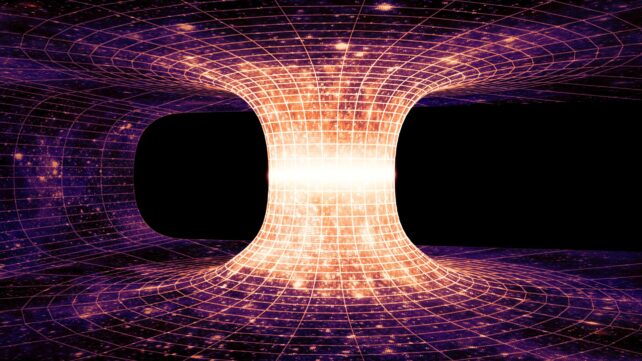
Beyond a black hole's event horizon, information as we know it meets a mysterious fate.
There, in one of the most extreme environments in the Universe, quantum information is thought to become scrambled almost beyond recognition, dispersed into a bewildering tangle of quantum interactions.
Connect two such monsters to each other via an umbilical wormhole, however, and something incredible becomes possible.
Under just the right conditions, information swallowed by one black hole could emerge from the other.
This idea is still very much ensconced in the realm of theory – but it has inspired a particular approach to quantum teleportation that, researchers have now discovered, doesn't actually require one of quantum computing's more powerful resources to work remarkably well.
That resource is quantum magic – and by showing that a black hole-inspired teleportation protocol can achieve high fidelity without it, physicists Sudhanva Joshi and Sunil Kumar Mishra of the Indian Institute of Technology (Banaras Hindu University) have opened a new window into understanding this very peculiar, but very real phenomenon.
Quantum teleportation doesn't work quite like the teleportation of science fiction.

No physical matter is moved, nor is the process instantaneous. Instead, the quantum state of one particle is transferred to another, using a connection between them known as quantum entanglement, as well as classical communication.
Entanglement is one of the strangest consequences of quantum mechanics – where the properties of two objects become so deeply correlated that they can no longer be fully described independently. This link cannot be explained using classical physics.
The process doesn't allow information to travel faster than light, and the original quantum state is destroyed in the process. But still, the result is almost magical: a quantum state can be reconstructed across large distances, and no one has to go anywhere.
In quantum mechanics, though, "magic" has another, more precise meaning.
In quantum computing, magic is a property that allows certain quantum operations to go beyond what can be efficiently simulated by an ordinary computer.
Think of it like freight. A truck and a plane can both transport cargo between two cities, and for some journeys, either will do the job.
But a plane has capabilities that a truck cannot efficiently reproduce, such as crossing an ocean in a matter of hours.
Quantum magic is a little like that additional capability. It allows quantum computers to perform certain calculations that ordinary computers cannot efficiently replicate – but not every quantum task requires it.
Now we need to go back to the black holes.
These ultradense objects are thought to be the fastest scramblers of quantum information in the Universe. What falls in becomes so hopelessly tangled up with everything else that's in there that recovering the original information would be extraordinarily difficult – even setting aside the small problem of the event horizon.
But according to quantum mechanics, the Universe can't just destroy quantum information. It's one of the rules. And, at least in theory, if two black holes are connected in just the right way, information that gets scrambled by one can be retrieved by the other.
Physicists have developed quantum teleportation protocols inspired by this theory, using quantum circuits to mimic the scrambling process rather than actual black holes (can you imagine, though).
And this raises an intriguing question. How much quantum computational power does that scrambling really need?
That's what Joshi and Mishra set out to investigate.
To find out, the researchers mathematically investigated two different ways to scramble quantum information in a black hole-inspired teleportation protocol.
One involved a class of quantum operations known as Clifford circuits. These can generate entanglement and manipulate quantum information, but they don't require quantum magic, and their behavior can be efficiently simulated by an ordinary computer.
The other involved more general, randomly selected quantum operations, known as Haar-random scramblers, which typically possess substantial quantum magic.
The researchers crunched the numbers for both approaches, then compared how faithfully each could teleport quantum information – basically, how closely the recovered quantum state matched the original information.
And the results contained a big surprise.
On average, both approaches achieved exactly the same teleportation fidelity, even though one used quantum magic and the other didn't.
But an average is only part of the story of a dataset.
Say you have two sets of five numbers, and the average of both sets is 10. For one set, every one of the five numbers is exactly 10. The five numbers in the other set are -1,000, 0.5, 4, 45.5, and 1,000 – add them together and divide by five, and you still wind up with 10.
Something similar emerged with the two teleportation protocols. Although the average scores were the same, the Haar approach was dramatically more consistent than the Clifford approach.
In one numerical comparison involving eight quantum bits, or qubits, the variance in teleportation fidelity in the Clifford approach was around 40,000 times greater – far more spread out around its average performance.
This suggests that although quantum magic isn't necessary to achieve excellent average teleportation fidelity in this model, the choice of scrambling operations can make a rather significant difference to how consistently that fidelity is achieved.
But there was another interesting result.
The researchers also found that, as the modeled quantum systems grew larger, the Clifford approach became increasingly successful, with its teleportation fidelity approaching perfection – despite the scrambling operations generating no quantum magic at all.
Its results also became more consistent as the systems grew larger, although the Haar approach remained substantially more reliable.
The researchers also found that adding quantum magic wasn't enough on its own to improve the teleportation results. The way the scrambled information was decoded was crucial – the decoding process had to be matched to the way the information was scrambled in the first place.
Now, this doesn't mean physicists have figured out how to teleport information through actual black holes. The study is theoretical, based on mathematical models of quantum systems under idealized conditions, the kind of foundational work that could guide future attempts to reproduce and test the protocols on real quantum hardware.
Whether the findings hold in more realistic scenarios remains to be seen. But the results suggest that the ability to scramble and recover quantum information isn't necessarily dependent on the computational sophistication of the scrambling process.
That could help physicists better understand not just the wild behavior of quantum information, but a small – very small – part of what it might take to recover information from some of the most mysterious objects in the Universe.
The research, which is yet to be peer-reviewed, is available on preprint server arXiv.
This article was fact-checked by Fiona MacDonald and edited by Fiona MacDonald. While we pride ourselves on our process, we are only human. If you spot a mistake, please let us know.