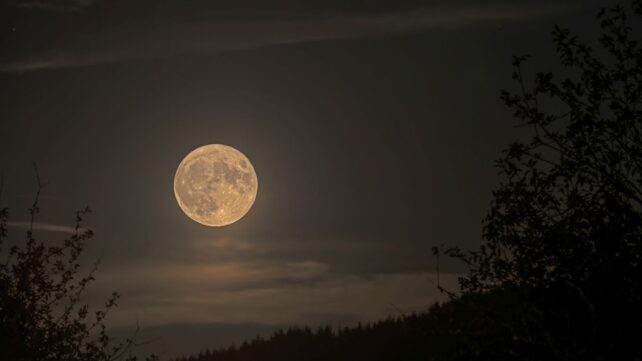
Who needs trainspotting when there are so many different moods of the full Moon to see?
And the full Moon that will grace Earth's skies on May 30 and 31 is one you will not want to miss.
It's referred to as a blue micromoon, and it results from a rare concatenation of circumstances that won't recur until 2053, depending on how you define a micromoon.
Not only is it a blue Moon – the rare appearance of a second full Moon in a calendar month, which occurs once every few years or so – it's also going to be near apogee, the farthest point in the Moon's slightly elliptical orbit with Earth.
The Flower Moon is the Farmer's Almanac name given to the full Moon that shines in May. These designations don't usually apply to a blue Moon, but there's no reason you can't secretly attribute it some Flower Moon vibes.
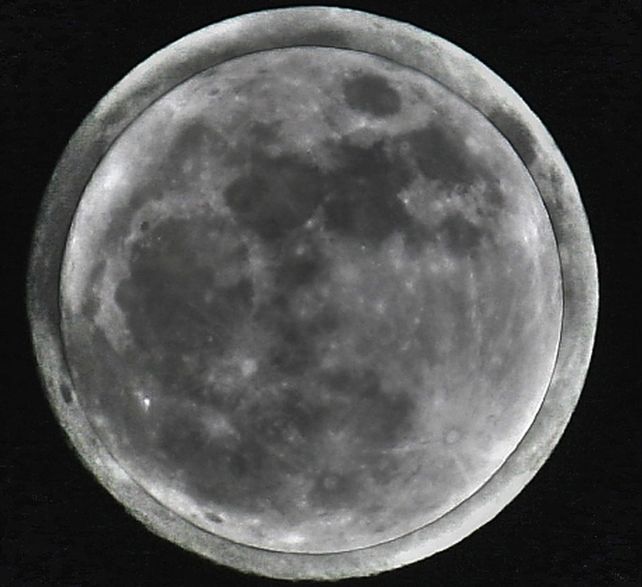
At a distance of 406,135 kilometers (252,360 miles), this moon will be the most distant full micromoon of the three taking place in 2026 – which means it will be the smallest full Moon we see this year, or indeed until 2028.
The next blue micromoon won't be seen until at least July 2053.
Micromoons and their more attention-hogging counterparts, supermoons, are a natural aspect of the slightly oval shape of the Moon's orbit. Because it's not a perfect circle, there's a point in each orbit at which it is closest to Earth, known as perigee, and a point at which it is farthest, known as apogee.
The Moon's average distance from Earth is about 384,400 kilometers, but perigee and apogee distances vary because the Moon's orbital path wobbles about a bit, mostly as a result of gravitational tugging from the Sun and the long-term changing relationship between Earth and Moon.
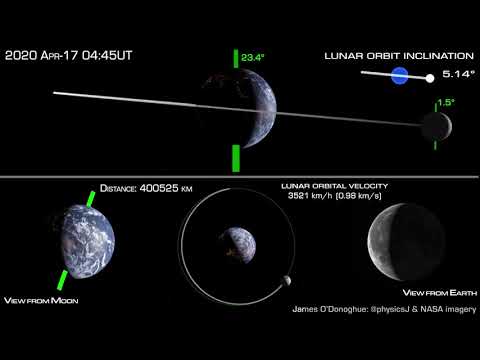
In addition, the lunar orbit precesses – the oval doesn't follow the exact same path every time. This means the timing of the perigees and apogees is slightly out of sync with the lunar cycle, so we only see two or three full micromoons and three or four full supermoons a year.
Just to make it even trickier, there is no official definition for a supermoon or a micromoon, and whether or not we get a full one depends on whose metrics you apply.
Time and Date sets a strict micromoon cutoff at 405,000 kilometers from Earth's center, but astrophysicist and eclipse specialist Fred Espenak of Astropixels defines it as "within 90 percent of its greatest distance to Earth in a given orbit" – a more forgiving definition that accounts for changing apogee and perigee distances.
A blue Moon is much more standardized.
It's not a Moon that literally appears to be the color blue, but a phenomenon that occurs because the lunar month, also known as the synodic month, and the calendar month are slightly out of sync. A synodic month is 29.53 days. A calendar month is usually 30 or 31 days.
This means that the full Moon's position in the calendar month shifts slightly from each month to the next – and, once every two or three years, it falls early enough in the month that the next full Moon is at the end of the same month.

Technically, a full Moon is what is known as a syzygy, a fun Scrabble word that refers to the straight-line alignment of three or more astronomical bodies – in this case, Earth, the Moon, and the Sun.
Because of this alignment, the full Moon will be on the opposite side of the sky from the Sun, so you can look for the blue Flower micromoon at the eastern horizon opposite sunset, wherever you are in the world.
Related: The Moon's Mysterious Origins Still Stump Astronomers
Looking at the Moon is something fun you can do, for free. You can even make a game of it. This time, you get to tick off the double whammy of a blue micromoon.
That's as good as a shiny Pokémon any day.