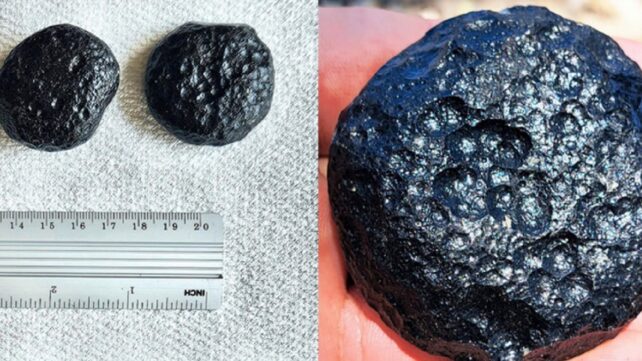
Hundreds of glass fragments found in Brazil are traces of an ancient impact that scattered them millions of years ago, scientists have found.
These blobs of material represent spray from melted rock that was liquefied in the impact, then rapidly cooled and hardened to form pebble-like glass objects, some the size of a pea and others as large as a golf ball, known as tektites.
The resulting tektite strewn field is one of only a handful discovered to date.
"I was very surprised!" geologist Álvaro Penteado Crósta of the University of Campinas in Brazil told ScienceAlert. "Tektites are a very rare material on Earth."
And, fascinatingly, scientists have yet to identify an accompanying impact crater.
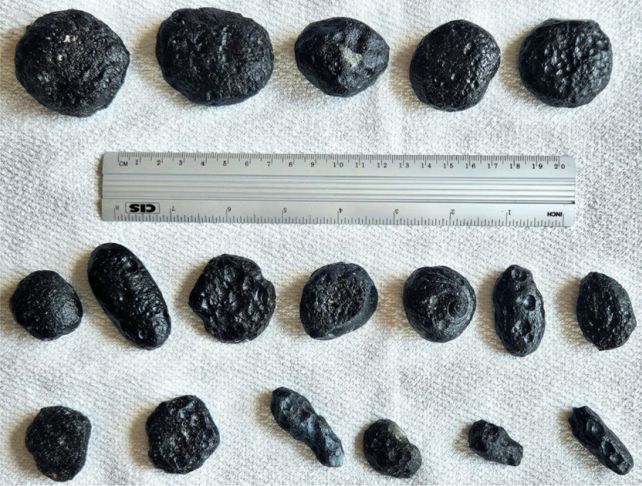
Earth's impact history is a lot murkier than that of other rocky bodies such as the Moon, Mercury, and Mars. Our home planet has tectonic, geological, and atmospheric processes that gradually wear away or obscure the evidence that something large collided with Earth.
One of the fingerprints of an impact can be tektites, which form when a meteorite slams into Earth with enough force to generate temperatures high enough to melt surface rock. These molten blobs are flung into the air, solidifying as blobs of glass that can scatter far from the site of impact.
The area covered by their spread is known as a strewn field, but they're very rare because of how quickly the tektites degrade – they last just a few tens of millions of years, at most.
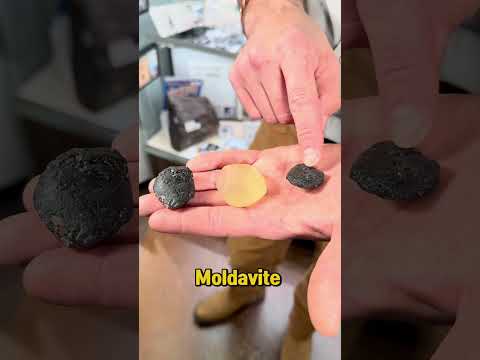
The discovery story begins not with scientific fieldwork or laboratory analysis, but with a local resident of Minas Gerais in Brazil. He had found one of the strange glass beads, looked up what it might be, and reached out to meteorite expert Gabriel Silva of the University of São Paulo.
"Although the photos the resident sent us looked like tektites, at first Gabriel and I were skeptical because tektites from other places, like Thailand and the Philippines, can be easily purchased online these days," Crósta recalled. "Also, tektites and obsidian (volcanic glass) may look similar when seen in photos."
But then a second report came in some weeks later, from another resident living about 60 kilometers (37 miles) from the first. So the researchers requested some samples. Initial tests suggested the globs could be tektites – after which, of course, the only thing to do was to go to Minas Gerais in person and look for more themselves.
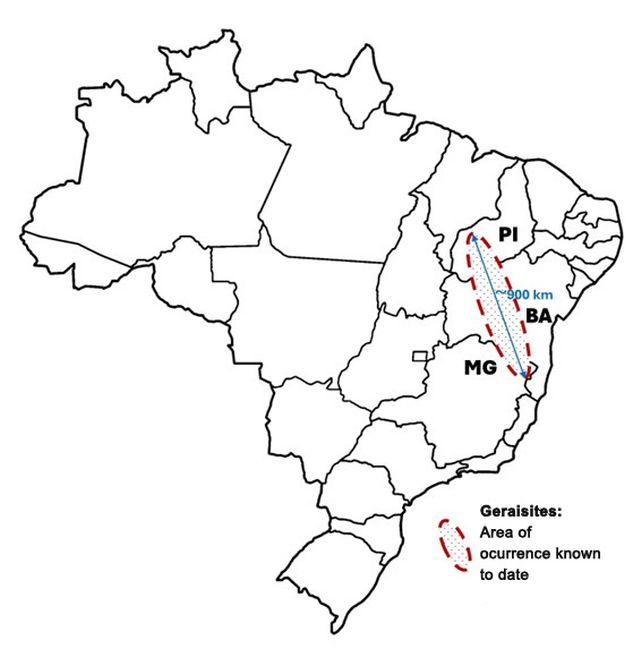
More than 600 of the objects have now been discovered. When the paper was published, they spanned a region 90 kilometers long in Minas Gerais – but since then, new finds in the neighboring states of Bahia and Piauí have extended the known strewn field to over 900 kilometers.
These Brazilian tektites have been called geraisites, after the state in which they were first identified.
"The most exciting moments happen when we find these tektites in the field ourselves," Crósta said, "and later, when we have the confirmation of their origin based on the analytical data."
Key to confirming the glass was of impact origin lay in something it barely contained: water.
Volcanic glasses like obsidian typically contain between 700 parts per million and 2 percent water. The geraisites contained between 71 and 107 parts per million. "One of the decisive criteria for classifying the material as a tektite was its very low water content," Crósta says.

Tektites have a near-total absence of water because the extreme heat of an impact – far beyond what a volcano can generate – effectively boils off almost all moisture from the melted rock as it hurtles through the atmosphere.
Dating of argon isotopes in the tektites yielded a maximum age of around 6.3 million years, a date that could be younger if the impact site contained its own argon. Chemical and isotopic analysis of the geraisites also revealed something striking about the rocks that were melted by the impact.
The source material was ancient continental crust – most likely granitic rocks from the São Francisco Craton, one of the oldest and most geologically stable regions of South America.
"The isotopic signature indicates a very ancient continental, granitic source rock," Crósta says. "This greatly reduces the universe of candidate areas."
Just how ancient? The rocks that were vaporized by the impact were already around 3 billion years old when the meteorite struck. They formed during the Mesoarchean era, when Earth itself was less than half its current age.
The elephant in the room is the missing impact crater. The size and shape of the strewn field, and the identity of the geraisite source rock, should roughly indicate where the impact struck. But so far, no nearby impact structure of the right age has been identified.
Related: Strange Glass in Australia Reveals a Massive Impact We Never Knew About
This is not as peculiar as it seems. Only three of the known tektite strewn fields have a clearly identified crater. The largest strewn field is the Australasian one, and its crater is thought to be buried deep under the ocean.
The researchers are working on reverse-engineering the properties of the impact event, adjusting for new information as it becomes available, such as the expansion of the field from 90 to 900 kilometers. This data is vital to calculating the energy, velocity, and volume of molten rock.
The discovery of the geraisite strewn field fills a significant gap in Brazil's incomplete impact record, the researchers note, and suggests that tektites may not be as rare as we thought, but may get mistaken for other types of glass.
"This has important implications regarding Earth's overall impact record," Crósta and his team write in their paper, "hinting that there might be other still undiscovered tektite occurrences with distinct origins, chemical compositions, and ages."
The research has been published in Geology.