
A quantum state of matter has appeared in a material where physicists thought it would be impossible, forcing a rethink on the conditions that govern the behaviors of electrons in certain materials.
The discovery, made by an international team of researchers, could inform advances in quantum computing, improve electronic efficiencies, and deliver enhanced sensing and imaging technologies.
The state, described as a topological semimetal phase, was theoretically predicted to appear at low temperatures in a material composed of cerium, ruthenium, and tin (CeRu4Sn6), before experiments verified its existence.
At extremely low temperatures, CeRu4Sn6 reaches quantum criticality, a point where a material teeters between changes in its phase, where conditions are so cold that quantum fluctuations dominate, effectively turning the material into a puddle of waves rather than a fog of particles.
Related: Belgium's 'Little Einstein' Earns PhD in Quantum Physics at Age 15
The plot twist in this study is that quantum criticality can give rise to states thought to be defined by interactions between particles, such as the behavior of electrons as discrete charge carriers.
"This is a fundamental step forward," says physicist Qimiao Si, from Rice University in the US.
"Our work shows that powerful quantum effects can combine to create something entirely new, which may help shape the future of quantum science."
In physics, topology refers to the geometry of material structures. Particular topological states can protect properties of particles, unlike the way neighboring particles might jostle and disrupt each other's behavior.
Understanding topological states usually requires stitching together properties into particle-like maps, something a material isn't thought to have under quantum criticality.
Both quantum criticality and topology are useful in materials for different reasons. Having them in combination could yield a new class of materials with strong sensitivity in their quantum responses and reliable stability.
When the researchers chilled CeRu4Sn6 to near absolute zero and applied an electric charge, they observed a phenomenon known as the Hall effect in the electrons carrying current through the material. Essentially, the current bent sideways.
According to the researchers, this was a clear signal of topological effects. The Hall effect usually requires a magnetic field to deflect the electrons, but no magnetic field was present in this case. Instead, the path of the current was being shaped by something inherent in the material.
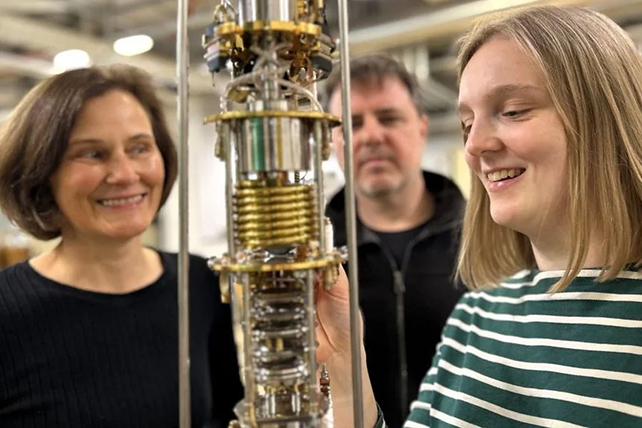
"This was the key insight that allowed us to demonstrate beyond doubt that the prevailing view must be revised," says physicist Silke Bühler-Paschen from the Vienna University of Technology.
What's more, the scientists found that where the material was most unstable in terms of its electron patterns, that's where the topological effect was strongest; the quantum critical fluctuations actually stabilized the newly discovered phase.

There's much more work to do. The researchers want to see if this quantum state can be found in other materials, to establish just how general it is.
They also want to take a closer look at the topology observed here, and the precise conditions required to make it possible.
"The findings address a gap in condensed matter physics by demonstrating that strong electron interactions can give rise to topological states rather than destroy them," says Si.
"Additionally, they reveal a new quantum state with substantial practical significance."
"Knowing what to search for allows us to explore this phenomenon more systematically," he adds.
"It's not just a theoretical insight, it's a step toward developing real technologies that harness the deepest principles of quantum physics."
The research has been published in Nature Physics.