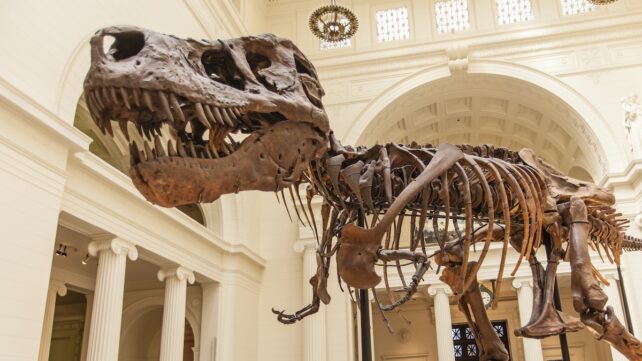
You probably wouldn't say it to its face, but the famously fearsome Tyrannosaurus rex has long been the butt of tiny arm jokes.
But new research could explain their hilarious hands, though it offers no guarantee it will stifle the giggles.
The study suggests that as their prey grew bigger, tyrannosaurs and other large predatory dinosaurs evolved to use their powerful jaws as their primary weapon.
As such, their arms shrank over time with disuse, until they became the funny little chicken wings we laugh at today.
This research is far from the first to suggest that these puny limbs were vestigial, but it goes further by linking the shrinking arms with the evolution of huge, powerful heads and jaws.
"We sought to understand what was driving this change and found a strong relationship between short arms and large, powerfully built heads," says Charlie Roger Scherer, vertebrate paleontologist at University College London.
"The head took over from the arms as the method of attack. It's a case of 'use it or lose it' – the arms are no longer useful and reduce in size over time."
As for what external forces might be driving these changes, the team suggests that it's because T. rex wasn't the only creature growing to unprecedented sizes.
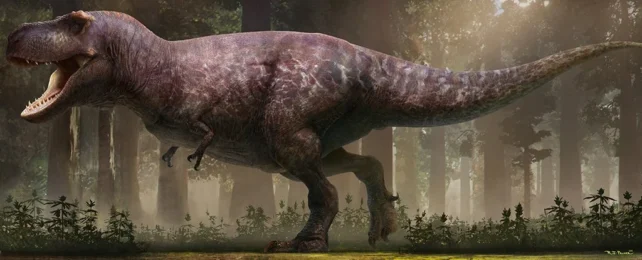
At the same time, sauropod dinosaurs were ballooning into the largest land animals ever to walk on Earth.
Even the beefiest of biceps aren't going to be enough to wrangle one of those, so it's no surprise that these predators pivoted to jaws packing the strongest bite force ever measured for any terrestrial animal.
"These adaptations often occurred in areas with gigantic prey. Trying to pull and grab at a 100-foot [30 meters] long sauropod with your claws is not ideal," says Scherer.
"Attacking and holding on with the jaws might have been more effective."
Although T. rex is the most famous example, it's far from the only one to skip arm day. The pattern of shrinking arms and growing heads seems to apply to multiple different lineages of theropods – mainly carnivorous dinosaurs with the basic body plan of a T. rex.
So for the new study, the team quantified the reduction in those limbs and developed a new system for scoring how robust their skulls were, based on factors such as size, estimated bite force, and relative dimensions.
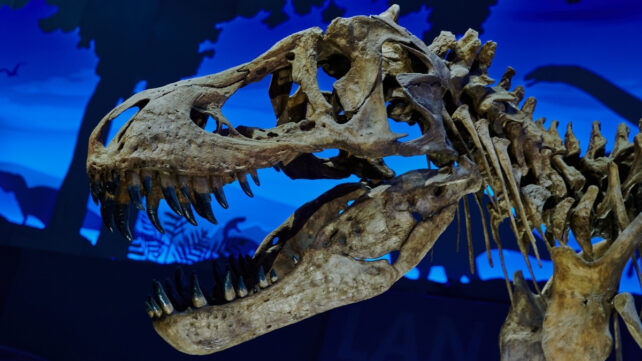
Then, the researchers compared the length of the forelimbs with the length and robustness of the skull in 61 theropod species.
Sure enough, the link between reduced forelimbs and skull robustness was found to be strong in five separate families of theropods: tyrannosaurids, abelisaurids, carcharodontosaurids, megalosaurids, and ceratosaurids.
Skull or body size alone didn't seem to correlate with forelimb size. Many of these predators grew into behemoths, but some stayed relatively small, even while packing a powerful head/tiny arm combo.
Stranger still, the team found that, across different lineages, the arms shrank by different proportions. In some cases, the whole limb shrank in tandem, but in others, some parts shortened more than others.

While we comfortably make jokes from a distance of 65 million years, those arms were stronger than they look.
Even if you muzzled a T. rex, you wouldn't want to arm-wrestle one – it's thought that they could still curl more than 100 kilograms (220 pounds).
That's far too weak to hold down a fleeing sauropod, but developed enough that these arms probably still had some secondary purpose. Scientists have suggested that the dinosaurs may have used them to help lift themselves off the ground after resting, hold on during mating, or viciously slash at prey.
Others even hypothesize that T. rex evolved short arms so they wouldn't accidentally be bitten off by frenzied relatives around the dinner table.
Related: Scientists Found a T. Rex Tooth Embedded in Another Dinosaur's Skull
Whatever these carnivores were doing with their arms, the researchers on the new study suggest that if their hypothesis is accurate, big heads probably appeared before the puny arms.
"While our study identifies correlations and so cannot establish cause and effect, it is highly likely that strongly built skulls came before shorter forelimbs," says Scherer.
"It would not make evolutionary sense for it to occur the other way round, and for these predators to give up their attack mechanism without having a backup."
But who knows; evolution does some weird things.
The research was published in the journal Proceedings of the Royal Society B: Biological Sciences.