Many of the body's processes slow down or falter as we get older, including tissue regeneration. In a new study, researchers detail a promising method to get this vital repair work back up to speed.
The study, from a team at the University of California, San Francisco, identified four transcription factors – proteins that control the activity of other genes – that have a rejuvenating effect on cells.
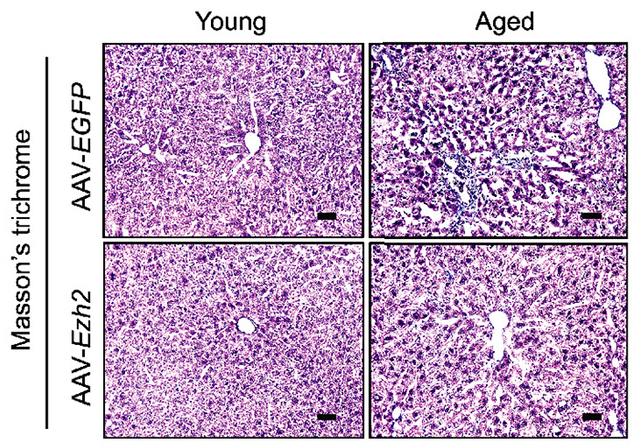
When the researchers boosted production of one of these transcription factors in the liver cells of elderly mice, they noticed numerous benefits: fat and scarring were significantly reduced, and glucose tolerance improved – all signs of a more youthful organ.
Related: Blood of Exceptionally Long-Lived People Reveals Crucial Differences
The team also tinkered with the levels of all four transcription factors in lab-grown human fibroblast cells. Fibroblasts make up connective tissue and provide scaffolding around other cells and organs. Again, multiple signs of youthfulness were spotted as a result, including increased cell division and boosted energy levels.
"By altering gene expression using the transcription factors we identified, old fibroblasts behaved as if they were younger, and improved the health of old mice," says biochemist Hao Li.
To identify the four key transcription factors, the researchers first compared old and young human fibroblast cells using a computational model to see how gene expression differed with age.
Having drawn up a shortlist of 200 transcription factors that could be controlling the 'youthfulness' of cells, they began systematically toggling them on and off – changing the transcription factors produced.
The results of this tinkering led the researchers to the final four transcription factors that they tested in more detail: E2F3, EZH2, STAT3, and ZFX. Altering the levels of these factors in liver cells of mice and human fibroblast cells grown in plastic dishes shifted the cells towards a younger mode.

The fact that these proteins had an effect across two different species and cell types suggests we could be looking at a universal blueprint of sorts, one that could be broadly applied to reactivate youthful states in older cells.
"These results suggest a shared set of molecular requirements for cellular and tissue rejuvenation across species," write the researchers in their published paper.
It's still early days for this research, and we're not yet talking about extending lifespans, replacing limbs or rejuvenating the whole body. We only have the results from a few cell types.
Long-term safety needs to be considered, too. The experiments in mice lasted only a few weeks, so we still don't know what effects rejuvenating cells in this manner might have over extended periods. Too much cell growth connected to EZH2 has been linked with cancer.
However, with a global population that's growing older and living longer, potential ways of keeping our bodies healthier for longer should warrant further investigation.
"Our work opens up exciting new opportunities to understand and ultimately reverse aging-related diseases," says biochemist Janine Sengstack.
The research has been published in PNAS.