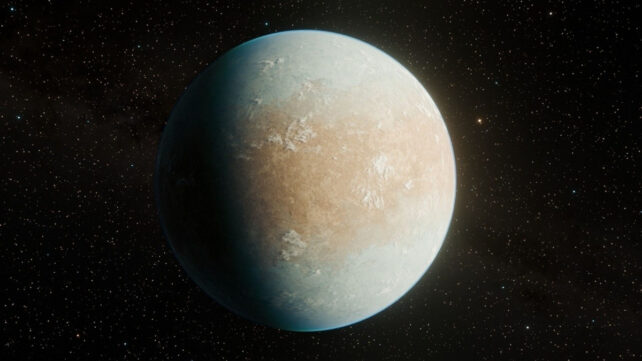
Astronomers have announced the discovery of what appears to be an "ice cold Earth," a chilly but potentially habitable rocky world similar to our own located less than 150 light-years away.
As described in a recent study, this excitingly Earth-like exoplanet candidate, named HD-137010 b, may be slightly larger and about 1.2 times as massive as our planet. The length of its year may also be equal to ours, since it appears to swing around its mellow, orange star every 355 days.
Judging by the length of its year, researchers suggest that there is a 51 percent chance that HD-137010 b resides just inside its star's habitable zone, skirting the solar boundary where liquid water may form on its surface.
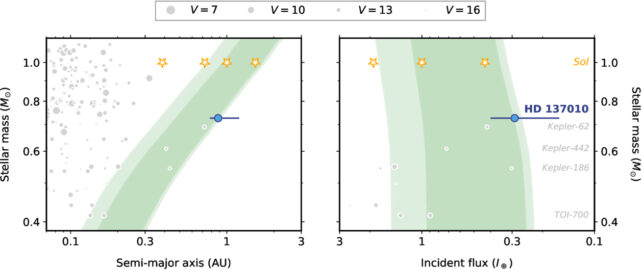
HD-137010 b orbits a star called HD-137010, a K dwarf that's about 70 percent the size and mass of the Sun.
This cooler, dimmer dwarf will live much longer than our G-type star due to its more miserly hydrogen consumption. HD-137010's smaller mass gives it a main-sequence lifetime (the duration it spends fusing hydrogen into helium) longer than the current age of the Universe.
Overall, HD-137010 is a tantalizingly unique discovery: "This is the first planet candidate with Earth-like radius and orbital properties transiting a Sun-like star bright enough for substantial follow-up observations," the researchers say.

Follow-up observations are necessary to confirm the planetary status of HD-137010 b, though researchers "anticipate there is a high likelihood that it is a genuine planet."
They teased out its existence using data from NASA's now-retired Kepler space telescope, astronomy's first devoted planet-hunter, via a technique called the transit method.
The transit method involves using an observatory like Kepler to 'stare' at a star and wait for its light to dim as a potential exoplanet transits, or passes in front of it. The resultant stellar silhouette causes a dip in starlight that can reveal the exoplanet's radius and orbital details.
Astronomers have only seen HD-137010 b transit once. And since they must view multiple transits to confirm a candidate exoplanet, worlds with Earth-like orbits "require several years of observations."
Yet there's much reason for optimism.
The discovery of HD-137010 b "demonstrates the detectability of temperate and cool Earth-sized exoplanets orbiting Sun-like stars through single transits," the researchers explain.
Future observations may need to wait for next-generation observatories, like the ESA's PLATO, as such worlds are at the observational limit of today's facilities.
For now, the existing orbital and stellar details suggest that HD-137010 b could sit within its star's habitable zone. But because it receives less than a third of the energy the Earth receives from the Sun, HD-137010 b may be between -68 and -85 degrees Celsius (-90 to -121 degrees Fahrenheit), even colder than our famously frigid red neighbor.
Although it may be frostier than Mars, HD-137010 b could still exhibit fortuitous atmospheric conditions to allow water to exist on its surface.
Given what researchers know about other Earth-sized exoplanets in their stars' habitable zones, they say "it appears eminently plausible that a moderately CO2-rich atmosphere would be conducive to liquid surface water."
However, just as the long orbit of HD-137010 b complicates its confirmation, its Earth-like characteristics come with another caveat. If it has a CO2 abundance similar to Earth's, then HD-137010 b may be trapped in a 'snowball' climate.
This scenario produces a fully glaciated planet that's highly reflective, bouncing incoming starlight and further reducing its surface temperature to around -100 degrees Celsius.
Yet HD-137010 b may not be alone. It appears to be isolated, but other known exosolar systems imply otherwise.
Additional planets may exist either inside or outside the orbit of HD-137010 b. In fact, such bodies could form a "solar system-like architecture" with multiple planets extending throughout the habitable zone, and perhaps a more distant, Jupiter-sized member.
Related: Ancient 'Wet Lava Ball' Exoplanet Defies Expectations
With so many similarities to our own solar surroundings, could an "ice cold Earth" support life? A frozen world may not seem conducive to life as we know it, but Earth itself was a snowball multiple times throughout its 4.5-billion-year geologic evolution.
This research is published in The Astrophysical Journal Letters.