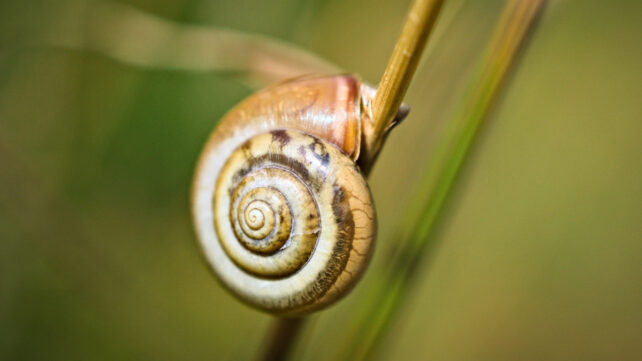
The rhythms of prehistoric cyclones and other extreme weather events could be mapped using the shell on a land snail's back, according to new research led by a team at the University of Queensland in Australia.
It all comes down to the way a snail's shell forms.
A tiny, newly hatched snail already has a shell, and it's equally tiny.
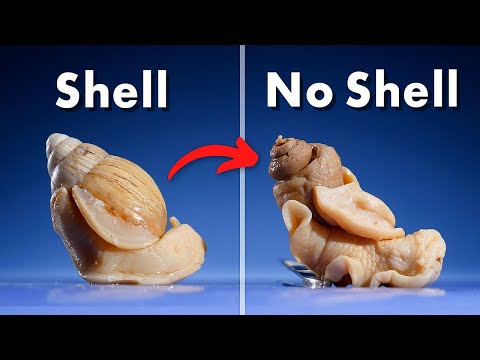
Shell is hard, to offer protection to the snail's organs, but it also constrains how the little mollusc within can grow.
Since it can't make the coiled tube of its shell wider, the snail grows 'out' from its central spiral at the shell's opening.
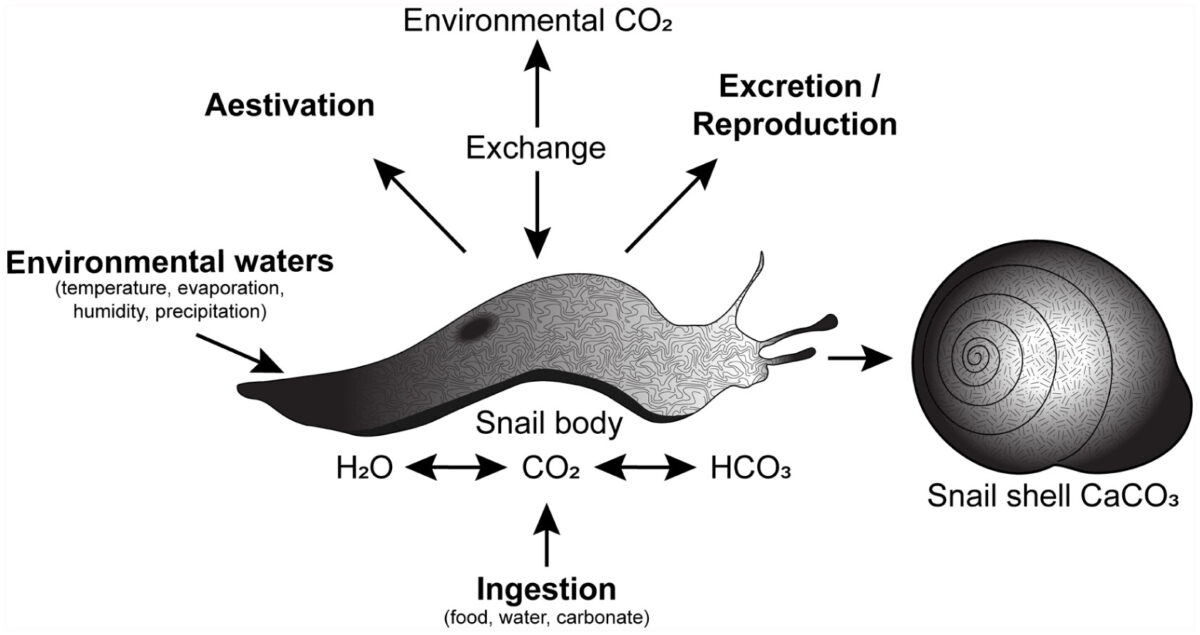
As its body expands away from the shell, the snail's mantle – a special organ on their back that exists exactly for this purpose – secretes calcium carbonate at the opening of the shell, which hardens into solid crystals on contact with the outside world.
And so, the snail's shell grows 'out' too, spiraling in lockstep with its inhabitant.
The shell of a snail is, then, a little similar to the growth rings of a tree: Each new ring of calcium carbonate a snail adds to the opening of its shell incidentally records details of the snail's life at that time.
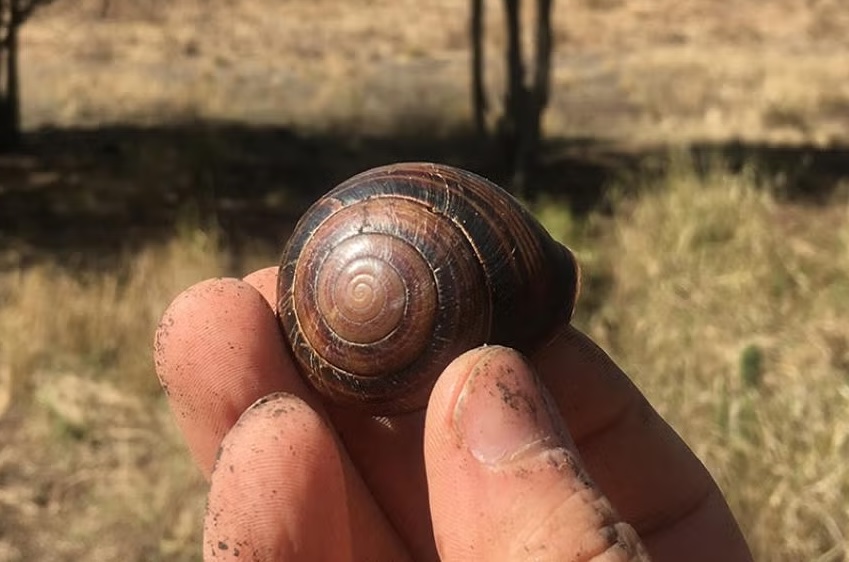
For instance, in the new study, the shell of one Biggenden Banded Snail (Figuladra bayensis) had elevated levels of radiocarbon in certain growth bands, which were clearly from nuclear tests.
"We used high-resolution radiocarbon dating to determine the age of the growth bands in the shell," says geologist and environmental scientist Nicholas Patton, who led the research.
"It contained elevated levels of radiocarbon from the nuclear tests in Australia in the 1960s, meaning we could date the growth bands and reveal the snail had lived for about 4.5 years."
Carbon and oxygen isotopes are also locked into the shell material, which scientists can read as clues to the climatic and environmental factors the snail lived through, and the food they ate.
"What we saw was the shell did not grow continuously during the snail's life; there were periods of rapid growth separated by periods of little or no growth," Patton explains.
In some years, it grew by 23.7 millimeters, and in others, the shell packed on 144.3 millimeters of growth.
"But the results showed the snail was responding to extreme rainfall events rather than annual wetness," says environmental scientist Jamie Schulmeister.
The team linked phases of rapid growth following extreme rainfall to specific cyclones in 2015 and 2017: Severe Tropical Cyclone Marcia and Tropical Cyclone Debbie, both of which caused massive downpours in the Coalstoun Lakes National Park, where the snail shell was collected.
Perhaps, Shulmeister thinks, snail shells could be used to map extreme weather events that happened in the past.

Shells, by their mineral nature, stick around in the environment far longer than the snails that built them.
And there is a growing science in using this kind of biological evidence to figure out what went on before modern meteorological records began.
Related: Expired Cans of Salmon From Decades Ago Preserved a Huge Surprise
"If we are able to find shells within different layers of sediment deposits, we can combine the individual shell records together to extend this information further back in time," says Patton.
"It was surprising and quite exciting that the humble snail could be a tool to reconstruct the paths of past cyclones even in prehistoric times," Shulmeister adds.
The research was published in The Holocene.
This article was fact-checked by Rachel Garner and edited by Peter Dockrill. While we pride ourselves on our process, we are only human. If you spot a mistake, please let us know.