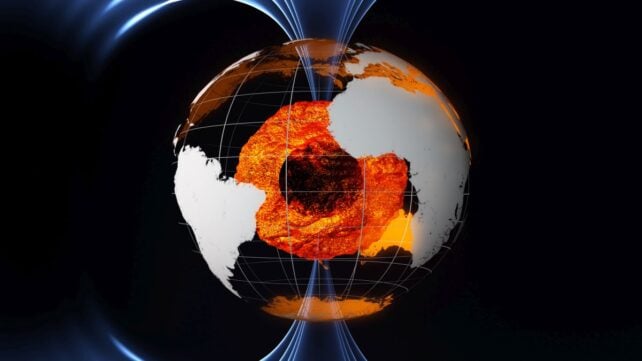
Something strange is going on, deep below the ground beneath our feet.
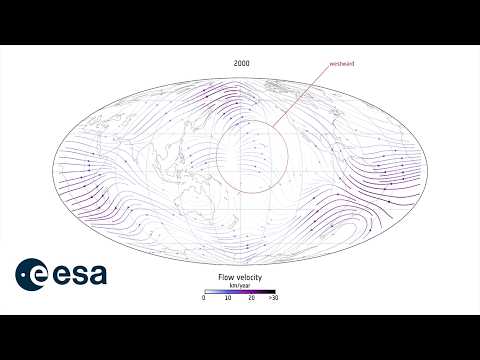
In the molten ocean of iron churning in Earth's outer core, a section deep beneath the Pacific Ocean suddenly reversed direction and started moving eastward against the planet's usual westward flow.
This happened in 2010, according to satellite measurements of Earth's magnetic field, and scientists are still trying to figure out what caused it.
"The large-scale flow reversal beneath the Pacific raises new questions about the behavior of Earth's deep interior," explains geoscientist Frederik Dahl Madsen of the University of Edinburgh.
"Scientists now want to understand whether the reversal represents a short-lived fluctuation, part of a repeating oscillation, or a new stable equilibrium for core circulation. Continued monitoring will be essential to determine how the flow evolves over the coming years."
Change in our planet's interior is no mere trivial curiosity. What happens there is crucial for our planet's habitability.
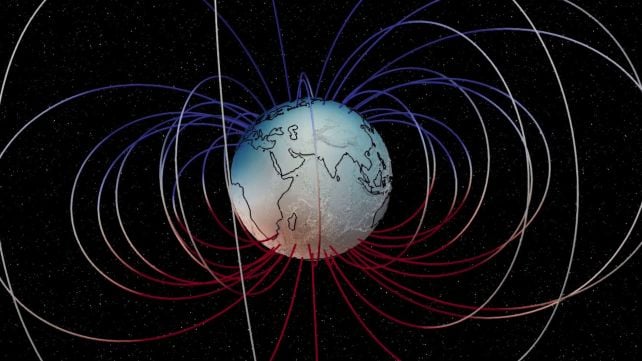
It's from the roiling, molten, conducting metal at Earth's heart that the planetary magnetic field is generated, as kinetic energy is converted into magnetic energy that expands into a protective cage of magnetic field lines wrapping around the planet. This core engine is called the geodynamo.
The magnetic field is vital to our continued existence. It helps keep the atmosphere we breathe in and harmful cosmic radiation out.
But understanding it means using those external magnetic fields to delve into the chthonic darkness deep in Earth's belly.
By studying changes in Earth's magnetic field, scientists previously determined that the molten outer core generally flows in a westward direction.
Then, in 2011, something unexpected happened. Scientists saw hints that the flow beneath the Pacific was moving eastward.
Now, after examining 27 years of satellite data from 1997 to 2025, Madsen and his colleagues have pieced together a picture of what might be happening down there.
Most of the outer core's motion is dominated by a circulation pattern called the eccentric planetary gyre.
The researchers' analysis reveals that, in 2010, in the region beneath the Pacific Ocean, part of the outer core abruptly departed from this pattern, shifting from a weak westward flow before 2010 to a strong eastward one after 2012.
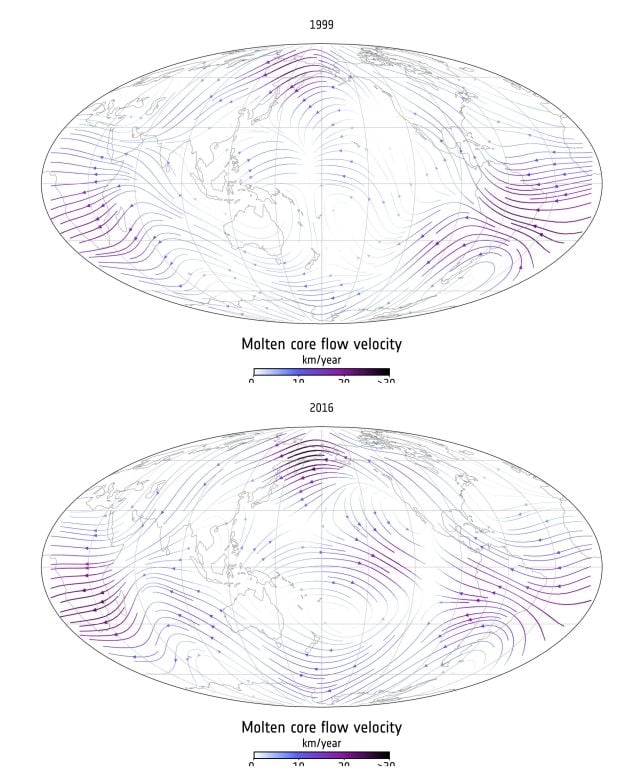
This flow continued to strengthen until 2020. As of the most recent measurements, it appears to be weakening again.
The phenomenon didn't appear to be a small eddy or localized disturbance, but accounted for around 5 percent of the outer core's surface flow. Nor was the signal consistent with the circumspheric zonal bands observed on fluid bodies such as Jupiter and Saturn.
Rather, it seemed to have a large, wave-like structure – as though a chunk of molten core material suddenly thought better of where it wanted to go, surging in the other direction.
This was deeply unexpected. Scientists had assumed that the large-scale flow of Earth's outer core was more or less stable and consistent. This finding suggests that there are processes that can influence it strongly enough to alter its behavior in bulk – and that our planet's interior may be more dynamic and variable than we thought.
What could have caused the sudden change is not known for sure, but other measurements from around the same time suggest something big was happening around 2010.
Every 5.8 years or so, the length of Earth's day changes slightly, a phenomenon that has been linked to Earth's core. In 2010, there was a disruption to this cycle that did not resolve until 2014.
There were also seismic signs that the inner core's behavior may have changed around this time.

Satellites also recorded a series of geomagnetic jerks in 2017 – abrupt glitches in Earth's magnetic field linked to turbulent activity deep inside the core. The researchers believe this activity may be related to the earlier changes that occurred in 2010.
Related: Earth's Flipping Magnetic Field Heard as a Sound Is an Unnerving Horror
None of this is dangerous to us surface-dwellers, but since Earth's magnetic field plays such a critical part in protecting us from space weather, understanding the engine that drives it will help scientists improve forecasting.
"This research raises intriguing questions about how Earth's deepest layers are dynamically connected," says mission scientist Elisabetta Iorfida of the ESA's Swarm satellite project.
"As the magnetic field continues to evolve, satellite missions are providing an increasingly detailed view of the dynamic processes unfolding deep inside our planet, revealing that Earth's core may be far more variable and complex than once believed."
The research has been published in the Journal of Studies of Earth's Deep Interior.