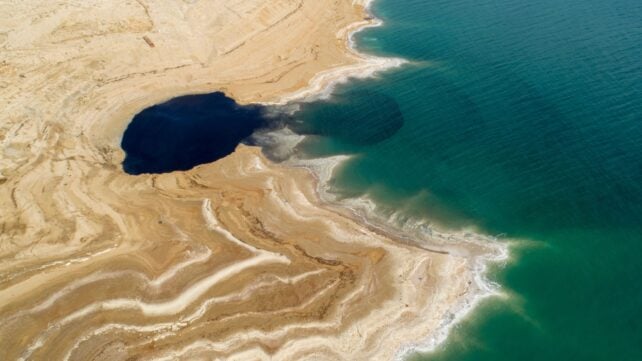
Imagine following the retreating shoreline of the Dead Sea. As the water withdraws, ground once submerged comes into view. But beneath the remaining water lies a puzzle: why is this shrinking lake also getting warmer?
With Jordan to the east and Israel and the West Bank to the west, the Dead Sea is an exceptionally salty lake.
Hotter air is an obvious suspect. Yet a new study suggests part of the explanation lies within the lake itself: water loss can contribute to warming, and that warming can sustain further evaporation and water loss – a feedback loop between shrinking and heating.
The mechanism could explain how ancient seas produced vast salt deposits without requiring the surrounding climate to have been exceptionally hot and dry.
Led by Emmanuel Guillerm of Germany's GFZ Helmholtz Centre for Geosciences and Binghamton University in the US, the team built a model linking water loss, salt concentration and heat exchange.
The Dead Sea provides a natural laboratory. Human diversion of incoming water has contributed to falling lake levels and salt precipitation.
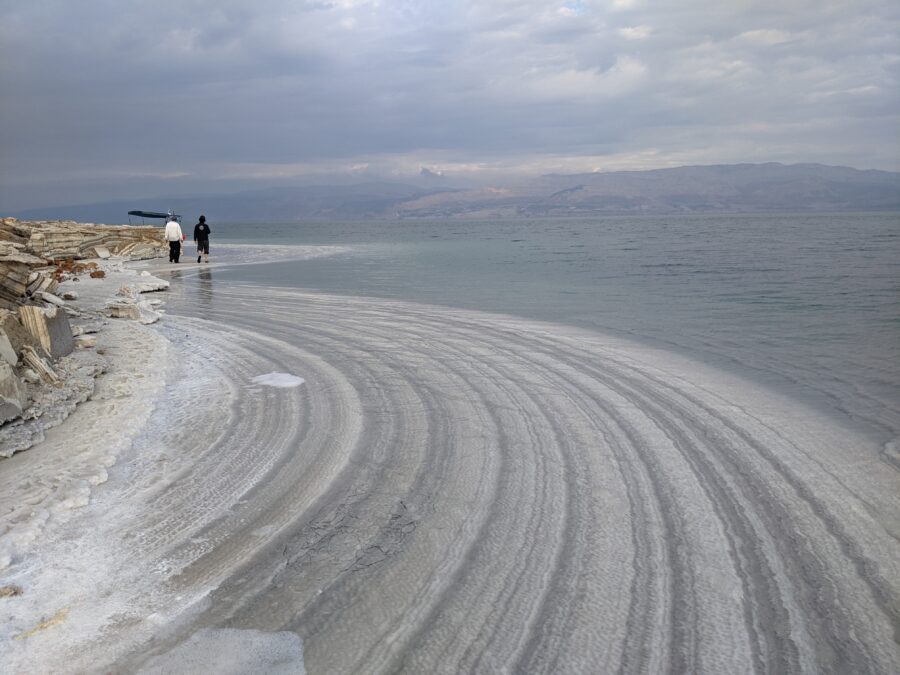
Between 1979 and 2019, its level dropped by about 34 metres. Over that period, its deep waters warmed by 2.8°C, while its upper layer warmed by about 1.7°C.
Calibrated using 2012–2015 measurements, the model reproduced the observed 1979–2019 warming trend and seasonal temperature patterns.
Next, the team tested the two influences separately: keeping air temperature constant in one simulation and lake level constant in another.
By the 2010s, rising air temperatures contributed about 1.3°C to deep-water warming in these simulations. Declining water levels contributed about 1.5°C.
Evaporation carries heat away, cooling the remaining water, much as evaporating sweat cools our bodies.
Dissolved salts change that process. They reduce water's tendency to evaporate at a given temperature. As water disappears and the brine becomes more concentrated, evaporative cooling weakens.
The remaining water can therefore become warmer. When it is warmer than the air above it, the temperature difference can sustain evaporation despite the high salt concentration.
"This part of water warming is thus due to water diversion, and adds on top of water warming due to anthropogenic air warming," Guillerm tells ScienceAlert.
Heat also moves downwards. In summer, warmer, saltier water overlies cooler, slightly fresher water. Because heat diffuses faster than salt, sinking streams can transport heat and salt into the deeper layer through a process called salt fingering.
Winter mixing provides another route for atmospheric warming to reach the depths.
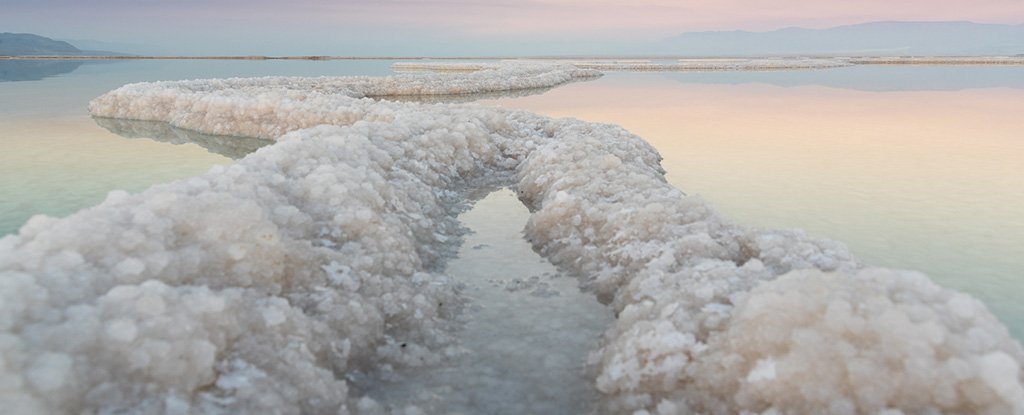
The researchers then explored the future under two warming scenarios, assuming all inflows stop, industrial extraction ceases, and the lake continues mixing once a year.
Under those conditions, the study projects roughly 85 metres of water-level decline by 2100 and around 5–8°C of water warming, depending on greenhouse gas emissions.
Excluding inflow tends to overestimate decline and warming; excluding industrial extraction tends to underestimate water loss. Guillerm thinks these effects balance, noting no break in simulated decline at the 2019 transition to projections. Groundwater inflow remains uncertain.
The simulations prescribe future air warming while keeping humidity, wind and incoming sunlight at repeating historical seasonal patterns.
In longer simulations, increasing brine concentration sustained warming even after imposed air warming stopped.
Restoring historical freshwater inflow would stop lake-level decline, Guillerm says.
"Warming due to increasing salinity would stop," he explains.
He says a dilute surface layer would insulate deeper waters from atmospheric warming, which would continue at the surface.
The team then asked what would happen in a much larger basin: an eastern Mediterranean completely disconnected from the ocean.
The experiment assumed complete isolation; whether this occurred during the Mediterranean's ancient loss of water remains debated.
"Our work does not provide the solution," Guillerm says.
The simulation began with a surface 400 metres below sea level and brine already concentrated enough for rock salt to crystallise.
Over roughly 8,000 years, simulated water temperatures rose by around 20°C, while the water level fell by 2.5 kilometres.
Descending to lower elevations exposed the surface to warmer air. Salt concentration and changes within the water layers also contributed.
Highly soluble potassium-bearing salts formed in the simulation despite an assumed relative humidity of 65 percent.
These minerals and unusually warm ancient brines are often interpreted as evidence of exceptionally hot or dry conditions. The model suggests isolation and shrinkage can produce them under less extreme regional climates.
Tiny brine pockets trapped in salt crystals preserve clues to past water temperatures. Warming through successive layers might record a sea's progressive shrinkage.
The researchers propose using those temperature changes to investigate how far ancient seas fell as they dwindled.
The research has been published in Geophysical Research Letters.
This article was fact-checked by Fiona MacDonald and edited by Fiona MacDonald. While we pride ourselves on our process, we are only human. If you spot a mistake, please let us know.