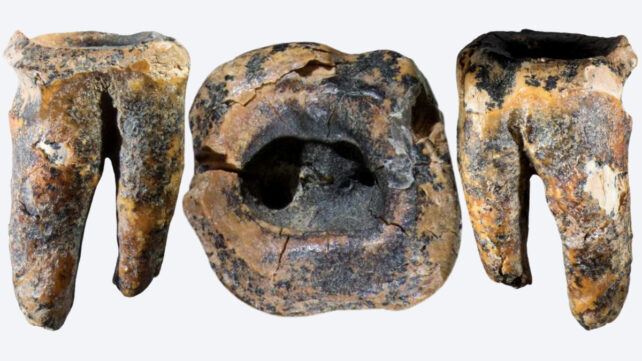
A 60,000-year-old Neanderthal tooth left behind in a cave in modern-day Russia contains a deep hole that cannot be explained by decay alone.
The tooth is a molar from the lower left jaw of a Neanderthal, an extinct relative of modern humans.
This prehistoric human had a bad tooth infection, probably for a long while.
At a time when finding food was difficult enough and pain relief was in its infancy, a toothache that prevented a person from eating could become a life-or-death matter.
Eventually, it must have become such a problem for this Neanderthal that they were willing to go to extreme measures to relieve it.
According to a team of scientists from institutes across Russia, the pained individual likely did so by performing a sort of prehistoric root canal: drilling the tooth with a sharp stone tool to remove the damaged pulp (or more likely, getting a friend to do it – gulp).
If the team is right in their interpretation, it suggests Neanderthals conducted some clever dentistry. They may have known they could salvage an infected tooth if they removed the pulp and just left the rest.
What's more, the tooth "currently represents the earliest known evidence of intentional dental intervention", the team writes in their paper. Previously, that distinction had belonged to Homo sapiens.
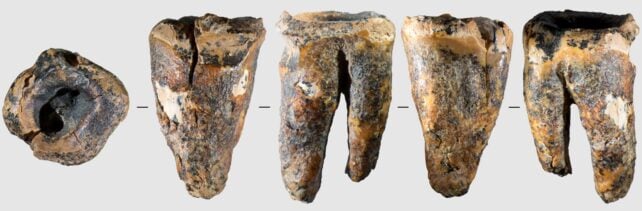
"When we first saw [the tooth], our initial thought was: this is probably just a tooth root where the crown had broken off naturally," archaeologist Kseniya Kolobova of the Russian Academy of Sciences told ScienceAlert.
But Alisa Zubova, an anthropologist on the team who specializes in teeth, wasn't satisfied with that explanation for the unusually-shaped cavity.
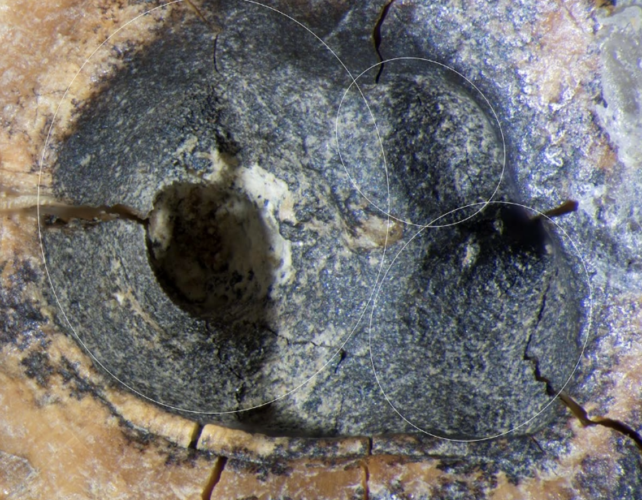
Taking a closer look at the tooth's surface under the microscope, the team found "clear linear marks typical of a rotating, drilling motion," Kolobova explained.
"We also saw that the cavity is actually made of three overlapping depressions," she said.
"That could no longer be explained by disease or accident. This was intentional, hands‑on treatment."
Of course, Neanderthals did not have the precise, electrified dental drills we use today, let alone modern anesthetics.
More likely, they had to use the materials they had at hand.
In this case, the team believes a very fine, pointed piece of jasperoid, a stone that was readily available in the environment.
We know the Neanderthals in this part of Russia were knapping jasperoid to make other kinds of tools at the time, and some of these have even been found inside Chagyrskaya Cave, the same site where the molar was discovered.
"They made complex, asymmetrical bifacial knives, scrapers, and these small retouched points. The fine motor skills and technical knowledge were already there," Kolobova explained.
"So, did they look at a carious, painful tooth and suddenly invent a new tool? No, I doubt it. Instead, what they likely did was repurpose an existing tool design for a novel, highly specialized task."
To prove this kind of tool was up for the task, the team attempted some Neanderthal dentistry themselves.
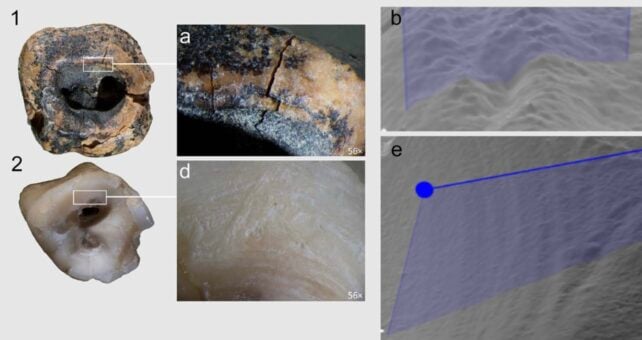
While they had some success drilling into old teeth from anthropological collections, the Neanderthal-like tools were most efficient when applied to a wisdom tooth recently extracted from the mouth of their very own traceologist, Lydia Zotkina.
"Lydia's tooth… was as close as we could possibly get to the fresh, moist condition of a Neanderthal tooth still in a person's jaw," Kolobova said.
"She drilled into her own tooth using a replica of [a] Neanderthal stone tool. In our lab, we still make jokes about it: 'The most personal contribution to the project'."
While several teeth were cracked by the hard spikes of jasperoid, they were able to achieve similar results seen in the Neanderthal molar by applying a gentle, careful rotating motion with the stone.
The team also makes the case in their paper that the Neanderthal 'drilling' technique is "more advanced" than H. sapiens' method of scraping carious teeth to try and remove decay.

We're not booking in for this treatment any time soon, but it's astonishing that prehistoric humans were experimenting with such a "sophisticated" technique so long ago.
The discovery adds to mounting evidence that Neanderthals had a culture far beyond earlier stereotypes of brutish cavemen: They buried their dead, decorated caves, cared for their communities, and potentially dabbled in medicine.
And, it seems, when they had a toothache, they were willing to go through intense, short-term pain if it meant they would be better off in the long run.
Related: We Outlasted Neanderthals Thanks to One Key Difference, Study Suggests
"They conceptually transferred an existing technology to a completely new domain," Kolobova adds.
"That shows a remarkable level of cognitive flexibility."
The research was published in PLOS One.