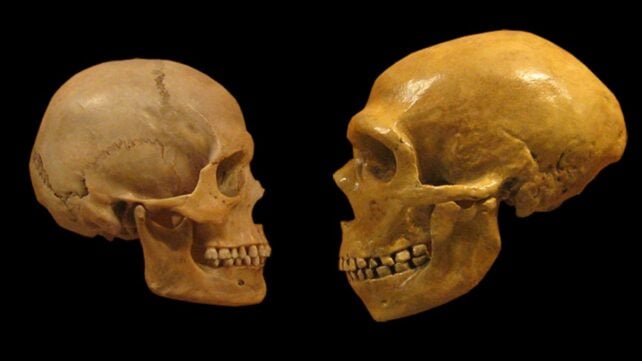
More than 40,000 years ago, the European continent was home to two human lineages: our direct ancestors, Homo sapiens, and our cousins, the Neanderthals.
There was to be only one sole survivor.
For more than a century, scientists have tried to figure out why. Why did our own branch of humanity flourish, while another was chopped short?
Historically, Neanderthals have been portrayed as brutish, hunched-over hominins, relatively slow of body and mind.
Today, we know better.
Growing archaeological evidence suggests that Neanderthals were not only more intelligent than we once assumed, but they also walked upright, used tools to make fire, spun fibers into string, created abstract art, and maybe even coordinated hunts for big game.
So what did we have that they didn't?
In all likelihood, there is no single explanation, but researchers at the University of Montreal in Canada and the University of Cambridge in the UK think they have found a crucial difference that helped humans survive.
Humans did not outcompete Neanderthals because of our better brains, or our superior physicality, the authors argue. Instead, their modeling suggest humans may have survived because groups of H. sapiens were probably more interconnected than Neanderthals.
Between 35,000 and 60,000 years ago, the European continent was undergoing a major climate shift. At the same time, waves of Sapiens were migrating out of Africa into this new land, bringing two lineages of early humans head to head.
To figure out where this might have led, the study authors built several models similar to those used in conservational biology to map suitable species habitats. They added data on geographical regions, climate variability, and from archaeological sites.
The team, led by anthropologist Ariane Burke from Montreal, found that the most suitable areas for Neanderthal groups in Europe were less well connected than habitats suited to Homo sapiens.
"These networks act as a safety net," explains Burke.
"They allow for the exchange of information on resources and animal migrations, the forming of partnerships, and temporary access to other territories in the event of a crisis."
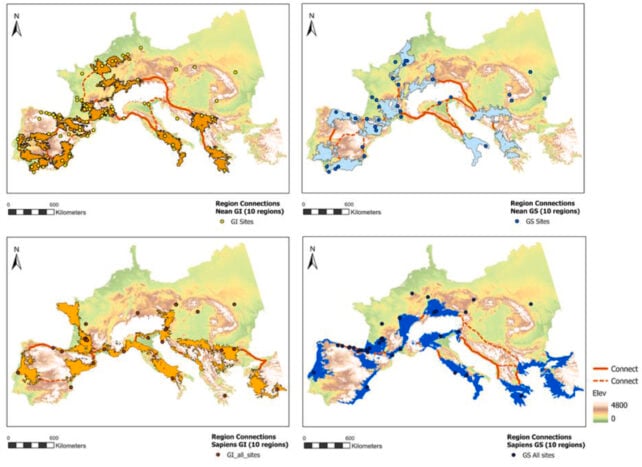
Genomic evidence supports the idea that Neanderthals lived in smaller populations than ancient Sapiens in Europe. Some scientists have even hypothesized that a crash in the Neanderthal population led to low genetic diversity, which may have contributed to their decline.
If these small and dispersed Neanderthal groups did exist, they may have been more vulnerable to environmental changes.
"Neanderthals living in Western and Southeastern Europe were only tenuously connected as the distances separating them were quite large," the authors hypothesize.
The findings suggest that regions in Europe most likely occupied by Neanderthal and Sapiens barely overlapped, which weakens the case that the two lineages were competing for the same land and resources.
But even a small amount of overlap – the study found Neanderthal and Sapiens regions overlapped by up to 5 percent at any given time – could have a significant effect on the future.
Some scientists think that Neanderthals and Sapiens reproduced so extensively over the millennia that it led to the complete genetic absorption of one species by the other.
Today, people of non-African ancestry have inherited between 1 and 4 percent of their DNA from Neanderthals. Remnants of our extinct cousins still exist in us.

Burke and colleagues acknowledge that the reasons behind the disappearance of Neanderthals may not be the same right across Europe. Their models are based on a patchy fossil record, but they could point to areas more densely occupied than others.
"It is possible, for example, that Sapiens played a more active role in the extinction and/or genetic assimilation of Neanderthals in Western Europe, where their core regions overlap,' the team explains.
In regions like the Balkans and southern Italy, however, Neanderthal regional networks are distantly located, so genetic or demographic vulnerabilities "may best explain their disappearance", the team adds.
Related: A Surprise Cave Finding Has Once Again Upended Our Story of Humans Leaving Africa
However Neanderthals vanished from the face of our planet remains a mystery. In many ways, the ending to their story is the beginning of our own.
The study is published in Quaternary Science Reviews.