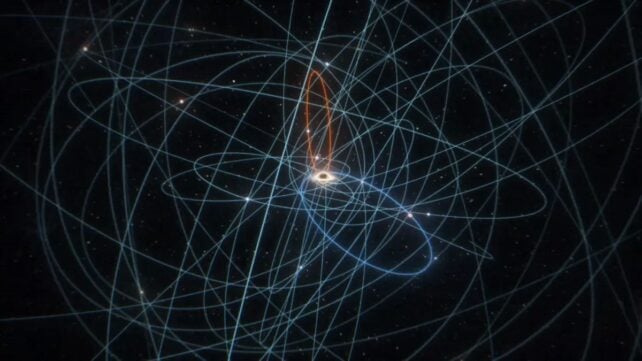
In the extreme environment at the heart of the Milky Way galaxy, things can get a little hinky.
And by hinky, we mean almost inconceivably bonkers.
There lurks a supermassive black hole named Sagittarius A*, tipping the scales at around 4.3 million times the mass of the Sun.
Although that's relatively modest as far as supermassive black holes go, the gravitational regime in its immediate vicinity provokes some wild behavior in the stars that inhabit it.
And now astronomers have discovered an object that leaves the rest in the dust.
Described in a new Nature paper, S301 is on a searing 8.7-year orbit around Sgr A* that reaches a peak velocity of more than 25,000 kilometers (15,534 miles) per second during its closest approach to the black hole, a distance similar to that between Saturn and the Sun.
That's a whopping 8.5 percent of the speed of light – and it veers close enough, finally, to perform measurements that may reveal elusive properties of Sgr A* itself, first its spin, and eventually whether it obeys the famous theory that proposes black holes have no 'hair'.
"The Galactic Center is like a remote laboratory, and the stars are the measuring probes," astrophysicist Felix Mang of the Max Planck Institute for Extraterrestrial Physics in Germany, a member of the GRAVITY+ collaboration that analyzed the star, told ScienceAlert.
"Our measurements get (for a fixed precision) only as good as the star that is approaching SgrA* the closest. Having now essentially a probe in hand with which we can gauge the spinning spacetime curvature around this massive black hole is just really cool."
The black hole at the center of the Milky Way isn't easy to study. Because black holes emit no light that we can detect, the best tool we have for studying them is the behavior of stuff around them.
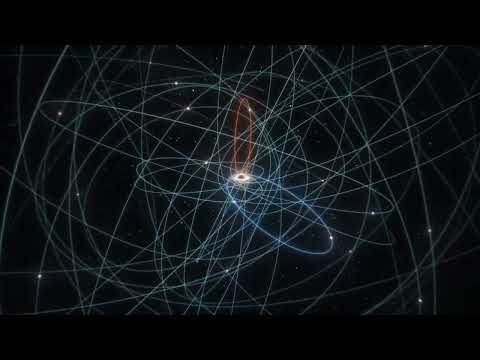
The stuff around Sgr A* is pretty interesting. It's surrounded by a swarm of close-orbiting stars on looping, elliptical orbits that, in the past, scientists have used to measure the properties of the black hole and test general relativity in one of the most extreme environments we can see.
One star in particular, S2, has been extraordinarily useful.
Its 16-year orbit, which in 2018 took the star within 17 light-hours of the galactic center, gave astronomers measurements of gravitational redshift and Schwarzschild precession – effects produced by the enormous mass of Sgr A*.
But S301 takes the black hole thrill ride to a whole new level.
Its wildly elongated orbit plunges around 10 times closer to Sgr A* than S2, swooping much deeper into the black hole's gravity well, where – much like a rollercoaster swooping into a dip – it accelerates to its blistering top speed before whooshing out again.
And, just like a rollercoaster, it's not just the top speed that makes this ride interesting. It's what happens along the way.
At the closest approach, or pericenter, S301 is close enough to Sgr A* to travel through the very fabric of spacetime that is dragged along by the black hole as it spins – like sticking a fork into a bowl of spaghetti and twirling.
This is known as frame-dragging, or the Lense-Thirring effect.
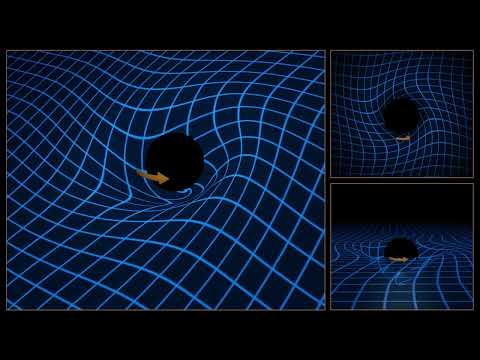
That twirling motion should very subtly alter the orbit of S301. Scientists can calculate with precision what the orbit of S301 would look like without the effects of a deep dip into Lense-Thirring territory; comparing that prediction with the altered real orbit gives a baseline to work backward and calculate the spin of Sgr A*.
And that could bring us within reach of testing the no-hair theorem, which states that, for an effectively uncharged black hole, once you know the mass and spin, every other feature of its gravitational field should be predictable from those properties alone.
"Our group has already measured the mass of Sgr A* to a sub-percent level," Mang told ScienceAlert.
"The spin would be the next step in proving the no-hair theorem, and in particular the spin of a massive black hole – this is unprecedented."
Measuring the spin alone won't settle the matter. But with enough observations, S301's orbit could eventually reveal another feature of Sgr A*'s gravitational field called its quadrupole moment.
General relativity predicts exactly what that measurement should be based on the black hole's mass and spin. If observation matches prediction, Sgr A* will have passed a formidable test of the no-hair theorem.
S301 may have another wild story to tell, too.
Its extremely elongated orbit hints that the star may once have been part of a binary system that ventured too close to Sgr A*. In a process known as the Hills mechanism, the black hole can tear such a pair apart, capturing one star into a tight orbit while flinging the other out at tremendous speed.
That could explain how S301 ended up on its current extreme trajectory, although its orbit alone isn't enough to confirm the scenario.
Finding its long-lost former companion hurtling away from the Galactic Center would provide much stronger evidence.
And, because the orbit is so short, we won't have to wait long. S301 reaches pericenter again toward the end of 2031, when the effect of spin on its orbit will be strongest.

The GRAVITY+ collaboration will continue tracking S301, while the upcoming MICADO instrument on the European Southern Observatory's Extremely Large Telescope should help astronomers reconstruct its motion in three dimensions.
Related: Something Far Darker Than a Black Hole Could Hide in The Heart of The Milky Way
Together, those observations could allow the team to pin down Sgr A*'s spin within the next decade.
And there may even be more treasures lurking in the deepest heart of the Milky Way.
"We expect more stars like S301 to exist in the Galactic Center, and in case we discover a similar one, this would facilitate a spin measurement even more," Mang said.
"The strength of the signal would no longer depend only on the relative orientation of the black hole's spin axis and the orbit of S301."
The discovery has been published in Nature.
This article was fact-checked by Clare Watson and edited by Clare Watson. While we pride ourselves on our process, we are only human. If you spot a mistake, please let us know.