Toxoplasma gondii has one heckin' reputation.
This single-celled parasite has gone down in infamy for its putative ability to subtly influence the behavior of its hosts in ways that will help it reach the cats it needs to complete its life cycle.
From the humble mouse to the complicated human, many papers have documented – and disputed – the effect of this microbe on its host.
Rats infected with T. gondii, for example, can lose their usual aversion to the smell of cats. In the wild, infection has been linked with strange risk-taking behavior in animals ranging from chimpanzees and hyenas to Yellowstone wolves.
But a fundamental chicken-and-egg problem may underlie many of these studies.
What if, argues zoologist Andrew Davinack of Wheaton College, Massachusetts, in a new commentary, animals are more likely to encounter T. gondii because they're natural risk-takers – rather than becoming risk-takers because they encountered T. gondii?
It's a distinction worth making, because it could mean T. gondii's towering reputation as a manipulative mastermind has been boosted by behaviors it ultimately isn't responsible for.
"A correlation between infection and behavior cannot, by itself, establish behavioral manipulation," Davinack writes in a paper published in Animal Behaviour.

If you have a cat – and probably even if you don't – you have likely heard of T. gondii. The tiny parasite is both highly flexible and very much not – it can make itself at home in almost all warm-blooded vertebrates, but needs to make its way back to a cat of some kind to mate and reproduce.
If it can't find a cat, it can't make babies – and scientists have traced increased risk-taking in infected animals as a means of increasing the odds of encountering a cat.
Animals such as rats can become fatally attracted to the smell of feline urine. For larger animals, such as chimpanzees, T. gondii infection has been associated with an increased risk of a run-in with a larger cat, such as a leopard. Hyenas infected with T. gondii are also more likely to be killed by lions.
And for fellow predators such as wolves, which are not preyed upon by cats but often share overlapping territory, T. gondii infection has also been linked with a propensity for ranging farther and becoming pack leaders.
Establishing a link between T. gondii infection – known as toxoplasmosis – and behavior in humans has historically been somewhat more complicated.
That's because human behavior is shaped by a bewildering number of interacting biological, social, and environmental factors – some of which may also influence a person's chances of encountering T. gondii in the first place.
Davinack, drawing on published research, argues that the same complexity should be extended to animals.
The wolves are an excellent example.
A 2022 Yellowstone study found that wolves whose territories overlapped more with cougars were more likely to be infected with T. gondii.
Infected wolves, meanwhile, were more likely to disperse and become pack leaders – which, in turn, might put them in more frequent contact with cougars in a sort of T. gondii feedback loop.
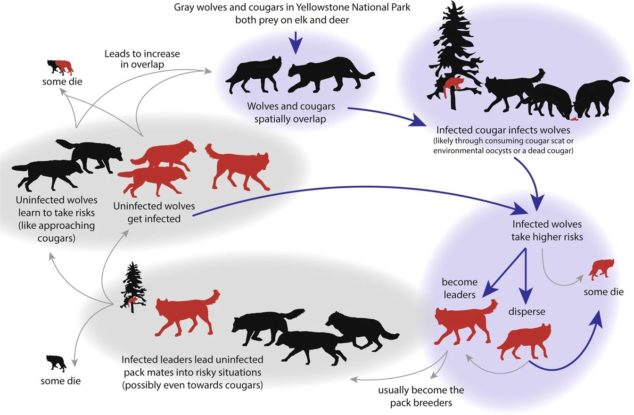
But the mere existence of the loop doesn't mean it begins with T. gondii.
Did T. gondii infection alter the wolves' behavior, making them more likely to roam into cougar territory? Or were wolves with a natural inclination to roam more widely simply more likely to encounter the parasite in the first place?
The original study accounted for factors including sex, age, social status, and territory overlap. But, Davinack argues, observational data still can't fully disentangle whether infection preceded the risky behavior, or the risky behavior increased the likelihood of infection.
The same problem may apply to many traits associated with T. gondii in wild animals, such as boldness, dominance, dispersal, and exploration.
These behaviors could conceivably be influenced by the parasite – but they could also determine which animals are most likely to encounter it in the first place.
Davinack describes this as "ecological sorting": the same behavioral traits attributed to the parasite can also shape an animal's exposure to it.
But that doesn't mean that T. gondii is completely innocent, either.
In controlled laboratory experiments, there is compelling evidence that infection can alter behavior.
T. gondii can establish chronic infections in the central nervous system, and researchers have identified several possible routes through which it could interfere with neural function, including immune signaling and neuroendocrine pathways.
It's also important to distinguish "this animal is really audacious" from "this animal is behaving differently towards predators that might like to have it for lunch".
General risk-taking behaviors such as roaming, exploration, and dominance could just naturally increase an animal's exposure to T. gondii. A strangely specific change in its response to a feline predator is harder to explain that way.
Davinack considers the classic rodent experiments particularly compelling. Infected rodents don't simply become indiscriminately reckless; experiments have found specific changes in their responses to cat smells – precisely the predator T. gondii needs them to encounter to complete its life cycle.
Some wild observations show similar specificity. Infected chimpanzees, for example, showed reduced aversion to leopard urine, their natural predator, while their responses to the odors of other big cats did not show the same clear pattern.
Infected hyena cubs have likewise been observed approaching lions more closely, with a higher risk of being killed by them.
That's harder to explain as a natural behavior increasing parasite exposure, although the observational nature of the studies means cause and effect still can't be completely untangled.
But that doesn't mean we have to remain in the dark, either. The solution is to raise the evidentiary bar so that we can be more confident in the conclusions, Davinack says.
For example, rather than simply comparing infected animals with uninfected ones, future studies could track the same individuals over time. If an animal that was previously cautious becomes noticeably more adventurous after infection, that would provide much stronger evidence that the parasite caused the change.
GPS tracking and other movement data could also help researchers account for where an animal went – and therefore its likely exposure to the parasite – before it became infected.
"The stakes extend beyond any single parasite. As behavioral ecology increasingly engages with disease systems, invasion biology and microbiome research, similar exposure-behavior entanglements will arise repeatedly," he writes.
"Toxoplasma gondii simply provides a vivid and tractable example of a more general problem: when organisms interact with their environments in ways that structure their own infection risk, causality cannot be read directly from correlation."
The research has been published in Animal Behaviour.
This article was fact-checked by Rachel Garner and edited by Peter Dockrill. While we pride ourselves on our process, we are only human. If you spot a mistake, please let us know.