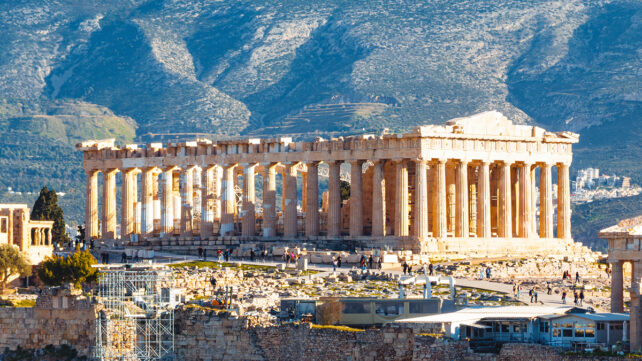
For 2,000 years, the architects behind the iconic Parthenon temple in Greece have had praise heaped on them for the clever optical illusions hidden in its architecture.
It was the Roman architect Vitruvius, writing some 400 years after the temple was constructed, who proposed the idea that the Parthenon's slight curves and irregularities were calculated to make the building appear perfectly straight and regular to viewers.
The visual corrections were built in, many came to think.
These optical corrections have themselves become so famous and widespread that they've been repeated through the centuries without too much close analysis – until now.
In a new paper published in Royal Society Open Science, mathematician Alain Goriely from the University of Oxford argues that there's no real evidence that the architectural choices evident in the Parthenon were intended to correct anything.
"This paper analyzes these corrections scientifically and argues that the proposed illusions are either unsupported by evidence or too small to have a perceptible effect under typical viewing conditions," writes Goriely in his published paper.
Using detailed mathematical models and survey data of the building, Goriely tackles four main "myths" associated with the design of the ancient Greek temple.
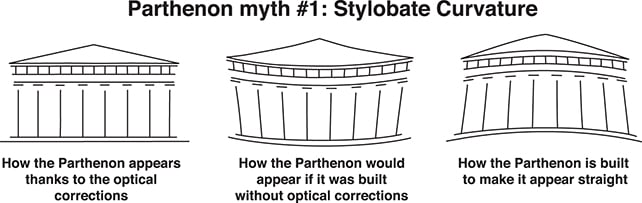
Firstly, the platform the Parthenon columns stand on (the stylobate) rises slightly towards the middle.
The thinking was that this made the temple look straighter from the front, but this doesn't check out, Goriely says – and it's possible it was more likely to help with drainage.
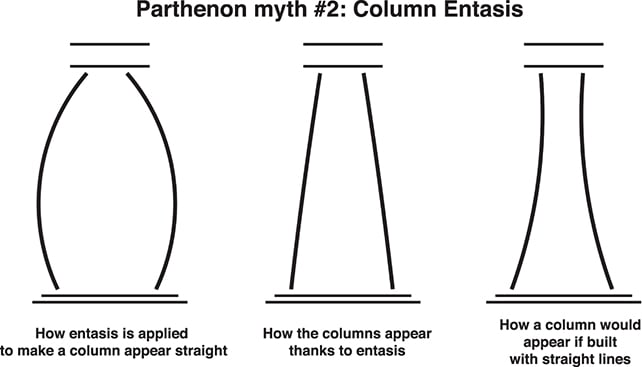
Second, the slight bulge in the columns (entasis): As with the stylobate, the traditional assumption has been that this would prevent the columns from appearing pinched (concave) from a head-on viewpoint.
Again, the math doesn't check out, and it could simply have been an aesthetic choice by the designers.
The third main myth identified by Goriely concerns the thicker columns in the corner of the temple, which were said to be intended to keep them looking consistent with the less well-lit columns behind.
There's no evidence this counter-illusion works, the study states, and one alternative possibility is that this was actually a structural choice.

Fourth, there's the myth that sculptures and features higher up on the temple are enlarged to counteract the effect of them being further away from viewers.
This is something our brains compensate for automatically, Goriely says, and is perhaps accounted for by natural variation or artistic convention.
"Finding no evidence for optical corrections does not explain the presence of architectural refinements," writes Goriely. "A more pragmatic interpretation is that such refinements reflect empirical practices developed by builders and craftsmen."
The mathematician suggests that several fallacies account for our believing these myths – including the application of 2D concepts to 3D shapes, the idea that we can know the intentions of the ancient Greek architects, and that there were ever designated viewing spots around the Parthenon where these optical illusions would apply.
However, it's worth pointing out that none of these myth rebuttals were actually tested in Greece. The fully formed Parthenon replica in Nashville, Tennessee, could be a good place to try them out, Goriely says.
In conclusion, the paper warns about the dangers of just accepting passed-down myths as fact, and encourages all of us to use our own mental capacities to challenge what we think we know – about the Parthenon or any other structure.
And it ends on a philosophical note, inspired by Francis Bacon's argument that knowledge must be gained from observation and experimentation, and Friedrich Nietzsche's idea that all truly great thoughts occur on a walk.
Related: Hidden Phenomenon Could Explain Why Old Buildings Feel Haunted, Study Finds
"Following this line of thought, I invite the reader to put this paper away and take a walk in a city," writes Goriely. "Disregard all intellectuals with too much time on their hands, including myself."
"Trust your own eyes, question what you see and decide for yourself whether the theory of optical corrections holds up."
The research has been published in Royal Society Open Science.
This article was fact-checked by Rachel Garner and edited by Peter Dockrill. While we pride ourselves on our process, we are only human. If you spot a mistake, please let us know.