Black holes are sneaky.
Unless they light up their surroundings with a rare feeding frenzy, it's very difficult to tell that they are there.
That makes it hard to know exactly how many invisible stellar-mass black holes our galaxy contains.
Now, astronomers have simulated the Milky Way to find its hidden "Galactic Underworld", estimating that around 170 million stellar-mass black holes are scattered throughout our galaxy.
What's more, the work predicts the distribution of those black holes, their sizes, and even what the explosions that created them may have been like – providing a roadmap for upcoming observations, which will in turn put the simulations to the test.
The findings have been submitted to AAS journals and can be found on preprint server arXiv while they undergo the formal peer review process.

Black holes are what's left of a massive star after it has effectively died. Having exhausted its fusion fuel, the star becomes unstable and explodes; no longer supported by the outward pressure fusion supplies, the star's core collapses into an object so dense that light cannot escape its gravity.
This poses a problem for astronomers, for whom light is the primary source of information about the wider Universe. If we can't see something with light in any wavelength, it's extremely hard to find – and even harder to take a census of how many like it are out there.
Using what we know about how stars, black holes, and galaxies evolve, scientists can simulate the Milky Way over its 13.6-billion-year history. If those simulations consistently reproduce a galaxy similar to observed reality, we can take its findings as a plausible approximation of the unseen Universe.
So, this is what a team led by astrophysicist Tom Wagg of the Flatiron Institute in the US did to estimate the number of stellar-mass black holes in the galaxy.
They built virtual Milky Ways, following billions of years of star formation, stellar deaths, black hole births, and Galactic evolution to estimate how many stellar-mass black holes should exist today.
Their work showed that, over the course of its lifespan, the Milky Way should have ushered around 170 million stars off the main-sequence coil and into the afterlife of a black hole.
That might sound like a lot, but when you consider the size of the Milky Way, it's really not. The team calculated that the distribution of black holes at the Sun's distance from the galactic center would be one black hole per 6,250 cubic parsecs (a parsec is 3.26 light-years) – a volume of space with sides around 18.4 parsecs.
Time tells a similar story. Spread across the Milky Way's 13.6-billion-year history, 170 million black holes works out to an average of roughly one new stellar-mass black hole every 80 years. In reality, though, the Galaxy's black hole "baby boom" happened much earlier, when star formation was much more profuse than it is today.
So we're unlikely to find any black holes lurking in our cosmic backyard.
That actually might be the least interesting of the team's findings, though.
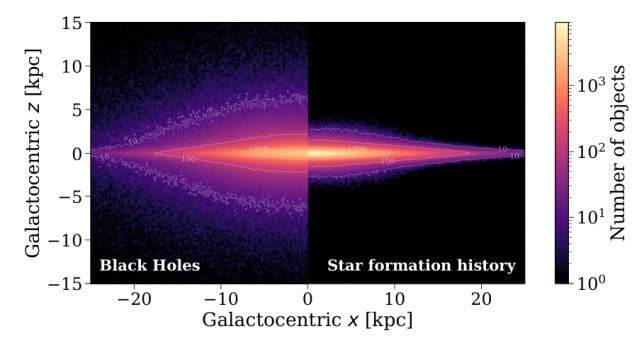
As previous work has shown, black holes don't often stay where they are born. Many are born in a lopsided supernova explosion that imparts what astronomers call a natal kick, punting the newly formed object across the galaxy.
On rare occasions, the kick is energetic enough to reach escape velocity from the Milky Way, but mostly, the black holes just go on a long journey inside the galaxy, which leads to a slightly different distribution from the stellar population.
The Milky Way's thin disk of stars has a height of around 306 parsecs. The black hole disk, the team found, has a height of around 790 parsecs – largely due to those natal kicks.
The simulations also suggest the lightest black holes fly farthest from the galactic plane because they receive the strongest kicks at birth.
That's because the supernova explosions that create them eject more star material, allowing more of the supernova's recoil to send the newborn black hole flying. Heavier black holes, by contrast, form with more material falling back onto the black hole, damping the kick.

That means future surveys won't just be counting black holes. The masses and motions of the black holes could reveal how the stars that created them died, helping astronomers distinguish between competing models of supernova explosions and black hole formation.
Related: Gaia Detected an Entire Swarm of Black Holes Traveling Through The Milky Way
And, of course, if those surveys are consistent with the predictions made by Wagg and his team, that will validate the simulations as a tool for understanding how galaxies evolve.
As the authors note, the present-day locations and motions of black holes preserve the imprint of their past.
If future observations bear that out, the Milky Way's hidden "Galactic Underworld" could become an unexpected archive of the galaxy's history.
The findings are available on arXiv.
This article was fact-checked and edited by Fiona MacDonald. While we pride ourselves on our process, we are only human. If you spot a mistake, please let us know.