
Waiting for chest X-rays or lab results to diagnose pneumonia and other lung-related diseases may not be necessary in the future. Researchers have developed a portable sensor prototype that has the potential to detect such conditions on a person's breath.
It is designed to work by analyzing nanoparticles that a patient inhales first. When those nanoparticles are then exhaled, they carry attached biomarkers that can reveal evidence of disease deep inside the body.
The prototype was developed by a team from MIT, and is called PlasmoSniff.
It has not yet been tested in humans, only mice, which means more work is needed to get this ready for a doctor's office. That said, the research team is hopeful about their idea.
With further testing, they think the sensor could be a quick and convenient asset in clinics or even the home, with no need for laboratory-grade electronics typically only found in hospitals.
"In practice, we envision that a patient would inhale nanoparticles and, within about 10 minutes, exhale a synthetic biomarker that reports on lung status," says mechanical engineer Aditya Garg.
"Our new PlasmoSniff technology would enable detection of these exhaled biomarkers within minutes at the point of care."
The nanoparticles that the sensor detects have been in development for several years. The biomarkers or chemical tags bundled with them become detached when they come into contact with specific protease enzymes (tiny snippets of proteins) unique to certain diseases.
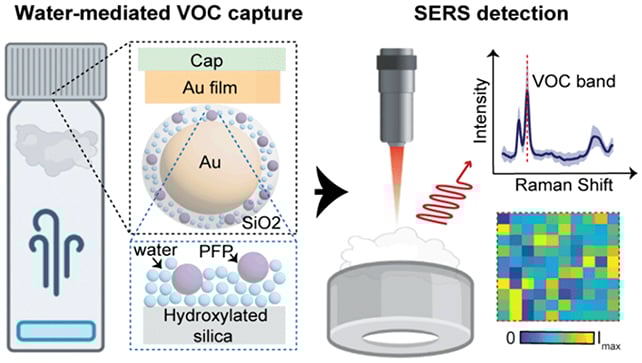
That gives researchers a signal to look out for – but these biomarkers are only exhaled in very small quantities. To detect those subtle traces, this new system uses an approach called plasmonics (the study and manipulation of light), which is where the PlasmoSniff name comes from.
Specifically, the sensor relies on a technique known as Raman spectroscopy, where light is used to measure the vibrations of a molecule. These vibrations act as signatures for the movement of atoms within chemical bonds and can be used to identify molecules.

The sensor itself uses gold nanoparticles suspended over a thin gold film – gold being an ideal metal for plasmonics. The water-coated, microscopic gaps inside the sensor trap the target biomarkers and amplify their vibrations enough to be spotted.
Human breath is packed with volatile organic compounds (VOCs), indicating everything from the state of our gut microbiome to how efficiently the body's metabolic processes are running, but this newly designed sensor picks out just a tiny fraction of the chemicals exhaled.
"This is a needle-in-a-haystack problem," says mechanical engineer Loza Tadesse.
"Our method detects that needle that would otherwise be embedded in the noise."
The researchers are at the prototype stage for now: they used mice rather than people to test the sensor and only scanned for one specific biomarker.
Testing on human breath will be more complicated, and the researchers also need to develop a mask-like attachment that can be used to analyze a patient's breath across a period of five minutes or so.
This would be combined with a device similar to an asthma inhaler to breathe in the nanoparticles. In healthy individuals, these nanoparticles would simply circulate out of the body without being broken down by disease.
If development and scaling are successful over the coming years, this could be a significant new method for monitoring and detecting disease – one which the researchers say can be adapted for a wide variety of purposes, not just checking for respiratory issues such as pneumonia.
Related: Tiny Robots Have Successfully Cleared Pneumonia From The Lungs of Mice
There might even be uses for PlasmoSniff outside of human health, in any situation where small traces of chemicals need to be detected in the air with a portable sensor.
"It's not just limited to these biomarkers or even diagnostic applications," says Tadesse.
"It can sniff out industrial chemicals or airborne pollutants as well. If a molecule can form hydrogen bonds with water, we can use its vibrational fingerprint to detect it. It's a pretty universal platform."
The research has been published in Nano Letters.