
Restricting a strange class of particles known as anyons to one dimension could force them into adopting one of two new forms, models suggest, hinting at new fundamental interactions in particle physics.
In a three-dimensional space, particles fall into two groups. There are fermions, which typically describe particles that don't overlap with one another, such as electrons and quarks, and there are bosons, which describe force-carrying particles that can pass through each other with ease.
"Every particle in our Universe seems to fit strictly into two categories: bosonic or fermionic," says physicist Thomas Busch, from Okinawa Institute of Science and Technology (OIST) in Japan. "Why are there no others?"
Half a century ago, theoretical physicists reasoned that the statistics behind these rules aren't so straightforward when a dimension is removed. The result is the 'anyon' – a third group that is neither boson nor fermion that appears in flat, 2D environments.
Since then, experimental evidence for the anyon's existence has grown, with lab studies finding new ways to constrain particles like electrons to force this third group into existence.
Now physicists from the OIST and the University of Oklahoma in the US have studied them in a single dimension, discovering a whole new level of complexity in the anyon's behavior.
"We've identified not only the possibility of existence of one-dimensional anyons," says Busch, "but we've also shown how their exchange statistics can be mapped, and, excitingly, how their nature can be observed through their momentum distribution."
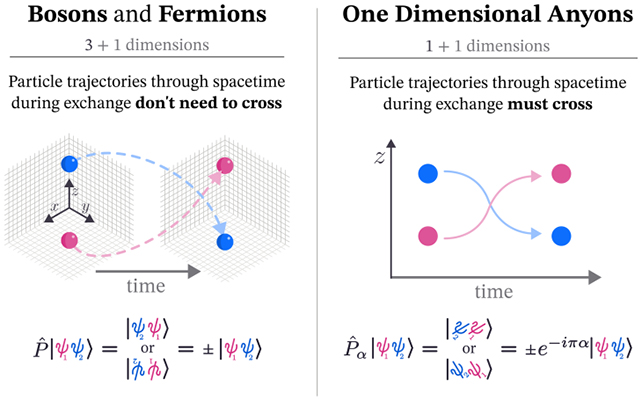
Particles can't go around one another when stuck in a 1D space, forcing them to interact. As particle interactions are a key part of classifying them, single-dimensional spaces give scientists an opportunity to analyze particle characteristics.
One of the key differences between bosons and fermions is how 'social' they are. In very simple terms, bosons tend to bunch up, and fermions don't. In the tight confines of one dimension, that 'sociability' becomes even more important.

In terms of anyons, the researchers reasoned, these forced interactions allow them to be categorized into bosonic and fermionic type anyons.
They also identified a factor of anyon interactions that controls how bosonic or fermionic a given particle is. What's more, the team showed how measuring the distribution of the particle's momenta could serve as a viable way of spotting their 'fingerprint'.
"Just as bosons and fermions, bosonic anyons and fermionic anyons have different particle exchange statistics," write the researchers in one of their published papers.
At this stage, the findings are theoretical and await validation through experiments. However, even in theoretical form, the findings reshape our fundamental thinking about particles and their interactions.
Related: Ghost Particles Interacting With Dark Matter Could Solve a Huge Cosmic Mystery
"The experimental setups necessary for making these observations already exist," says Busch. "We're thrilled to see what future discoveries are made in this area, and what it can tell us about the fundamental physics of our Universe."
There's a growing momentum behind research that goes beyond the binary idea of bosons and fermions, known more generally as parastatistics. While not everyone agrees that there's much more to find, some of the underlying math suggests we may not have the whole physics picture yet.
The research has been published in Physical Review A, here and here.