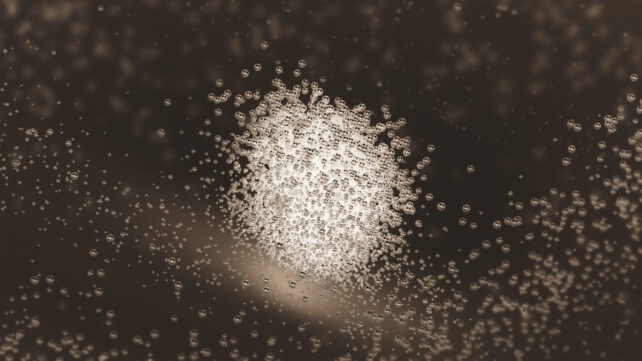
A new investigation of the early Universe led by Poland's National Centre for Nuclear Research has just found that there may be an interaction between two of the most elusive components of the cosmos.
By combining different kinds of observations, cosmologists have shown that what we see is more easily explained if neutrinos, aka 'ghost particles', weakly interact with dark matter.
With a vexing certainty of three sigma, the signal isn't strong enough to be definitive, but is also too strong to be a mere hint or noise in the data.
It's a finding that could open the way to a small expansion of the Standard Cosmological Model, relaxing the assumption that dark matter is entirely collisionless and allowing for faint scattering between neutrinos and dark matter.
Related: Neutrinos: 'Ghost Particles' Can Interact With Light After All
Neutrinos and dark matter are two components of the Universe that don't interact much with much of anything.
Neutrinos are among the most abundant particles in the Universe. They form in generous quantities under energetic circumstances, such as supernova explosions and the atomic fusion that takes place in the hearts of stars – so they're pretty much everywhere.
However, they have no electric charge, their mass is extremely small, and they barely interact with other particles they encounter. Hundreds of billions of neutrinos are streaming through your body right now. Every now and then, a neutrino collides with another particle, producing a shower of decay particles and photons that we need special underground equipment to detect.
Dark matter, on the other hand, doesn't seem to interact with ordinary matter at all, except gravitationally. The strong evidence for its existence comes from gravitational effects such as galaxy rotation rates and the warping of space-time that cannot be accounted for by normal matter. These effects suggest that roughly 85 percent of the matter in the Universe is made up of 'dark' matter that we cannot see.
The notion that these two very evasive things could interact with each other is not a new one, with papers theorizing that they might be fraternizing in ways we haven't detected dating back to the early 2000s.
In the last few years, scientists have published several papers tentatively hinting that neutrino-dark matter interactions exist. This new paper, led by physicist Lei Zu, who carried out the work at Poland's National Centre for Nuclear Research and is now based at the National Astronomical Observatory of Japan, sought to extend this idea beyond the realm of theory in the hopes of resolving one of cosmology's biggest issues.
This problem emerges when we look at snapshots of the early Universe, represented by the cosmic microwave background (CMB) and baryon acoustic oscillations (BAO), and compare them against the recent Universe.
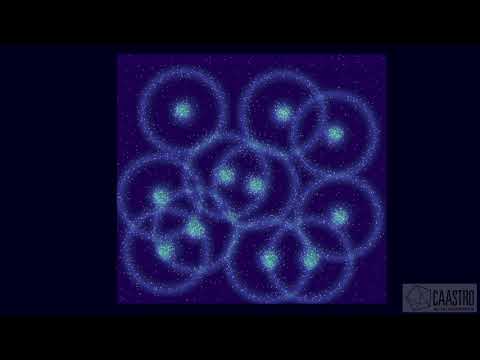
The CMB is a relic of the first light that streamed freely throughout the Universe about 380,000 years after the Big Bang; BAO are large-scale structures left over from an acoustic wave that propagated throughout the early Universe, frozen in time when the medium through which they traveled became too diffuse to support them.
If we extrapolate the CMB and BAO to the current 13.8 billion-year age of the Universe based on the standard model of cosmology, we end up with a Universe that looks significantly clumpier than the Universe we actually see around us.
"This tension does not mean the standard cosmological model is wrong, but it may suggest that it is incomplete," explains cosmologist Eleonora Di Valentino of the University of Sheffield in the UK. "Our study shows that interactions between dark matter and neutrinos could help explain this difference, offering new insight into how structure formed in the Universe."
In one concerted push, the researchers compiled one of the most comprehensive combined datasets yet for testing neutrino-dark matter interactions across the early and late Universe. They included two different observations of the CMB, three BAO datasets, and data from the ongoing Dark Energy Survey that is scanning the skies to map the distribution of dark matter and energy.
Then, they ran cosmological simulations for each of the CMB and BAO datasets alone, before combining them. But they added one more ingredient: Neutrino-dark matter scattering interactions.
The results showed a mild preference for scattering in the individual datasets, with the Universe coming out looking a little more like our Universe does today than a simulation without scattering. But the preference in the combined datasets was much stronger, with a certainty of 3 sigma.

That's extremely far from conclusive, but it agrees with earlier results and is strong enough to warrant further investigation.
"If this interaction between dark matter and neutrinos is confirmed, it would be a fundamental breakthrough," says theoretical physicist and cosmologist William Giarè of the University of Hawaiʻi, formerly at the University of Sheffield.
"It would not only shed new light on a persistent mismatch between different cosmological probes, but also provide particle physicists with a concrete direction, indicating which properties to look for in laboratory experiments to help finally unmask the true nature of dark matter."
"If" is doing a lot of heavy lifting there, but these mysteries have been sufficiently perplexing that this avenue of enquiry looks deeply tantalizing.
"Explaining and rigorously testing such a clear effect requires going beyond the typical approximations used in particle cosmology," concludes theoretical physicist Sebastian Trojanowski of the Polish National Centre for Nuclear Research, "which will be the subject of further research."
The results have been published in Nature Astronomy.