
Kissing a romantic partner is a nice way to share an intimate moment – not to mention a hearty dose of saliva and tens of millions of oral microbes.
Swapping spit is not the most appealing thought to spice up our Valentine's Day this year, but microbiologist Remco Kort from VU Amsterdam in the Netherlands hasn't caught the ick; he's caught the kissing bug.
He thinks that sharing our saliva and its various components may have more to do with falling in love than we ever knew, and he's laid out a whole host of questions he wants answered in a new paper.
What happens when humans swallow their partners' microbes after kissing them? Can they impact our gut? Our hormones? Our brain? Can exchanging saliva affect our very feelings of love?
Kort certainly thinks that's a possibility. In his "hypothesis-driven discussion," he frames human saliva as a potential "influencer and reflection of intimacy" that taps into a positive feedback loop – one where love and affection improve health, and health in turn nurtures love and affection.
"Unlike other forms of physical contact, deep kissing involves saliva mixing and direct tongue-to-tongue contact, effectively inoculating partners with each other's oral microbes," Kort writes.
Like an oral vaccine, that inoculation of germs may come with surprising health benefits.
After the gut, the oral cavity is home to the body's second most diverse bacterial community, and recent studies indicate that the microbial makeup of the mouth has widespread effects on inflammation and distant organs such as the brain and the heart.
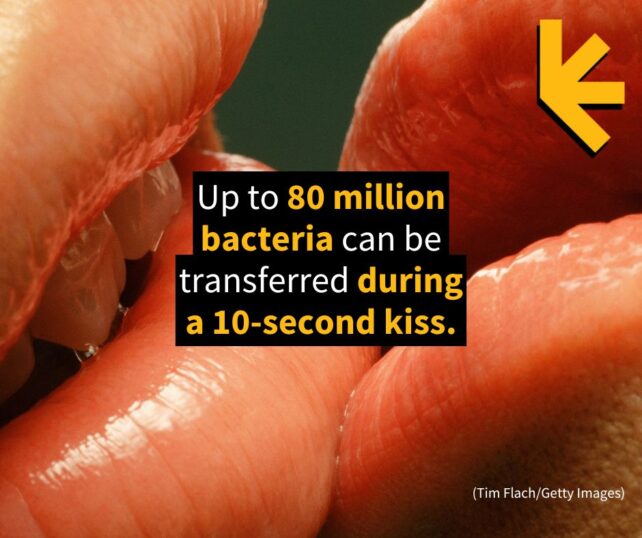
What's more, emerging evidence, including past experiments by Kort, have found that kissing between two romantic partners leads to the transfer of millions of oral microbes. With time and frequency, this leads to oral bacterial communities that look more alike.
"In turn, microbial similarity and associated sensory cues – such as taste, scent, and emotional bonding – can reinforce the desire for continued intimacy, perpetuating the cycle of kissing and microbial exchange," suggests Kort.
Besides billions of microbes, saliva also contains hormones like cortisol and adrenaline, which could impact the other person. The mouth is even home to bacteria that can sense and respond to key neural messengers like oxytocin, dopamine, and endorphins, all of which surge in the body during intimate kissing.
"These physiological changes may indirectly promote a favorable oral environment," speculates Kort.
Related: Neanderthals And Our Ape Ancestors Probably Kissed, Study Reveals
In the past, some evolutionary biologists have also speculated that passionate kissing is advantageous because it shares key immune information via oral microbes. This may help partners build immunity to each other's germs, and to pathogens they may not have encountered before, explains Kort.
While that exchange has benefits, it could also spread disease, which is probably why open-mouthed kissing is typically reserved for trusted romantic partners.

For now, these ideas are hypothetical, though Kort has proposed a study design to test some of them.
Beware the couples that volunteer to participate: You may learn more about your saliva and your partner than you ever wanted to know.
The study was published in Evolution and Human Behavior.